
Original-Cin Q&A: Aimee Carrero on the Rigors of Playing a Paramedic in New Film Code 3
By Bonnie Laufer
Aimee Carrero has a knack for jumping into roles that feel real, relatable, and full of heart. See The Menu and Your Friends & Neighbors. Her latest project, Code 3, is no exception.
In the new film, she steps into the world of first responders alongside Rainn Wilson and Lil Rey Howery. The film, to quote the brain trust over at IMDb, “follows a paramedic who is so burnt out by the job that he is forcing himself to resign, however, he first must embark on one last 24-hour shift to train his replacement.”
Bonnie Laufer chatted with Carrero about working with her co-stars, how she prepared for the role, and why Code 3, which is available on demand December 19, left such a personal impact on her.
CLICK HERE to read John Kirk’s review of Code 3.
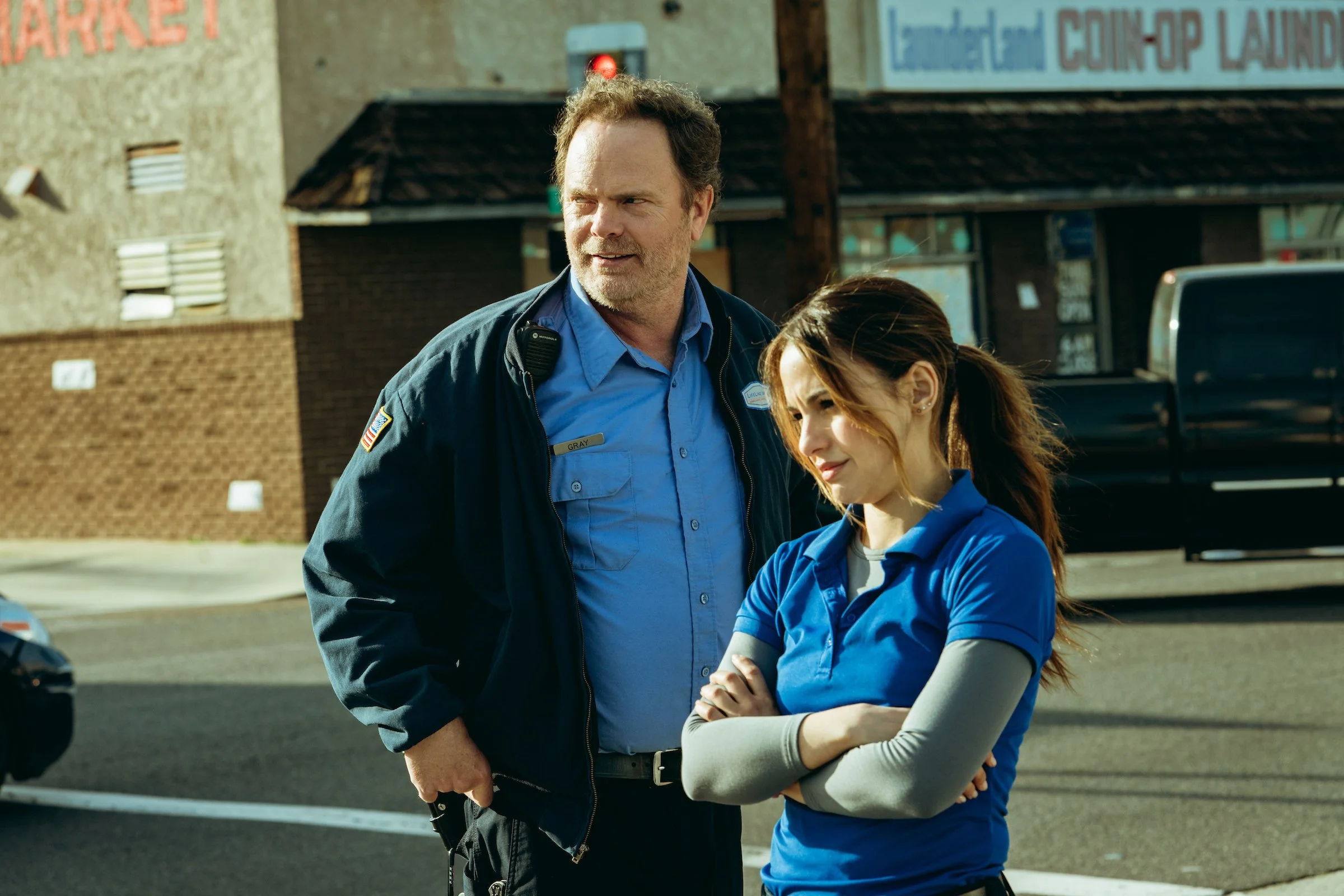
Rainn Wilson with Aimee Carrero.
ORIGINAL-CIN: Although there are a lot of comedic moments in the film, it really is a tribute to frontline EMS and paramedic workers. Did you ride along with any before shooting to get a sense of what they go through during a shift?
AIMEE CARRERO: Yes, that was one of the selling points for taking the role. We rode along with one of the busiest stations in L.A. County. We were supposed to go for about four hours but ended up staying for 12. It was the most eye-opening 12 hours of my life. What's so crazy is that for the dudes at the station, it was just a Tuesday, but I will never forget every single call we went to and every person we met. It's such a demanding job on every level, and it’s very intimate. You're going to people's homes and you're meeting them on the worst day of their life.
People don’t wake up that morning and think something horrible was going to happen. It's just a really intense job and I think this movie does a good job of distilling that, because there are a lot of very serious moments, but then when those dudes get back in that truck, they’ve got to make a joke just to get through the day. I found that was a realistic tone for the movie, because that's how they get through their shifts.
O-C: With Rainn Wilson and Lil Rey Howery in that ambulance with you for most of the shoot, I can’t imagine how you kept a straight face.
AC: It's one of those things where, probably like when a journalist goes to interview someone you feel you know like the back of your hand because you've had parasocial experiences with them. But you’re like, ‘I can't let that shit in, because then I won't be able to do my job.’ It's kind of the same thing, when I work with people I really look up to. I just tried to be as prepared as possible, and I knew I was in very good hands. I knew that because I've always thought that comedic actors are truly like the most gifted dramatic actors.

O-C: I say that all the time! There are so many comedic actors that turn in the most amazing dramatic performances! How do they turn that switch? What did you see with Rainn and Lil Rey?
AC: Well, I think they're both very thoughtful people. When you meet them in the wild, I think one would expect that they are always on: telling jokes, being jovial. But most of the time, I find that they're actually very good listeners, very thoughtful and don't lead with this sort of manic energy.
There are plenty of people who are just constantly looking for a funny thing to say, and maybe it’s an insecurity thing. But I find people who are funny and have made a career doing this don't have to do that. I think they're funny because they're very good at seeing humanity, seeing the truth of a moment and to see the truth of a moment, you have to be in the moment.
Rel and Rainn are both very with you in the moment when they're talking to you. I wonder if that's part of it. I'm not sure, but there's an old saying: ‘dying is easy, comedy is hard’ and I think that's true, because you have to be operating on so many cylinders. There’s a lot going in your brain in order to make something comedic, versus just sitting in the truth of the moment.
O-C: While we’re on the topic of comedic brains, you have some great scenes with Rob Riggle who plays the jerk doctor in charge of the emergency room when the paramedics drop off the patients. He plays a jerk so well, right?
AC: Yes, he does and he's one of the nicest people you'll ever meet. There has to be a deep understanding when you see an actor do something so well. You're like, ‘This was the role they're born to play’ and it's usually because they have a strong connection. I'm not saying that Rob at one point in his life was a jerk but maybe he had experiences with a lot of jerks (laughs). I know he was in the military for a long time, maybe he had experiences with people like that and you just know it in your bones, and you're able to speak it like a very fluent language.
O-C: This is a fun movie that also deals with mental health issues and burnout. Did it give you more insight and appreciation for what these frontline workers do?
AC: Absolutely! I had no idea. My mom is a schoolteacher, so I grew up understanding that there are some jobs that are vocational because I would sometimes go to work with her and I would be like, ‘I could never do this job.’ You know what I mean? I think that's the truth with a lot of these professions that are just so underpaid and underappreciated and under-supported, and it was really shocking how little they're paid in the United States.
O-C: In Canada too.
AC: I was shocked to learn that the lowest paid worker is the paramedic, and that's a paramedic not even an EMT or EMS, which I didn't even know were different levels. They're still so woefully underpaid and everyone's going to need health care at some point in their life, and the chances are good that you will need emergency health care. I don't know how they do it, but I do know it takes a special person to do the job, and my appreciation level has gone through the roof after doing this film.