
The Voice of Hind Rabab: A Harrowing Listen, An Essential Watch
By Liam Lacey
Rating: A
The Voice of Hind Rajab, a docudrama about last hours and death of a five-year-old Palestinian girl in Gaza, received a record 23-minute ovation at the Venice Film Festival this past September, where it won the Silver Lion Grand Jury Award.
Executive produced by Joaquin Phoenix, Rooney Mara, Brad Pitt, Jonathan Glazer and Alfonso Cuarón, among others, the film has ended up on several best-of lists for the year. Yet reviewers, employing such adjectives such as “gutting,” “shattering,” and “heart-rending,” seem to practically dare viewers to summon the nerve to see it. Masha Gessen, in a New York Times opinion piece, wrote about the film under the headline that many potential viewers might relate to: “The Movie I Was Afraid to See.”
Director Kaouther Ben Hania (The Four Daughters, The Man Who Sold His Skin), a twice Oscar-nominated filmmaker, has previously explored the space between fiction and non-fiction where art meets social experiment.
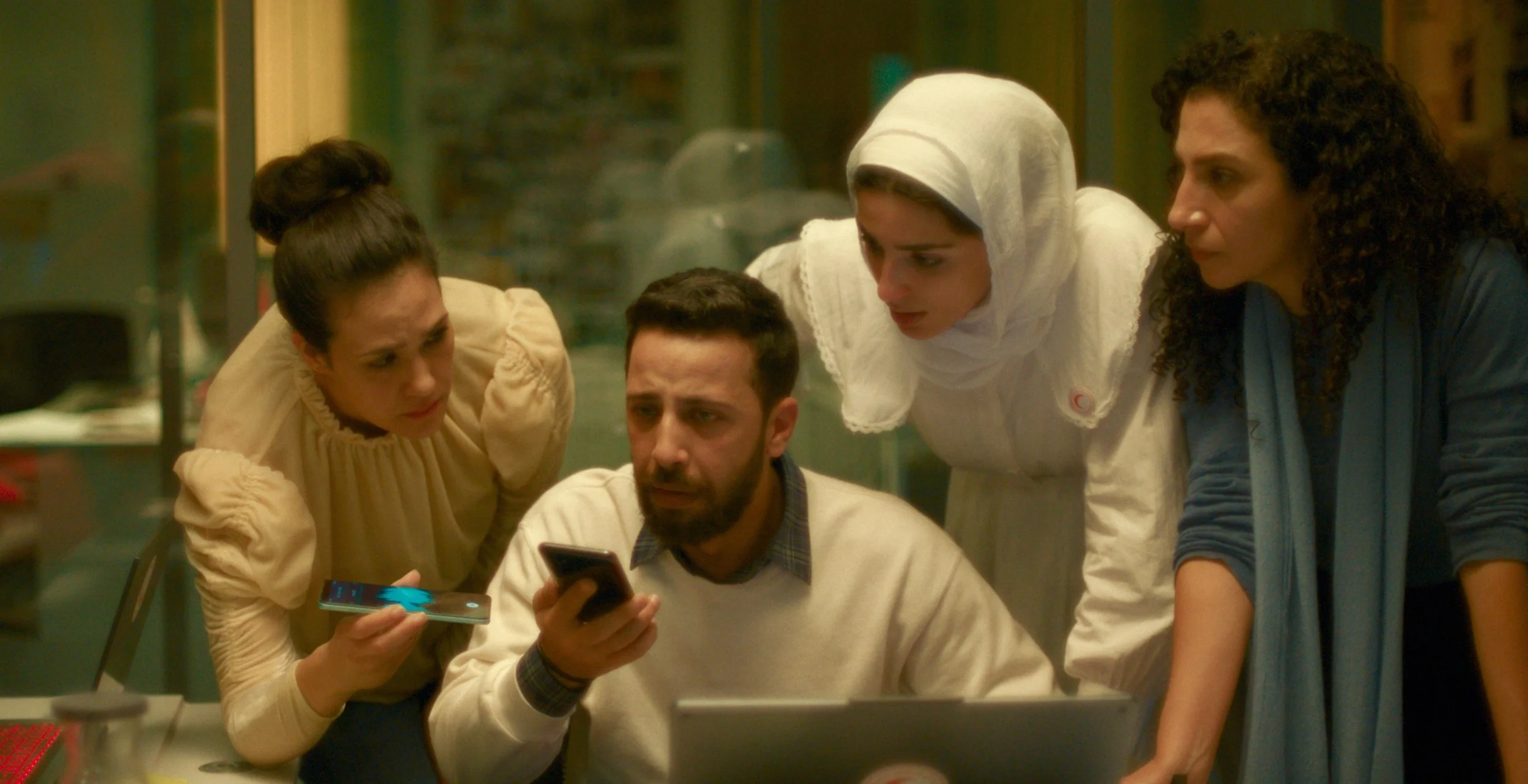
Set over the afternoon of January 29, 2024, most of The Voice of Hind Rajab is a single-set dramatic reenactment of a small group of Palestine Red Crescent aid workers in the West Bank city of Ramallah.
The actors interact the real audio from Hind Rajab, a five-year-old girl trapped in her uncle’s bullet-ridden car in Gaza, along with the corpses of six relatives. The family was fired on by the Israeli Defense Force (IDF) tank while trying to flee their Gaza City neighbourhood under IDF orders.

Using satellite imagery, investigations by The Washington Post — along Sky News and other researchers — proved that the IDF subsequently killed two ambulance drivers who were trying to rescue Hind before killing the child an hour later.
We do not see these executions, either as documents or re-enactments. Hind has no physical presence in most of the film beyond the intermittent green blip on a WAV audio file taken from about 70 minutes of her recorded voice on the phone to the Palestine Red Crescent workers.
A few critics have suggested Ben Hania’s hybrid approach is ethically uncomfortable, chafing at the film’s “tear-jerker” tactics. In a post-Venice interview in Vogue, the director responded: “I think that the movie is not comfortable to watch to start with because it’s showing us our human failure, the killing of a child.”
No doubt, the subject could have been treated as a worthy documentary, but Ben Hania clearly wanted to shake things up by breaking the conventional boundaries, and she proves she knows exactly what she’s doing.
One essential point here is that the audio of Hind Rajab’s pleas was already part of the public discourse around the Gaza war and the killing of more than 20,000 Palestinian children. After Palestine Red Crescent lost their connection to Hind, they posted her calls on social media, pleading for effort to find the child and the medics, whose corpses were found 12 days later after the IDF withdrawal.
The story of her ordeal and death went viral. At Columbia and University of California at Berkeley, student protestors named occupied buildings after Hind; she was memorialized in a song by the rapper Macklemore.
A second point is that the film, made in cooperation with Hind Rajab’s surviving family, is deliberately not sensational. There’s no bloodshed or onscreen explosions. The focus is one of four central characters, often using dialogue.
There’s the empathetic Rana (Saja Kilani), the young and emotional Omar (Motaz Malhees), the by-the-book coordinator (Amer Hlehel), and Nisreen (Clara Khoury), who takes over when the others begin to flag. They simultaneously work to soothe and console the terrified child, while feverishly trying to arrange her rescue in the aquarium-like glass walled office.
Shot in widescreen, the film has the urgency of a ticking-clock thriller. But each time we hear Hind speak on the phone (“I’m scared. Come get me”), the illusion is pierced. We know no one was saved. The office, and the pragmatics of an absurd nightmare, serve a metaphor for our feelings of complicity and helplessness.
Omar first hears from Hind’s cousin in Germany, who has had a desperate call from a 15-year-old girl in the shelled car. The cousin is killed while on the line to the Red Crescent, leaving only Hind alive. Omar determines that the car is at a gas station a few blocks from the family’s home and, just eight minutes away from the nearest ambulance.
But that would be too easy. The coordinator Mahdi (Hlehel) explains that he must first establish a safe route, which has to be done in concert with the International Committee of the Red Cross and the Coordinator of Government Activities in the Territories, a unit of the Israeli Ministry of Defense.
At one point, Mahdi takes a marker and sketches out the network of routes on the glass wall, which looks only slightly less complicated than the London subway system. We also see aerial maps of the destroyed city and live maps with green dots representing ambulances winding through the wreckage.
Without Israeli approval, Madhi insists, the ambulance drivers will probably end up on the list of medical workers killed in the war, as he points to their photographs on the wall.
“How can you coordinate with the army who killed them and all those people?” Omar demands. As the argument escalates, Omar goes further: “It’s because of people like you that we’re occupied!”
Gessen, in their New York Times column, focuses on how often the characters speak of “coordination,” a word with dark history in situations where people under occupation are forced to compromise with their oppressors. The film, they say, is about Hind Rajab, but it’s really about the “moral injury” inflicted on those forced to collaborate.
For those of us at a distance, The Voice of Hind Rajab dramatizes the frustration of impotent empathy. As Susan Sontag wrote in her final book, Regarding the Pain of Others, “Compassion is an unstable emotion. It needs to be translated into action, or it withers.
“The question of what to do with the feelings that have been aroused, the knowledge that has been communicated. If one feels that there is nothing 'we' can do — but who is that 'we'? — and nothing 'they' can do either — and who are 'they' — then one starts to get bored, cynical, apathetic.”
So, yes, The Voice of Hind Rajab is both emotionally distressing and ethically uncomfortable, brutally so, as it was intended to be. But for all the reviewers’ gut-wrenching adjectives, the critics were physically safe from harm.
“It’s not your life,” said Ben Hania in that same post-Venice interview. “It’s OK. You have a comfortable life. We all have a comfortable life. But it’s important to know what is happening on the planet we are living on. If you can’t, it’s too difficult, do something about it.”
The Voice of Hind Rajab. Directed and written by Kaouther Ben Hania. Starring Saja Kilani, Motaz Malhees, Clara Khoury, Amer Hlehel and the voice of Hind Rajab. In theatres December 25 at Toronto’s TIFF Lightbox and in theatres across Canada in January.