
No Other Choice: Park Chan-wook's Social Satire of Downsizing is Darkly Antic and On-Point
By Jim Slotek
Rating: A
The traumatically violent “Vengeance Trilogy” - marked by the profoundly disturbing Oldboy - remains the apex of South Korean auteur Park Chan-wook’s career. But he has clearly looked outside that genre box of late.
His 2022 film Decision to Leave was pointedly a film noir, with violence in the past tense, a sustained mood and complicated motives.
And his latest, No Other Choice, is a barbed social satire, straight from the playbook of his South Korean colleague, Parasite director Bong Joon Ho. It comes complete with dark humour, both sly and slapstick. Such violence as there is, is the work of bungling amateurs, badly thought-out and generally too clumsy to be troubling.
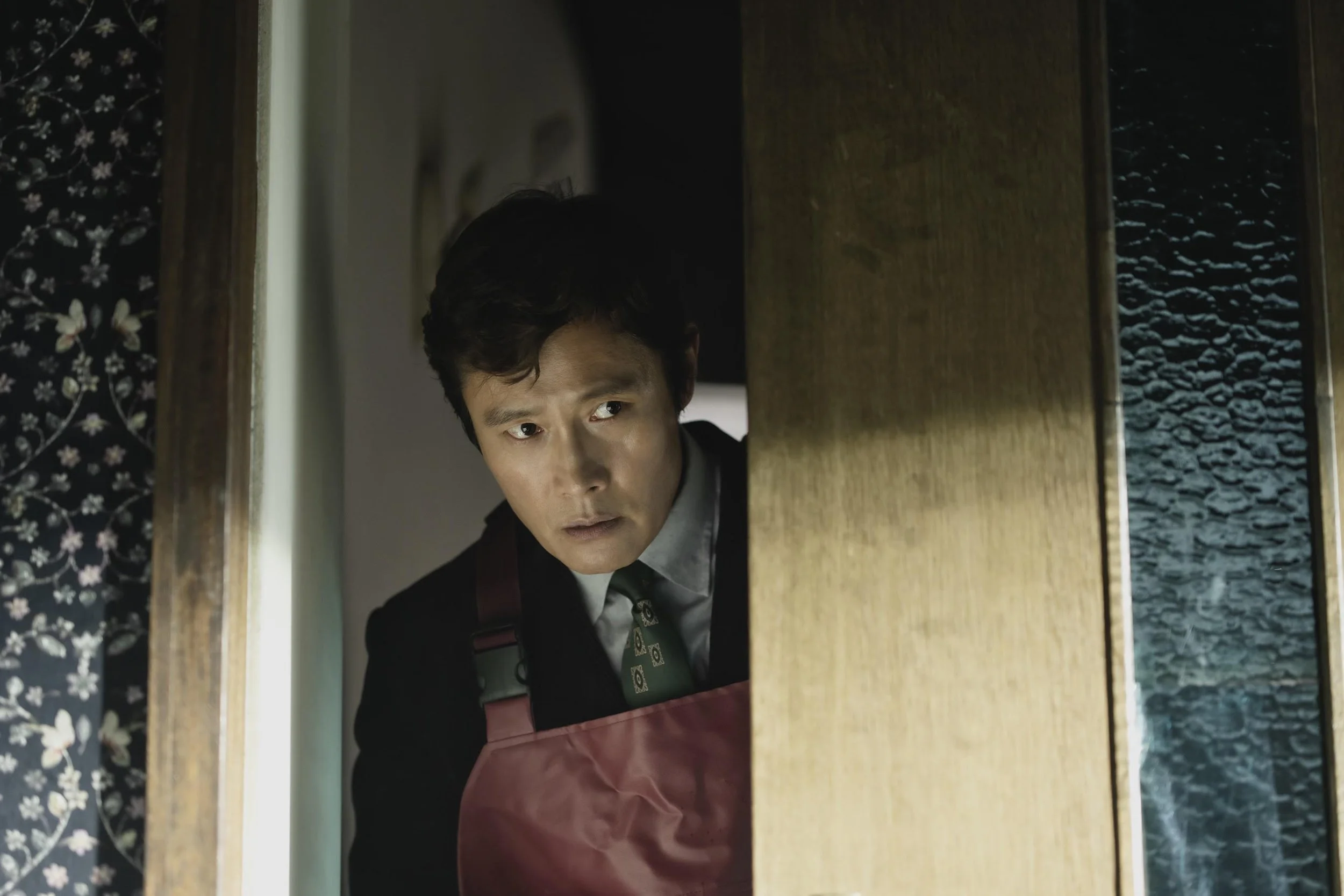
Man-su (Lee Byung-hun) wants his job back in the worst way, in No Other Choice
Some of this thematic course change (and some humour) can probably be ascribed to Canadian filmmaker Don McKellar, who signed on as a co-writer for the film (which has parts in English, given it’s the story of a career paper company executive who’s laid off after Americans buy his workplace. The two have since worked together as showrunnerss for the HBO Vietnam War-set series The Sympathizer).
The story has been told before, originally by Donald Westlake in his 1997 horror thriller novel The Ax Subsequently, Costa-Gavras made his own 2005 film version, (The Axe), both the tale of a discarded career manager who is eventually willing to go to any lengths to regain the job that defined his life and lifestyle.
For its part, Park’s No Other Choice was named Best International film at the Toronto International Film Festival, is nominated for Best Picture at the Golden Globes, and remains on the Oscar shortlist, with nominations imminent.
That the tale has remained fresh nearly 30 years after the novel suggests how longstanding and entrenched is the notion that all jobs are in peril from the moment you’re hired, and the imposition of this is nearly always cruel (“There is no Iron Rice Bowl,” a union negotiator once told me, paraphrasing Mao, during my time as a union rep at my former workplace).

Man-Su (Squid Game’s Lee Byung-hun) is so confident of the security of his mid-management white collar job, that he feels he has the comfort zone to genially support his downscaling workforce. His “we’re all in this together” attitude lasts as long as his job does. Once cut loose, his struggle is entirely personal and self-centered.
When we’re introduced to his pampered household, we understand that Man-su is, in fact, one of those most in the cross-hairs in a merger. He’s a “legacy salary,” on the high end of a cost-cutting scale, at an age where his future value, and value on the job market, has declined.
His home is upper-middle-class opulent, and his wife Mi-ri (Son Ye-jin) makes it her life’s work to spend her husband’s generous income on beautiful things. Unlike Parasite, No Other Choice shows us the income drain from higher up the scale, where the fall can seem trivial at first (his teenage stepson Si-one (Woo Seung Kim) is outraged that the sudden cost-cutting means losing Netflix), but can also be life-affecting (their neurodivergent daughter Ri-one (So Yul Choi) has prodigy level ability on the cello, but proper training and shaping of that talent is now out of financial reach).
Man-su goes through the motions, the meetings and the determined walks to appointments, his portfolio in hand, utterly rejected at each turn as his severance runs out. What’s left are temporary blue collar jobs, and Mi-ri returning to her former job as a dental hygienist, with former members of her social circle as her patients.
There’s no lightbulb that goes off in Man-su’s head that makes him consider the darkest approach to his job search. It’s a cumulative anger built on a year of rejection and diminution of his self-esteem. His anger is first focused on one of his interviewers, Seon-chul (Park Hee-soon), who is particularly dismissive and mockingly blunt. He will be his first attempted murder, albeit one that goes off the rails fairly quickly.
The attempt on Seon-chul, is followed by others on fellow job hunters –including Si-jo (Cha Seung-won) and Beom-mo (Lee Sung-min) - who Man-su assesses as being his chief competition. Some attempts succeed, despite the ineptitude of the wannabe murderer, and sometimes with the intervention of others. Digging body-sized holes at night is a repeated motif of No Other Choice as the movie settles into its darkly antic third act.
There are mistaken identities, accusations of adultery, mis-assumed suspects, and an ending of the be-careful-what-you-wish-for variety.
Well shot, well acted and with locations that vary from brutalist factory sites to beautiful nearby forests, No Other Choice is both believable and absurd as it unfolds. But its social relevance remains spot-on.
No Other Choice. Directed and co-written by Park Chan-wook. Starring Lee Byung-hun, Son Ye-jin and Park Hee-soon. In theatres December 25.