
The Secret Agent: 70s-Era Brazilian Thriller with an Absurdist Twist One of the Year’s Best
By Liam Lacey
Rating: A
We’ve all heard the warnings.
Authoritarian-leaning governments around the world are following a path set by historic dictatorships, with corporate corruption, persecution of marginalized groups, attacks on universities, the manipulation of the media and the use of state-sponsored violence on citizens.
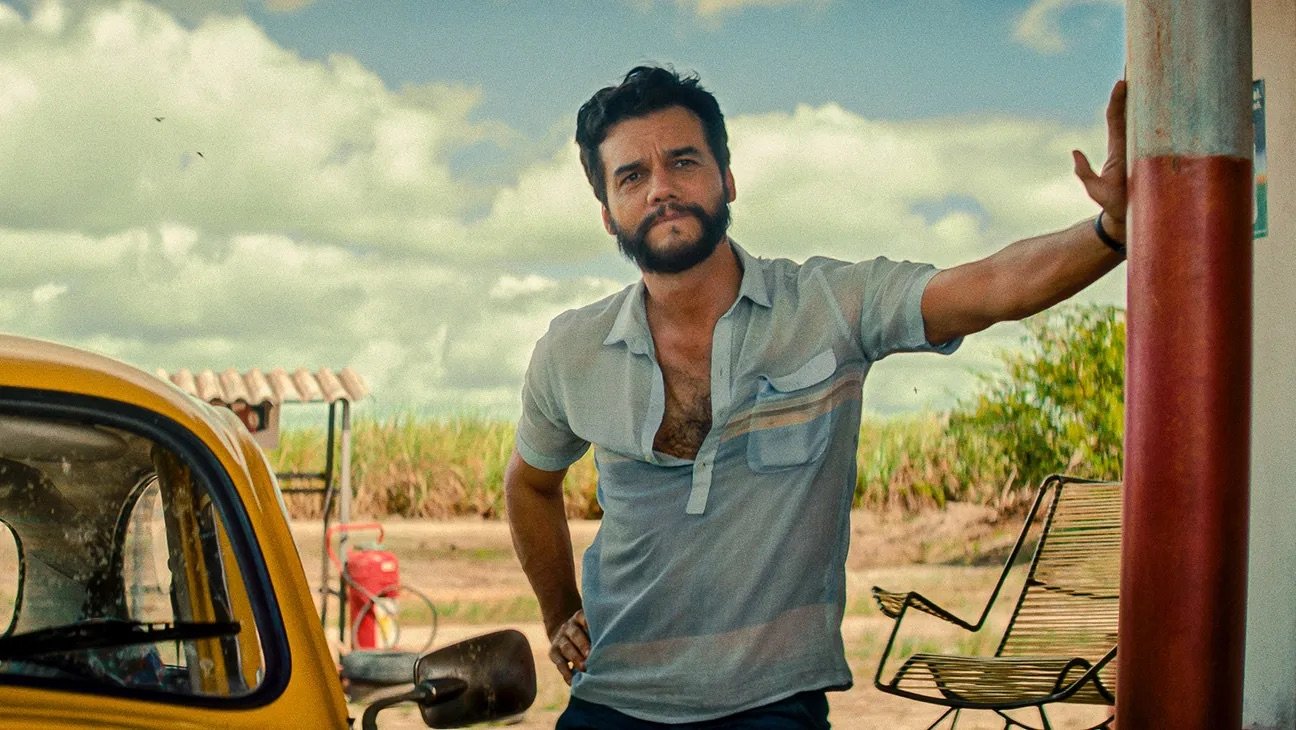
But no number of warnings by YouTube pundits or op-ed contributors can suggest the dangerous tentacles of history as convincingly as a film such as The Secret Agent, from the Brazilian director Kleber Mendonça Filho.
The Secret Agent, which is Mendonça’s fourth critically acclaimed feature on power and politics in his native country — see also Neighboring Sounds, Aquarius, and Bacurau — promises to be his biggest success so far.
The film won prizes for best direction and best film by international critics’ jury (FIPRESCI) at Cannes earlier this year and it arrives just one year after one of last year’s best films, Walter Salles’ sombre docudrama I’m Still Here, also set during the Brazilian dictatorship that ruled the country from 1964 to 1985.
The Secret Agent — a time-jumping, shaggy dog story stretching to 160 minutes and told in three interwoven chapters with vivid digressions — is anything but sombre. Mendonça, a former film critic, has crafted a film steeped in seventies’ cinematic references, especially Steven Spielberg’s Jaws, David Cronenberg’s body horrors, and the paranoid American political thrillers of the era, stuffed with affectionate care for depicting the fashion, cars, décor and music of the era.

There’s also an invented urban legend, treated as a stand-alone schlock film, in which a man’s hairy leg, detached from its body by a shark bite, roams the parks of the city of Recife at night and kicks lovers, gay and straight, who are canoodling in the dark. You can take it both as a symbol of state violence and comic relief from the film’s darker themes.
The visual panache of The Secret Agent is obvious from the opening sequence as the driver (Narcos’ Wagner Moura in a soulful, understated performance) driving a canary yellow Volkswagen bug, arrives at a rural gas station near the city of Recife during Carnival time. Shot in widescreen Panavision anamorphic lens, the image deliberately evokes a classic Western with the arrival of a stranger in a corrupt town.
A few feet from the gas pump lies a man’s corpse, partly covered in cardboard. The attendant explains that the body belongs to a would-be tire thief, shot by the night watchman a couple of days before. When the police show up, they ignore the corpse, preferring to use their visit to shake down the new visitor in town for a contribution to their “Carnival fund.” The corrupt cops, we learn, take advantage of the chaos of Carnival to make people disappear.
As he heads into town, the driver, traveling under the name Marcelo, drives past characters in Carnival costumes while children bombard him with water cannons. Eventually, Marcelo makes his way to a safe house of leftist outsiders — gays, dissidents, immigrants — under the care of the elderly den mother, Dona Sebastiana (a terrific Tânia Maria).
Marcelo gets a job at the local government documents archive, while he waits for a contact to find passports and safe passage for him and his young son, Fernando (Enzo Nunes). The boy, who is obsessed with the movie Jaws but is too young to see it, has been living with the parents of Marcelo’s late wife.
Marcelo’s father-in-law Alexandre (Carlos Francisco) works as a projectionist in a local cinema. It’s the kind of place where a woman in the lobby believes she is experiencing demonic possession while watching The Omen while a man in the back row gets a hand job.
In flashbacks, we learn why Marcelo (real name Armando) is a hunted man. He drew the enmity of a crooked federal official Ghirotti, who wanted to take over one of the professor’s patents for a battery. During a drunken dinner, the professor’s late wife, Fátima (Alice Carvalho) verbally lashes out at the man, which leads to a physical confrontation.
Now Fatima is dead (the nature of her death is unspecified), and Marcelo has gone underground, waiting in the safe house to meet with a facilitator, Elza (Maria Fernando Cândido) who interviews him and judges whether he’s a suitable candidate for fake passports and safe passage out of the country.
The tension ratchets up considerably in the film’s second half. Ghirotti has sent a couple of hitmen, Augusto (Roney Villela) and his stepson Bobbi (Gabriel Leone) to track down the professor with the instructions to “shoot a hole in his mouth.” While the hitmen are comically loutish, they remind us there is often no daylight between stupid and evil.
The third act of The Secret Agent is set in the present day in São Paolo where a young woman researcher, Flávia (Larua Lufesi) is transcribing audio from of interviews and surveillance tapes from the 1970s, including Marcelo’s interviews with Elza. Here, the film curves back to the present with a kind of magical symmetry, less a thriller resolution than a reminder of the shifting weight of experience over time.
The Secret Agent. Written and directed by Kleber Mendonça Filho. Starring Wagner Moura, Maria Fernando Cândido, and Alice Carvahlo. At Toronto’s TIFF Lightbox December 5, and in theatres across Canada in the coming weeks.