
At Starfleet Academy's Toronto Premiere, Trek Stars Talk About What It All Means
By John Kirk
Yeah – That IS Your Trek.
The release of a new iteration of Star Trek is never free of angst. The fans with an axe to grind come in various flavours.
You have gatekeepers, Nu-Trekkers, right-wing, left-wing, all with the dog-whistle refrain of “that’s not MY Star Trek” that never fails to find a fight among fans.
It never changes, to be frank. When Star Trek: Enterprise came out, there were criticisms that the technology and stories were too basic to satisfy diehard fans. Before that, Star Trek: Voyager was lambasted for being too unimaginative and just a rip-off of Lost in Space.
Yet both are now firmly ensconced in canon, and through the virtue of the rose-coloured lenses of time are enjoyed and accepted.
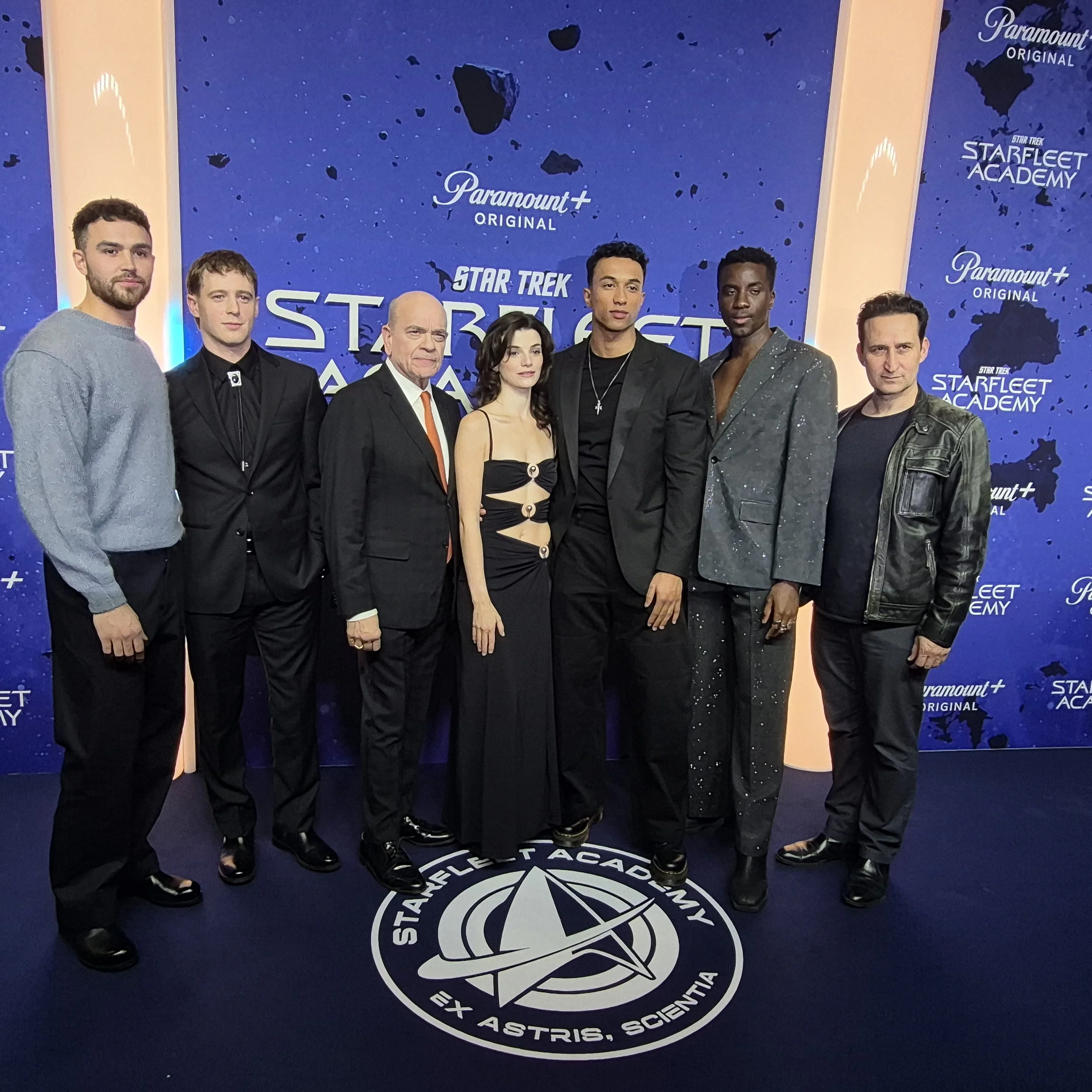
The cast of Star Trek: Starfleet Academy at their Toronto premiere.
Why? Because there are essential values of this series that have lasted for decades, and in this 60th year of Star Trek’s existence, the latest version of “the final frontier” finds itself in the 32nd century: Star Trek: Starfleet Academy.
Does it still have those values?
We went to the Paramount+ Toronto Premiere to find out. We asked one familiar face from Star Trek: Voyager, namely Robert Picardo, and two of the newest additions to the Star Trek family: Sandro Rosta and Karim Diané about their take and what values they see present in Starfleet Academy.
For instance: change.
“I thought it would feel weird coming back.” Robert Picardo started off. “It wasn’t weird.”
When asked about the nature of change in Star Trek, he had this to offer.
“One of the core values of Star Trek is change. Technology involves change. If it didn’t change then we’d all still be using rotary telephones.”
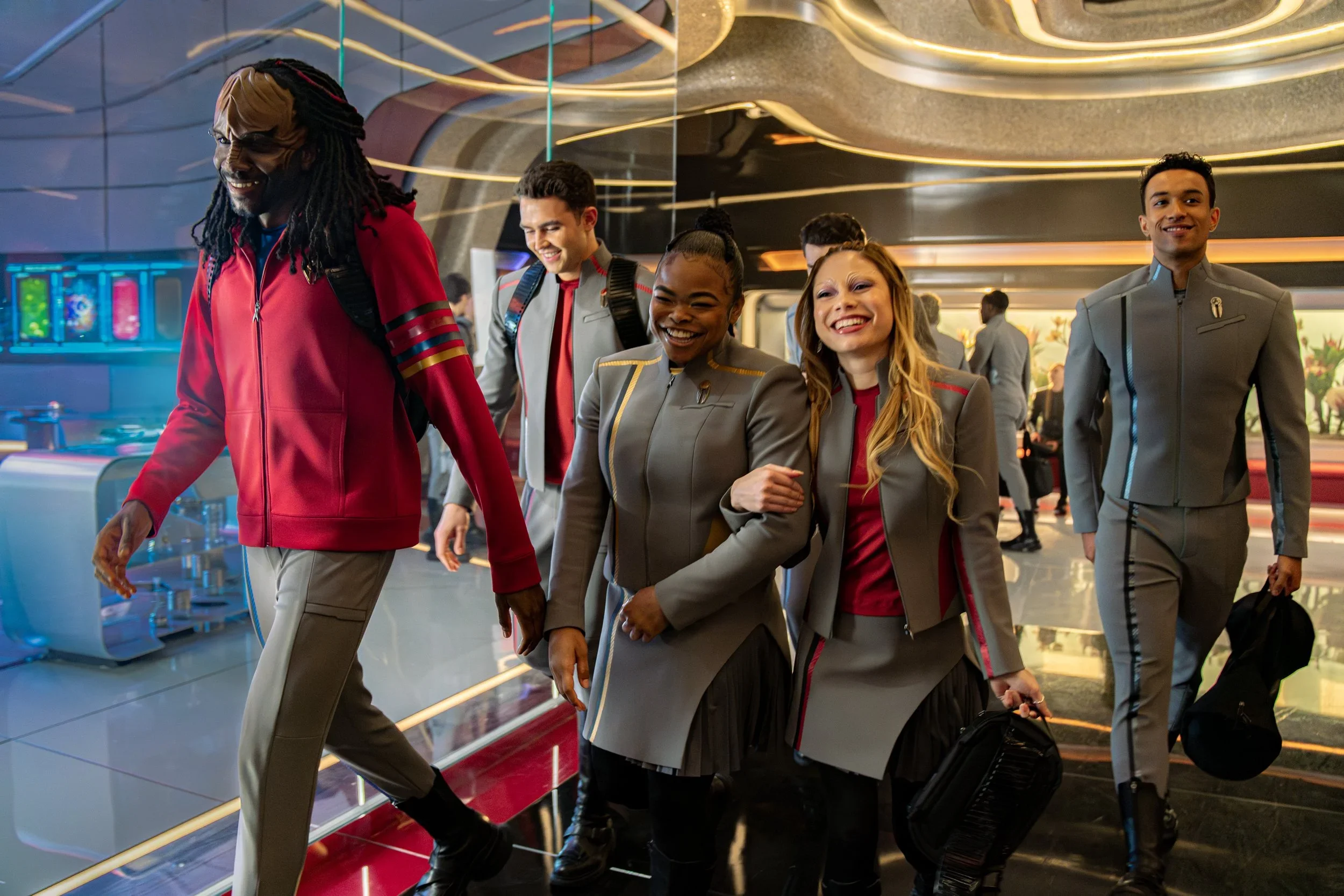
In costume, boldly going.
That’s compelling. Given that Star Trek is in dire need of new fans to reinforce the ranks of the legion of diehards who still remember it from its inceptional original series, 1966 to 1969. But it’s a difficult line to walk, given that there will always be fans who disapprove. Perhaps looking for the similarities instead of focusing on the differences might bring some peace? Picardo went on to describe his return performance as the Doctor, about 800 years past his character’s creation point.
“He’s still a windbag. That hasn’t changed. But he has a lot of his original touchstones, and it’s a joy to play this character again.”
There’s even a mention in the first episode of Starfleet Academy that the doctor introduced an aging program into his holographic matrix to facilitate comfort with organics. It’s a kind touch.
But Picardo’s point is clear: Star Trek is going to change, whether fans like it or not. I, myself, am a die-hard Trekkie who gets chills down my spine when the USS Reliant and the USS Enterprise are locked in combat, blindly seeking each other out in the Mutara Nebula in Star Trek II: The Wrath of Khan (in my estimation, the finest Trek film ever made). I don’t want to lose what made that film great.
Will Starfleet Academy take away from that, or is there room for it to co-exist?

Like it or not, there is. There has to be. Creators’ imaginations, like space itself, are infinite, after all. A friend of mine wisely told me that he has over 700 episodes of Trek that he can watch any time instead of watching what’s new. If he doesn’t like what’s out there, then he can choose to watch something he does. It’s a healthy perspective.
Star Trek united fans because it was a show that preached tolerance and acceptance. People of different races were represented in the original series. To be fair, the 1960’s were a far cry from the levels of cultural acceptance than today’s society is struggling with now, but the message is still the same. Back then, the ideals reflected were the ambitions of an American society coming to grips with itself. Still, whether you were black, of mixed race, a different social class, or disabled, the Star Trek of 1966 still had something progressive to offer and fans felt accepted.
That tradition was maintained through Star Trek: TNG, Star Trek DS9 and other iterations. Despite the decade it was made in, each show addressed issues, and as showrunner Alex Kurtzman told us at the premiere: “what Star Trek does best is really talk about now, like all great science fiction”.
That’s the challenge with every new version of this franchise, and it’s a tall order.
To connect with that spirit of inclusion, we talked with Karim Diané who plays Jay-Den Kraag, a unique Klingon cadet at Starfleet Academy who, unlike his predecessors, does not yearn for the call of battle but for life. He rejects his warrior’s heritage and wants to be a healer.
We asked him about what he brings to the franchise, in terms of being a new ambassador of Trek and classic values.
“Oh my God, to hear you say that I’m an ‘ambassador of Trek’, it’s very humbling. I mean, I haven’t thought of myself that way before this and, I’m just an actor. I got hired to do a job. I’m happy … I’m happy to represent a new generation of Trek.”
It’s in context to mention that Karim was emotionally moved by this acknowledgement.
“This is very important to me. There is space for everyone. We can talk about envisioning an optimistic future but to me, strength comes from our diversity. This is what I’ve been saying a lot and I want to reiterate it: our strength comes from our diversity. Every version of Trek has involved people different from each other sitting next and working with one other.”
He’s right. Bajorans working with Federation and Starfleet representatives, wondering if this is going to be the next occupation? Starfleet and a former Borg? Not to mention a Russian weapons officer sitting next to a Japanese helmsman in 1960’s television? The precedent exists.
“The more different you are, the more value you add to the collective. Growing up, I was made fun of a lot for being different. Being darker skinned, or being into theatre, liking dance and theatre. I was told, “Go be a football player or a basketball player.” To be cast in this role because I am a softer version of a young man is a wonderful feeling. I am different and I am here.”
We had to ask about classic values that he felt his character brought to the franchise.
“Honour. I love that Klingons are all about honour. A lot of people aren’t honourable and Jay-Den would never do that to his friends. A Klingon is about showing up for friends and family and that is a value that I will stand up for.”
Can’t argue with that. But then we had to ask Sandro Rosta (Caleb Mir) the same questions.
“As an ambassador for Star Trek, I think it’s important that the younger generations have a door to enter into. There needs to be a relatability for people to see themselves within the worlds we love. I was never introduced to Star Trek in the way that many people were, so I felt left out. But it’s a platform for everybody. It’s a brand-new character – not a remake, and I think it’s a real blessing for me to bring my experiences to.
“I think a lot of people of colour who grew up troubled, with struggle, can see themselves in this role and have an opportunity to be a part of a community, leadership – they can see themselves in Caleb.”
In terms of classic Trek values, what did Caleb’s character represent?
“I’ve had conversations with Alex about this. His foundation is care and empathy. He has had a good mother to instill good moral values within him. He missed that deeply when they were separated. That is something that has been buried within him for a long time but I think that it manifests itself as service.”
Service is a strong military tradition, and a core value that has been in Star Trek from its original ‘60s values. Over decades, Starfleet became more exploratory than military. But the notion of defending the Federation, the idea of service to its citizens has never diminished. Service is a Starfleet tradition.
Look, I don’t like some of the elements in the latest versions of Trek. But, I howl at Lower Decks and, as a teacher, I thought Prodigy had a lot of promise to help wrangle those younger fans. New Trek has its merits. What fans don’t like, they can ignore. But the notion that what has been created is devaluing Trek is wrongheaded.
For me, I see young professionals becoming part of a legacy that is admirable. I don’t think I want to be one of those people who exclude others, because then I become part of what Trek opposed.
I can accept what I don’t like, but I can also welcome those who want to be a part of it. After all, Infinite diversity in infinite combinations, right? It’s still Trek, after all.