
The Testament of Ann Lee: A Visionary Religious Musical, For Better and Worse
By Liam Lacey
Rating: A-
The word “visionary” as used nowadays implies someone who is ambitious, brilliant, and predicative. But before the 20th century, it held a more negative connotations of a person who was impractical, obsessive, and subject to hallucinations.
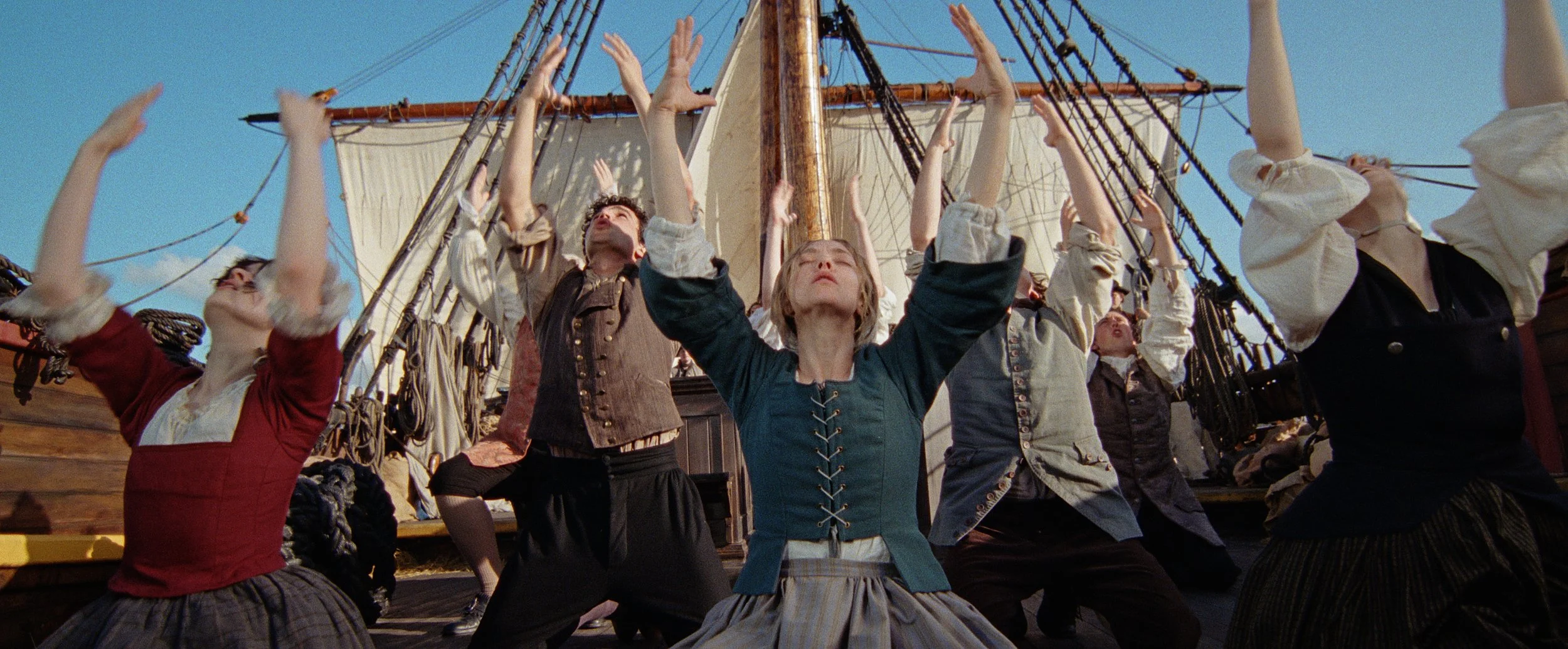
The Testament of Ann Lee, the third film from Mona Fastvold and second co-written with her partner, Brady Corbet, sits between both visionary meanings.
The film is grandly ambitious — a musical costume drama set over several decades and two continents, that belies its U.S. $10 million indie budget with a scrupulous attention to craft on every level, from cinematography, choreography, and music built around a fervently committed performance by a wide-eyed (she can’t help it) Amanda Seyfreid.
But why a film about Ann Lee? “How many stories have we seen about male icons on a grand scale; again and again and again,” said Fastvoid at the film’s premiere in Venice last September. “Can we not see one story about a woman like this?”
Of course we can. And I’m sure there has been more than one. But apart from trying to repair the gender imbalance in biopics, why this particular woman? Yes, Lee’s convictions about gender equality and communal shared property make her sound like a modern progressive feminist socialist.
But her belief that she was the second coming of Jesus Christ and that the only path to heaven was sexual celibacy make her sound like a delusional fanatic. These days, we tend to associate people who preach religious revelation over reason and praise the power of celibacy as exactly the opposite of progressive.

Never mind the paradoxes, here comes a musical! The score is by Oscar-winning composer Daniel Blumberg (he scored Corbet’s The Brutalist), adapted from Shaker hymns, with exuberant chants and grunts and bits of anachronistic electronic percussion, accompanying Celia Rowlson-Hall’s convulsive, fists-grasping-the-air choreography in explosive worship sequences that suggests a feverish 18th century flash mob. It’s all very much in keeping with the observation about dancing attributed to George Bernard Shaw, that it looks like “a perpendicular expression of a horizontal impulse.”
The most conventional element in the film is the chronological narrative, with intermittent off-screen narration by a Shaker acolyte named Mary (Thomasin McKenzie). She describes key moments in Lee’s life, starting in the mid-1700s in Manchester, England; Lee grows up with both heavenly visions and earthly disgust at the sight of her parents having sex.
A revivalist meeting at the home of Jane Wardley (Stacy Martin) and her husband James (Scott Handy) of a sect known informally as the Shaking Quakers for their convulsive dancing at meetings kindles Lee’s spiritual fire.
She marries blacksmith Abraham (Christopher Abbott) and a scene where he insists on whipping her buttocks before sex is gratuitously lurid (we get it; he’s abusive) but it’s the death of four infant children in a row that is the trauma that pushes her over the edge.
This leads her to preach, loudly, against the abomination of intercourse. Noise complaints about her multiday proclamations put her in prison, where Ann levitates and has the vision that she is the messiah. Her visions lead her to take a handful of followers, including her devoted brother William (Lewis Pullman) across the Atlantic to settle in the new world, where the evangelical Great Awakening and the Enlightenment are competing for the soul of the nascent America.

As the film changes continents, the visual style changes from Old Master painterly images of bonneted women and bewigged men’s faces popping out of the background darkness to a softer pastoral tone, where characters are seen in silhouette against the sunlight through doors and windows.
The odious Abraham splits when Ann permanently cancels his claims to conjugal rights. The settlers buy a farm in the Hudson Valley, their simulation of heaven on earth. As the farm flourishes, the angry outside world closes in. The Shakers arrived in America on the eve of the revolution, and their pacifist philosophy was seen by some as treasonous and their rituals demonic, leading to Ann’s martyrdom at the age of 48.
Today, the Shakers — whose numbers peaked at a few thousand before the Civil War (there are three members alive today, living in Maine) — are remembered by illustrations of their dances, some documentary films, their hymns and their sturdy furniture, which they sold to support their communes. Give Fastvold credit for adding this complex speculative new layer to their legacy, though I can’t help wishing her Ann Lee was more of a person and less about the legend.
The Testament of Ann Lee can be seen as a feminist companion piece to the much-awarded 2024 film The Brutalist, which Corbet directed and Fastvold co-wrote, starring Adrian Brody as a fictional Holocaust survivor and brilliant architect.
Each film is a period biography, broken into cryptically titled chapters, about a psychologically inscrutable protagonist who travels from the old world to America, and is subject to violent abuse before achieving a kind of redemption. Each is, in a way, is a tribute to outsider artists and the power of the creative imagination, even the kind that comes in the form of jailhouse religious vision.
The Testament of Ann Lee. Directed by Mona Fastvold. Written by Mona Fastvold and Brady Corbet. Starring Amanda Seyfried, Lewis Pullman, Thomasin McKenzie, Matthew Beard, and Christopher Abbott. Now playing in theatres.