
VisionQuest: How Did a Dead Marvel Hero End Up with His Own Series? It's Complicated
By John Kirk
Rating: A
If you weren’t already a fan of the comic version of the Avengers’ The Vision, then after watching Terry Matalas’s VisionQuest, an epic miniseries treatment of this character, you will likely be.
But first, some background.
Even in the comics, the synthezoid adventurer’s origins were a bit complicated. The same holds true for the MCU.
In the Marvel Cinematic Universe, as played by Paul Bettany, he was an artificial consciousness, created by Ultron, with the aid of Bruce Banner and Tony Stark, and using Stark’s already existing AI, J.A.R.V.I.S.. as a programming template.
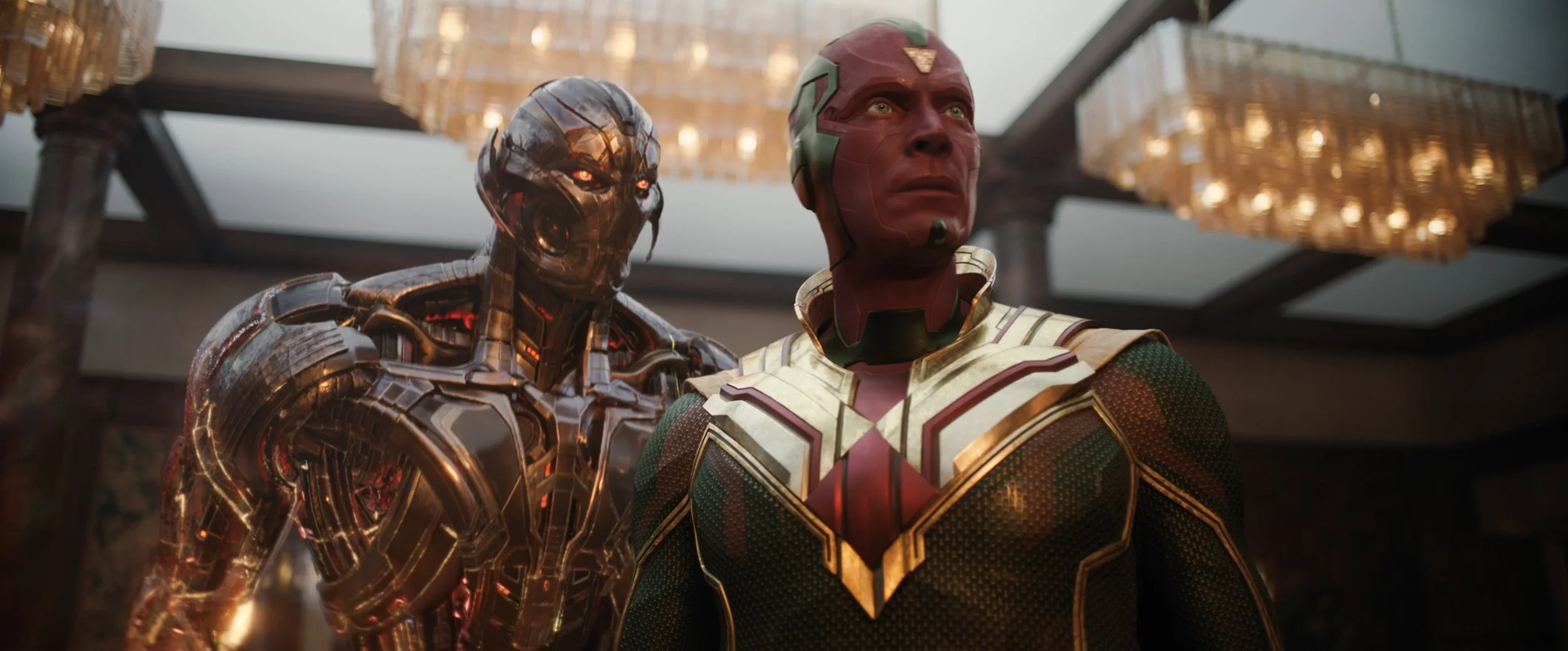
Ultron (James Spader) and the Vision (Paul Bettany) ponder the outside non-cyber world.
His body was made out of synthetic vibranium and one of the Infinity Stones, the Mind Stone. He developed a romantic relationship with Wanda Maximoff (Elizabeth Olsen), aka the Scarlet Witch and was destroyed during the Infinity War with Thanos.
Now for the complications. No, those weren’t them. I’ll try to simplify.
During the television series, WandaVision Wanda’s grief at losing Vision resurrected him through the power of her hex magic. Confronting another version of himself, constructed by S.W.O.R.D. (the successor to S.H.I.E.L.D.), he placed his memories in that other self and escaped to survive in the depths of the Internet, along with a number of other AI consciousnesses.
And finally, our story begins. Vision (Bettany) has hidden himself with the other artificial intelligences behind firewalls in a specially designed home. Aided by J.A.R.V.I.S. (James D'Arcy), FRIDAY (Orla Brady) and even the duplicitous Ultron (James Spader) and other AIs, he is content to stay hidden, observing the world and humanity from a safe distance. However, when the world finally comes looking for him, he is forced to venture out into the real world and discover … himself.
First, Matalas has crafted a story of potentially legendary proportions. To take on a character who arguably has the most complicated backstory in the MCU is a daunting task. However, he succeeds admirably by placing the story into a quest format in which the Vision needs to literally put the missing pieces of his life back together.

Meaty episodes dripping with rich narrative and engaging exposition from the cast make this a truly heroic comic story. The Vision is a tragic figure in this universe. Not only has he lived and died a hero’s death, but he has also lost both wife and family. Even if these memories were created by the hex power of the Scarlet Witch, they are still real to him. And that is a galvanizing force that propels him on this quest of self discovery.
But he is also plagued by the insidious presence of Ultron. Ultron originally crafted the Vision as a successor to help destroy the Avengers and the world they protect. Ultron still survives in a virtual prison of his own making. But how long can he remain?
If there’s anything that James Spader does well, it’s snark. But enhanced by a cleverly written, tech-oriented script with clear megalomaniacal overtones, he’s near-perfect.
When Vision finally emerges into the real world, he must contend with the threat of the bounty hunter, Paladin, played by long-time Matalas collaborator Todd Stashwick. Paladin never fails to bring his quarry to heel and he has been tasked by a mysterious client to bring Vision and his technology to him.
The history of Paladin is also expertly dealt with in this series. So, we are getting two origin stories for the price of one.
However, to simply describe this series as a mere origin story for the Vision would be a disservice. It’s more a saga that allows the audience to see a different side of the Vision and to set him up as an established and independent character in the MCU for more stories and more adventures.
Paul Bettamy has a hard measure to reach in this performance. He is tasked with both playing an artificial lifeform, but one that is also discovering new aspects of his personality. In this role, the Vision has to decide whether those are his own, generated by himself or were they simply parts of his programming that he hadn’t been made aware of? This isn’t just about discovering himself as an individual but tries to answer the question, just because he thinks, is he actually him?
The supporting cast is amazing: Orla Brady, who featured in Star Trek: Picard (S1), James D'Arcy, Diane Morgan and one of my personal favourite performers, Mary McDonnell. They add to the level of the series.
If you’re looking for a super-hero story that rises to the level of richly detailed and epic-level storytelling then, this is one you won’t want to miss.
Told you it was complicated.
VisionQuest. Showrunner, writer, episode director Terry Matalas. Cast: Paul Bettany, James Spader, Ruaridh Mollica, Todd Stashwick, T’Nia Miller, Lauren Morais, Orla Brady, Diane Morgan, Polly Frame, Henry Lewis, Jonathan Sayer, Emily Hampshire, James D’Arcy, Mary McDonnell
Streams on Disney Canada on October 14.