
Once Upon a Time in Harlem: The Harlem Renaissance Reunion Party is a Rare Doc Affair
By Liam Lacey
Rating; A
In 1972, documentarian William Greaves sent an invitation to a cocktail party to a few dozen artists, journalists, poets, historians and activists associated with the Harlem Renaissance, the cultural blossoming of Black music, art and literature that took place in Harlem in the 1920s and 1930s.
The reunion event took place at a musician Duke Ellington’s townhouse, though Ellington was not present. The group included painters, photographers, journalists, poets, librarians, impresarios, book shop owners and musicians, and a couple of younger academics who were students of the period.
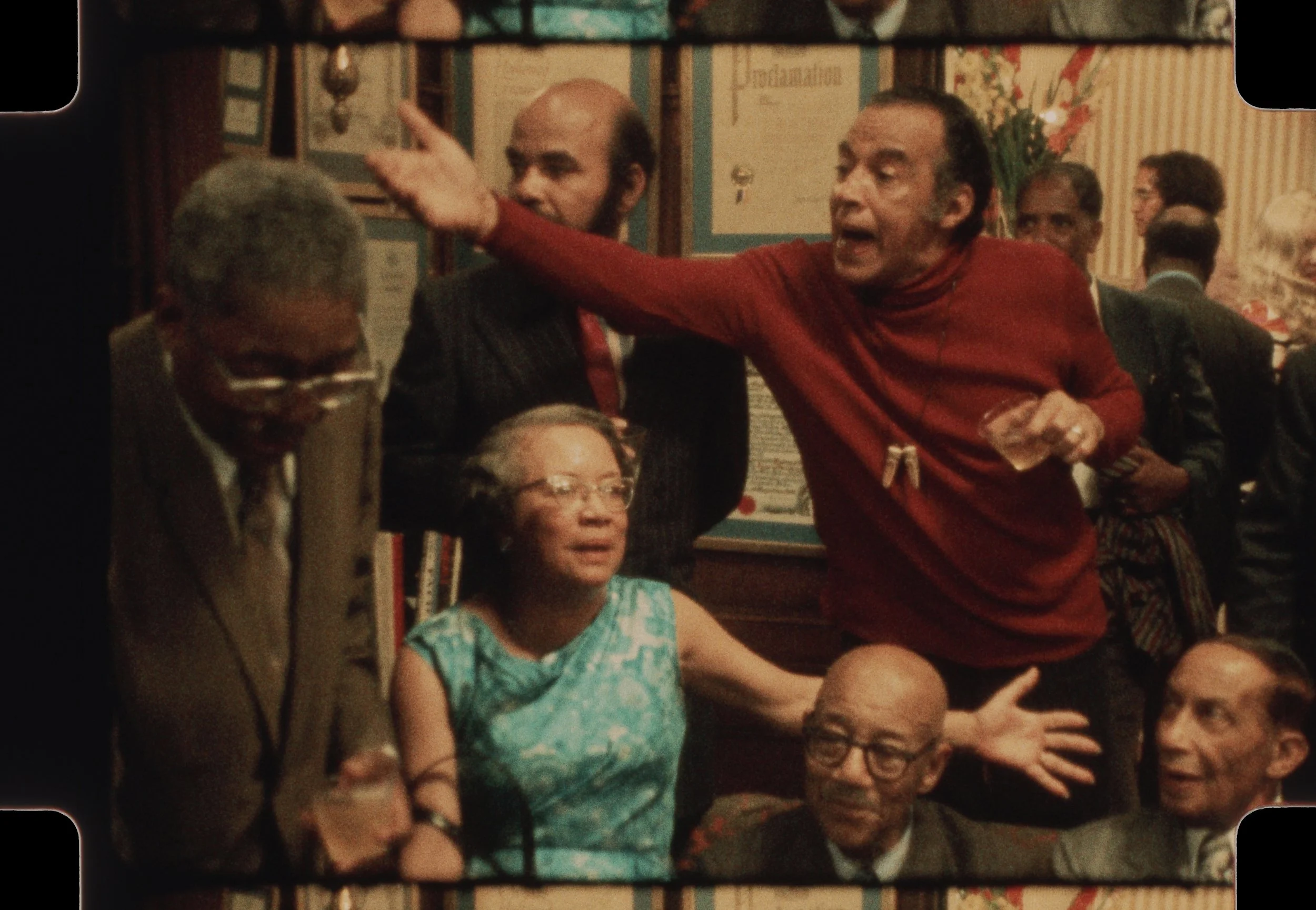
The party ran for more than three hours over drinks, with Greaves lightly directing the group conversation, while also filming one-on-one interviews in other rooms of the house. Split screen is used, judiciously, to show reactions to each other’s comments, and the guests are careful to make sure that everyone gets a chance to speak.
There are lots of lively but respectful arguments on such subjects as what was actually meant by Marcus Garvey’s Back-to-Africa movement, about whether Black art was distinct from American art, about the use of racial designations (“Negro, Black, or Afro-American”) about the relative weight of politics and the arts, and about who history overlooked.
Greaves never did finish the film, but now, more than 50 years later, his son David Greaves, one of the cinematographers on the original shoot, has finished the job for him with Once Upon a Time in Harlem, augmenting his father’s original vision with some graceful editing choices. Principally, he has added layers of context, with the reading of significant poems in voice-over, and dozens of photographs from the original Harlem Renaissance era, both of the party goers in their youth and some of their contemporaries who have passed on

The result is one of the year’s best documentaries, an extraordinary cinematic time capsule of Black cultural and political history, and a bridge between the cultural awakening of the 1920s and the Black Power movement of the early 1970s.
The guests, now, in their sixties through their nineties, speak of how the Harlem cultural moment came in the shadow of a plague of lynchings and white-on-black mob violence across the South following the First World War. A couple of the older guests, Eubie Blake and actor Leigh Miller, founder of the Negro Actors Guild, actually had parents who were born in slavery.
Of all the guests, the best-known today is Blake, the ragtime pianist and composer, who became a regular on The Tonight Show in the 1970s and the subject of a Broadway musical. Blake recounts a story about the dancing great Bill “Bojangles” Robinson attending a celebration of the pilot Charles Lindbergh, who ignored him. Mayor Jimmy Walker stepped forward to shake Robinson’s hand. Since then, says Blake, he never reached out his hand first to a white person he didn’t know.
Similar accounts of crude racism filter through their stories, but there’s also a tremendous sense of collective pride, and frustration that the younger generation don’t appreciate all they accomplished.
There are some fabulously perceptive and entertaining personalities here, several of whom feel like they deserve their own documentary. They quote poems, exchange reminiscences about figures such as Marcus Garvey, Paul Robeson, Zora Neal Hurston and Langston Hughes, and reflect on the state of the civil rights movement then and now.
What a privilege it is to be a guest, even virtually, and to eavesdrop at their party.
Once Upon a Time in Harlem. Directed by David Greaves. Once Upon a Time in Harlem can be seen in Toronto at the Cineplex Varsity (Oct.23-Oct. 29), Fox Theatre (Oct. 30-Nov. 5) and the Hot Docs Ted Rogers Cinema (Nov.1), in Ottawa at the Bytowne Cinema (Oct.30-Nov. 5) in Vancouver at the VIFF Centre (Oct.23-Oct. 30); Edmonton, Metro Cinema (Oct. 23, Oct.25) and in Winnipeg at the Cinematheque (Oct. 23-Oct. 27).