
La Bola Negra: Sprawling Epic from the Spanish Civil War Onward a Demanding Must-See
By Thom Ernst
Rating: A-
A lot goes on in La Bola Negra. Some of it is confusing, much of it is captivating, and nearly all of it demands your attention. It's a film that could benefit from a road map, preferably one with historical annotations and a reasonably detailed family tree.
Even then, you're likely to get lost. But getting lost is not necessarily a bad thing.
La Bola Negra is an ambitious, sprawling epic that crosses decades, mixes politics with personal tragedy, and occasionally wanders into the territory of magical realism. There are revolutions, protests, forbidden romances, artistic revelations, and a rather spectacular vision of a snowy afterlife. The film is concerned with persecution, sexual identity, and the sacrifices people make to survive in a world that would prefer they didn't exist.
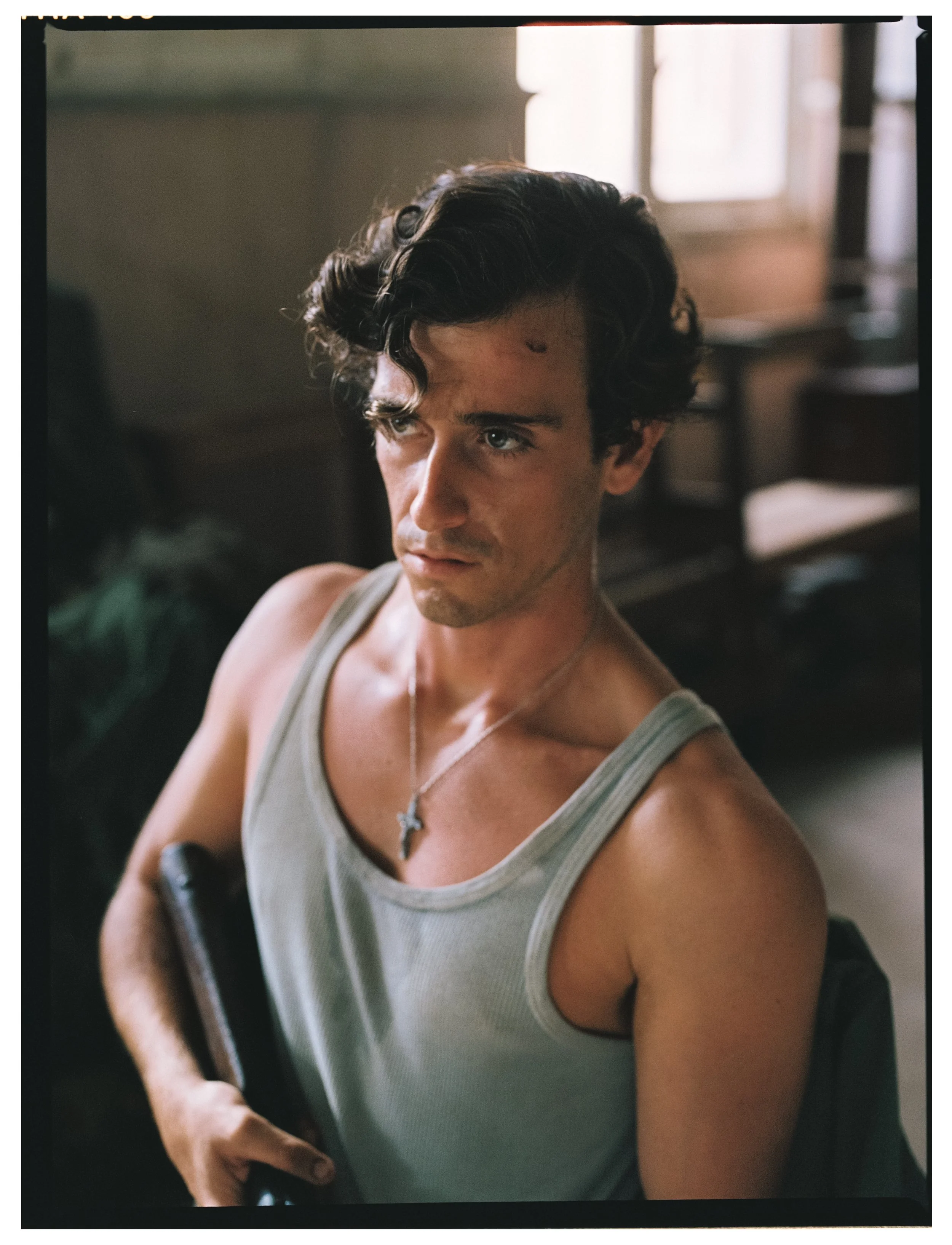
Sebastián (Guitarricadelafuente) guards a Republican soldier in La Bola Negra.
And somewhere in the middle of all this is a missing manuscript.
The film has already attracted considerable attention, including the People's Choice Award for Best Film at TIFF and a Best Director award at Cannes for its filmmaking duo, Javier Calvo and Javier Ambrossi. It's not difficult to understand the enthusiasm. Whatever its occasional excesses, La Bola Negra is the sort of filmmaking that reminds you what can happen when directors are given the freedom to think big. Very big.
For those whose Spanish needs a refresher, La Bola Negra translates as The Black Ball. The title refers to an old voting practice in which a black ball signifies a vote against admission. One black ball, depending on the rules, can be enough to keep someone out.
In 1932, a young man (Milo Quifes) seeking membership in an exclusive club discovers that rumours about his homosexuality have made him an undesirable candidate. His father encourages him to deny the allegations and request another vote. The complication, of course, is that the allegations are true.
It's worth remembering that the word "gay," at least in its contemporary meaning, has yet to enter common usage. Homosexuality is something whispered about, denied, concealed, or punished. The young man faces a choice between being accepted by the society that rejects him and acknowledging the person he is.
This is one of three major stories that Calvo and Ambrossi weave together, each unfolding in a different period. Rather than presenting them chronologically, the directors move back and forth, allowing one story to interrupt another, sometimes just as you've begun to get comfortable with where you are.
It takes some getting used to.
The film opens in 1937, during the Spanish Civil War, with a horrific attack on a village that leaves a young man named Sebastián (Guitarricadelafuente) as its lone survivor. His survival comes at a price. He joins the Nationalists, the right-wing forces fighting against the Spanish Republic.
Sebastián is assigned to guard Rafael (Miguel Bernardeau) a wounded Republican soldier. What begins as a relationship between captor and prisoner gradually develops into something more intimate. Sebastián finds himself attracted to the man he's supposed to be guarding, and the circumstances of their relationship make the possibility of love both dangerous and desperately appealing.
Rafael, sensing that he may not survive, asks Sebastián to retrieve a manuscript from his home. The manuscript is a play titled La Bola Negra.
And there, at last, is the thread connecting the film's many moving parts.
Jump ahead to 2017, when author and historian Alberto López Azcuna (Carlos González) inherits a manuscript from his estranged grandfather. The pages are believed to be part of the long-lost play, setting Alberto on a journey into a past that turns out to be considerably more complicated than he anticipated.
This is, admittedly, a woefully inadequate account of the film's narrative. There are other characters, other revelations, and enough dramatic complications to furnish several films. But these three stories provide something to hold on to as the directors lead us through their increasingly elaborate construction.
What emerges is a chronicle of gay men struggling to exist across different generations. The circumstances change, as do the social and political consequences of being homosexual, but the central struggle remains remarkably familiar.

The film might be described as a progression from persecution toward acceptance, although Calvo and Ambrossi are far too suspicious of progress to suggest that acceptance is either inevitable or complete. The freedom enjoyed by one generation has been purchased, often at considerable cost, by those who came before it.
And freedom, the film suggests, is a fragile thing.
The Spanish Civil War is more than a historical backdrop. Its divisions reflect the film's larger concerns with conformity, oppression, and the danger of surrendering personal identity to political authority. Sebastián's decision to join the Nationalists is particularly troubling because it makes his survival dependent on serving a cause that would have little sympathy for the person he is discovering himself to be.
There is no shortage of irony in that arrangement.
What makes La Bola Negra especially interesting is that its politics are not confined to speeches or historical events. They're played out through intimate decisions: whether to deny your sexuality, whether to love someone you're expected to hate, whether to preserve a work of art that might otherwise disappear.
The manuscript becomes more than a missing play. It's a record of lives that history has neglected, suppressed, or simply forgotten. Recovering it is an act of remembrance, and perhaps a small act of defiance.
Visually, the film is something else again.
There are moments when La Bola Negra recalls Bernardo Bertolucci, particularly his magnificent and occasionally unwieldy 1900. Both films have an appetite for history that seems almost impossible to satisfy. Both use personal relationships to explore political upheaval, and both occasionally threaten to collapse beneath the weight of their own ambitions. There's even a character, Carlos, who bears a passing resemblance to a young Robert De Niro.
Elsewhere, the film ventures into territory that would not seem entirely out of place in a Fellini movie. The theatrical flourishes, the cabaret-like sequences, and the occasional departure from anything resembling conventional reality give the film an almost carnival atmosphere.
Penélope Cruz makes a memorable appearance as a cabaret performer, one of the film's more delightful surprises. And a remarkable dance sequence involving Carlos becomes an exhilarating expression of freedom, communicating through movement what pages of dialogue might struggle to explain.
These are the moments when the film shakes free of its own complicated narrative and simply takes flight. But not everything works quite so effortlessly.The constant movement between timelines can be exhausting. At times, I wondered whether I was missing something important or whether the film was deliberately withholding information. I suspect the answer is a little of both.
But I was never bored.
That's an important distinction. A confusing film is not necessarily an unsuccessful one. La Bola Negra may demand more patience than most films, but it continually offers something in return: a startling image, an unexpected emotional connection, a moment of humour, or a piece of history that suddenly gives meaning to something we've already seen.
Beneath all its historical and cinematic extravagance is a fairly simple idea: people have always struggled for the right to live as themselves, and too many have paid dearly for trying.
La Bola Negra is unapologetically ambitious. I can't claim to have followed every turn in its elaborate journey. I'm not entirely convinced the directors expect us to. But I was willing to follow wherever they took me. Even when I wasn't quite sure where I was.
La Bola Negra is directed by Javier Calvo and Javier Ambrossi and stars Penélope Cruz, Carlos González, Guitarricadelafuente. Milo Quifes and Glenn Close. La Bola Negra is currently playing in select theatres.