
Winter of the Crow: Unexpected Action Star Leslie Manville in Moody Polish Cold War Thriller
By Liam Lacey
Rating: B+
Leslie Manville is often the best thing in whatever she does, as she proves again in the Cold War thriller, Winter of the Crow.
The British character actor’s 50-year-plus resumé includes eight Mike Leigh films, an Oscar-nominated co-star of Paul Thomas Anderson’s The Phantom Thread, and dozens of English comfort food TV credits (The Crown, River, Mum, Magpie Murders), not to forget a Tony and a Lawrence Olivier Award for her stage work.
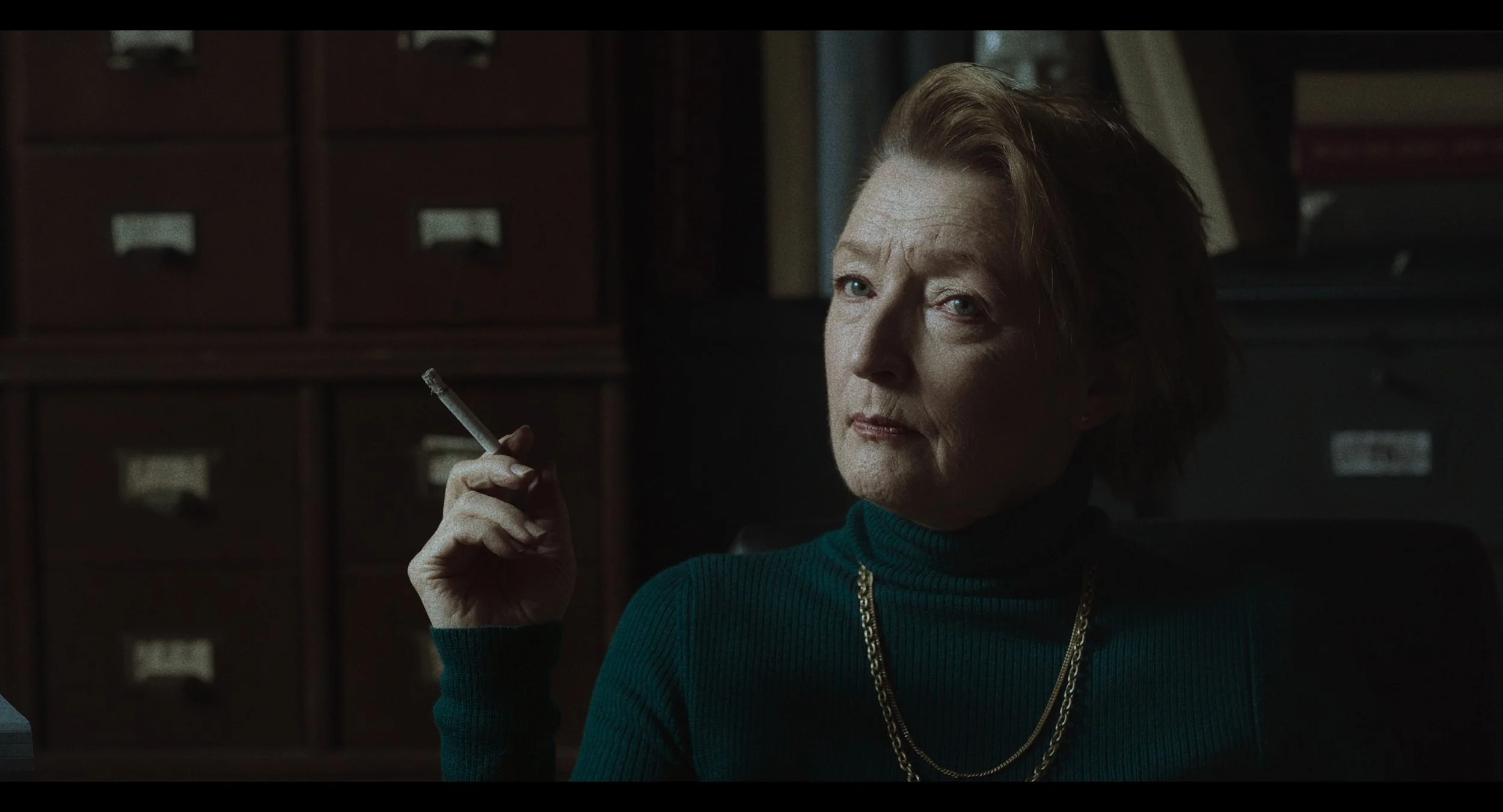
Now 70, she brings her characteristic mix of brittleness and warmth — along with some hand-to-hand combat skills — to the starring role in this stranger-in-a-strange-land tale.
Winter of the Crow is adapted from the short story Professor Andrews Goes to Warsaw by Nobel and Booker Prize–winning author and former psychotherapist, Olga Tokarczuk. Published in 1998, the story follows a British psychiatrist visiting Warsaw in December 1981, unwittingly arriving on the eve of the martial law crackdown by the communist government in its attempt to suppress the pro-democratic Solidarity movement.
The film, adapted by Kasia Adamik along with co-screenwriters Sandra Buchta and Lucinda Coxon, switches the protagonist’s gender and expands the original vignette into a Hitchcockian thriller, set during a winter blizzard in the empty streets of Warsaw following the military crackdown.

Manville plays Joan Andrews, an academic psychiatrist visiting Warsaw for a guest lecture, who becomes a target of the police and militia who have seized control of the city. When we first meet Joan at her London office, she is a brusque academic who treats her assistant dismissively before embarking on her cross-channel trip.
After buying a fur hat with earflaps at the airport for the expected cold, she arrives in the Polish capital only to discovers her checked baggage has gone missing. She snaps in annoyance at the Polish grad student Alina (Zofia Wichlacz) who meets her at the airport and hurries her to her lecture, promising she will return to collect Joan’s suitcase the next day.
Joan is even more annoyed when her lecture on the humane treatment of schizophrenic patients is hijacked by protestors, tossing toilet paper rolls in the air. One man in straitjacket pushes her off the podium, asking “How can a sick society provide mental care?”
After the interrupted lecture, Alina takes Joan not to the expected hotel but to a rundown apartment complex, where she’s invited to sleep on a pullout couch. After over-sleeping from a vodka-induced slumber, Joan looks out the apartment window to see a tank parked on the empty street. She then discovers that the phone lines are down, her promised ride has not shown up and Alina, who is unreachable, has Joan’s passport to recover the luggage.
Things rapidly get worse. After failing to call from a phone booth, Joan witnesses a man tossed out of a window to his death. Impulsively, she snaps a photograph of the body lying in the snow and, at once, finds herself on the run from the man’s killers.
Director Adamik (daughter of Agnieszka Holland who serves as executive producer here) has created a film that hovers between different registers: the stark reality of Joan’s predicament, and the hallucinatory nightmare images of a labyrinthine, locked-down city.
Deprived of her basic needs of shelter, food, and sleep and caught in a December blizzard, Joan — in her improbable fur hat — is surrounded by the tall shadows of brutalist architecture, unable to communicate with the few people she meets. Somehow, she makes her way to the British embassy, but when she finally reaches the compromised British ambassador (Tom Burke), he proves not a saviour but merely another stage in her journey.
Manville’s frayed-nerve performance holds the film together though not everything works. The pacing moves in spasms and lulls; there’s a tiresome back-and-forth about Polaroid photographs, and something faintly campy about Joan’s encounters with the beautiful-but-scary mystery woman, Beata (German singer-actress Sascha Ley) who seems to have stepped out of a forties’ film noir.
Also, it feels like a cheat to have subtitles for the Polish dialogue, when the story depends on Joan’s inability to understand the language. (The character in Tokarczuk’s story learns only the Polish words for “dead” and “alive”).
Though the original short story possessed an element of satire at the British intellectual’s blinkered self-confidence, Adamik’s film aspires to something more inspirational: Joan, in the course of the film, ascends through the hierarchy of human needs, from basic animal survival to higher moral purpose in solidarity with the students and fighting the dictatorship.
What is most effective here is the mildew-rot atmosphere of the gloomy production design and, of course, Manville’s emotionally raw performance. And, unfortunately, there’s the unsettling timeliness of this reminder of Cold War terrors, indicated by the film’s title.
Joan’s anxious observation of flocks of crows flying about the deserted Warsaw streets, which she views as an ill omen. As Alina explains to her, “crow” is a derogatory nickname for the military junta know as WRON (Wojskowa Rada Ocalenia Narodowego, or Military Council of National Salvation). The Polish resisters added a letter to spell WRONA, meaning “crow.”
Winter of the Crow. Directed by Kasia Adamik. Written by Kasia Adamik, Lucinda Coxon and Sandra Buchta, and adapted from the short story by Olga Tokarczuk. Starring Leslie Manville, Zofia Wichlacz, Andrzej Konopka, Sascha Ley, and Tom Burke. In theatres in select cities beginning October 9 and rolling out nationally throughout the fall.