
Original-Cin Q&A: 'The Chosen' Star Jonathan Roumie, on his Six Seasons as Christ
By Bonnie Laufer
As The Chosen enters its pivotal sixth season, the weight of history—and high expectations—reaches its peak. The series, about Jesus’ ministry reached the final week of his life in Season five.
Covering the final 24 hours of Jesus’ life leading to the crucifixion, Season 6 brings the series – the first such multi-season dramatic series about Jesus of Nazareth’s life - into its most raw, emotionally charged territory yet.
For Jonathan Roumie, stepping back into the robe of Jesus Christ under these intense conditions meant confronting both profound excitement and genuine terror.
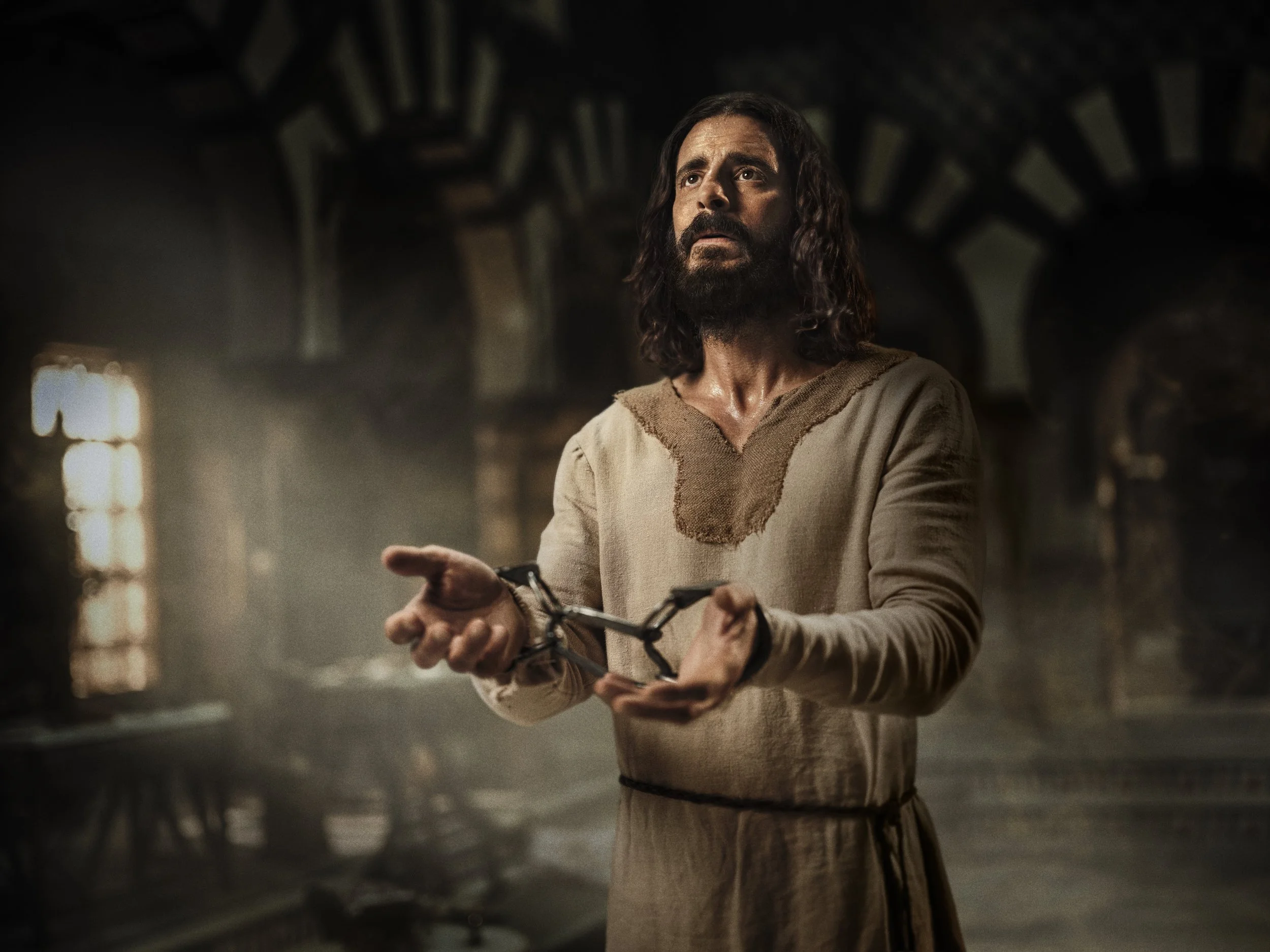
Jesus (Jonathan Roumie) surrenders himself to his fate.
We spoke with Roumie to discuss how he navigated the immense pressure of bringing authenticity to these defining hours, the physical and emotional toll of the role, and how he prepared to bring viewers into the heart of the story’s most profound moment.
Season 6 of The Chosen starts streaming on Prime on November 15th
CLICK HERE to watch Bonnie’s interview with Luke Dimyan who plays Judas Iscariot
CLICK HERE to watch Bonnie’s interview with Andrew James Allen who plays Pontius Pilate
ORIGINAL-CIN: Here we are at Season 6 of The Chosen and to say this season is intense is an understatement as it covers the last 24 hours of Jesus’ life leading to the Crucifixion. What scared you, or ultimately excited you about going into this season?
JONATHAN ROUMIE: All of it. All of it terrified me. All of it excited me, but I will admit, I was mostly terrified.
O-C: I can only imagine. Playing Jesus for so many years has to take a toll on you, especially knowing what’s to come.
ROUMIE: My main thought was, how do you even approach this with any kind of authenticity? How do you make it feel real to people? That was my prayer to God. It was like, please help me figure out how to make this real.
How do you know if there's an opportunity for me to understand on a deeper level what you went through? I welcome it and I'm here for it. Then he's like, “Okay, here you go!”
Throughout the series, I experienced a number of challenges. Physical challenges and injuries that contributed to my understanding a fraction of a percentage of what this might have looked like, and every bit of it to the best of my ability.
O-C: Having said that, this is the role you've played from the get-go for many years. Quite amazingly, I might add. How do you mentally and physically prepare yourself because you know what's coming, and it's not easy. No pun intended, but that’s a huge cross to bear.
ROUMIE: Yeah, it is. I don't claim to have been able to do any of this on my own accord or with my own strength. I rely heavily on my faith to get me through it, and especially this season.
I couldn't submit myself any more than I did because I knew if I tried to intellectualize it, if I tried to keep my faith separate from my understanding of the scenes, it would fail. So I had to submit to them on a spiritual level that normally as an actor is not really required.
This kind of spiritual intensity is usually not called for in most acting roles and with scenes of physical violence and torture, it's certainly not something that you wouldn't ever kind of come across in just an average role. So being that it's Jesus, it's all about, “Where do you start?” So for me, everything just starts with prayer, and that God sees me through the process, and He was with me every step of the way. It was the hardest thing I've ever done, but we did it, and I think we did something really special.

O-C: The camaraderie between this cast is quite evident. Over the years you've become such good friends. So how do you distance yourself in scenes, especially with Luke Dimyan and Andrew James Allen, the actors who play Judas and Pontius Pilate?
ROUMIE: I think you just commit to the work. You commit to what's in front of you, and you commit to these characters in ways that scene needs from you. Ultimately, Judas wants Jesus to understand how things could be better, how he could assert his mantle as king in the way Judas imagined it.
As Judas, all Luke has to do is just try to get me to believe him, and that's his focus. Everything else is now the context of the scene and put on by the audience. It’s about the historical context, the scriptural reality, by the Biblical truth of what's written in the book.
We're just committing to it and not oversimplifying, but our intentions and our actions are as performers. I, as Christ, feel pity that Judas doesn't get it. He just doesn't get it, and I'm sad because he was my friend, and he's doing this and he's just mixed up. He’s going down a road that he's going to regret.
O-C: It has to be hard as actors who have become friends and up until that point were friends as characters.
ROUMIE: Oh definitely, but we just have to put that all aside. Scripturally, Jesus says to John at the Last Supper, if not to Judas directly, It would have been better if Judas had never been born.
O-C: Yeah, but you know what? If not Judas, it would have been somebody else, right?
ROUMIE: Absolutely!
O-C: This leads me to my final question. If you could travel back in time, especially now having played Jesus for so many years, and you pick any of the disciples or anybody during that time period, and have a little chat with them, who would you pick? What would you say, and why?
ROUMIE: As the character?
O-C: Sure, let's go with Jesus.
J.R. Oh gosh, it's a really hard question because Jesus knows everything anyway. What would be the point of it? Everything had to happen the way it happened. There's no getting around it.
Like you just said before, if it wasn't Judas, it would have been somebody else and that somebody also was given free will, so they knew that somebody would pick that choice to betray him.
For instance, he knew Pilate would not do what he should have done as a person, and perhaps should have listened to his wife. It all had to happen. So with Jesus, it's a stacked deck. Nobody can win or maybe in the end, Jesus won.