
Victorian Psycho: Hey, All That Corseted Repressed Emotion Has to Blow Sometime
By John Kirk
Rating: B+
Victorian Psycho, despite its in-period aspect, isn’t Jane Eyre. It won’t be a box office smash, but damn! It is a fascinating watch.
If you have the guts to take a chance on a film that will leave you wide-eyed and disturbed, but somehow strangely satisfied after viewing, then this is one to take a chance on.
The premise: it’s 1858 and governess Winnifred Notty (Maika Monroe) arrives at Ensor House in Yorkshire to teach the Pounds children, Andrew (Jacobi Jupe) and Drusilla (Evie Templeton). Her employers, Mr. and Mrs. Pounds (Jason Isaacs and Ruth Wilson) are true representatives of the eccentric strain of repressed British aristocracy.
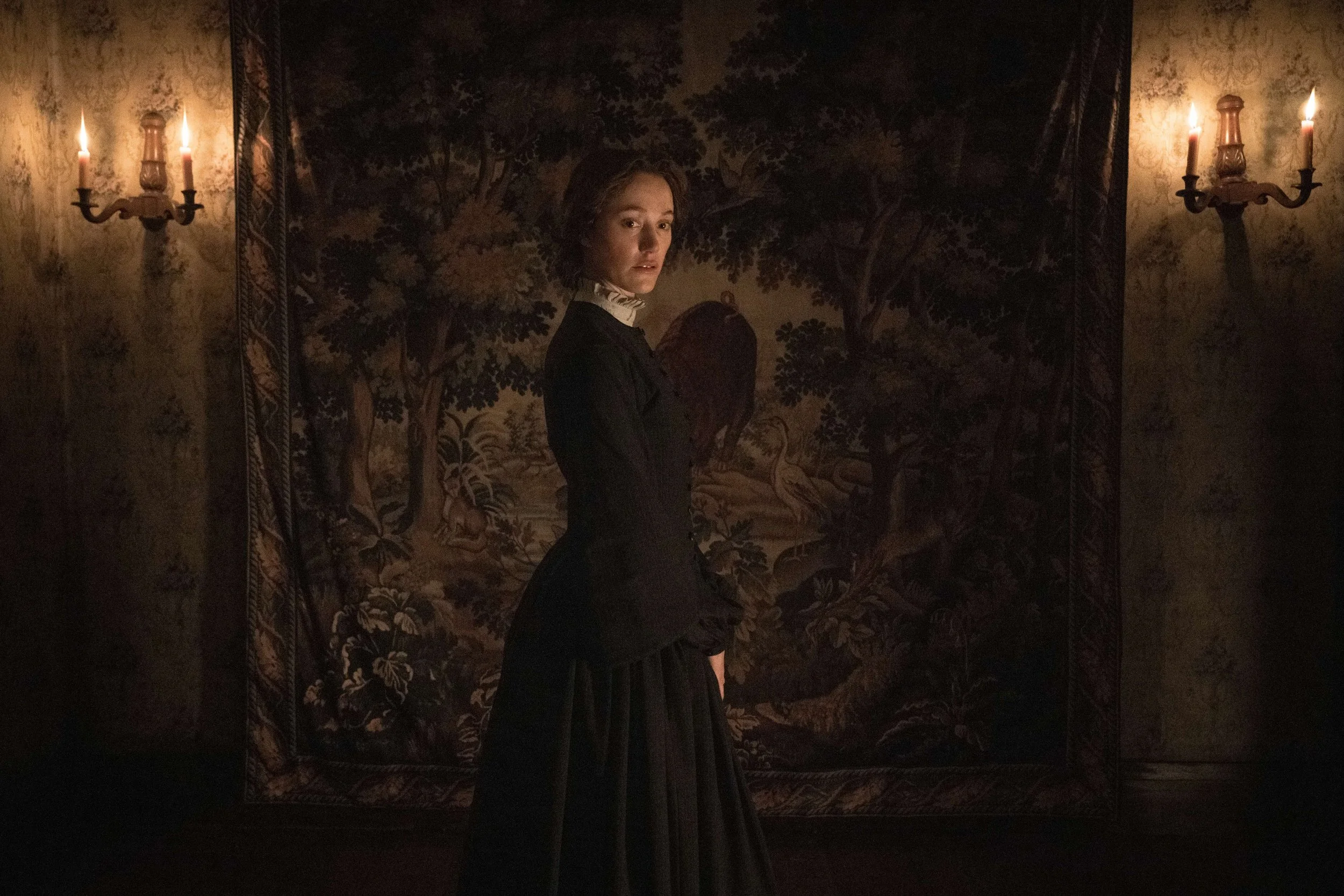
Maika Monroe is a nanny with an internal time-bomb in Victoria Psycho.
They are effete, elect and unforgiving. However, they are also blissfully unaware that their new governess may have eccentricities of her own.
What stands out in this film is the brilliant portrayals of the characters. Rigidly conformed to their predestined societal roles, each character in this film, regardless of station is a tightly-packed explosive just waiting to blow up. Winnifred, clearly more so than the rest.
Winnifred brings mystery to Ensor House. There are negative associations to the locations of her previous employments. She holds an anticipation that this position will be THE one. Instantly the audience is drawn to her character, wondering what she had done in the past and why is this family so important to her?
Very much like the mysteries behind Michael Henchard or the brooding Heathcliff in novels set around the same time, this is a gothic story that manages to capture that same brooding suspense and mystery that surrounds its characters.
Personally, I enjoyed Maika Monroe’s physical expressions of the struggling forces inside her, repressed and controlled, while she engages with both Mr. and Mrs. Pounds. The former sees her as an object of curiosity and desire, while the latter sees her as a servant to be used in whichever way she deems appropriate.
In true Victorian dramatic fashion, the internal monologues reinforce the pressures on all these characters, most particularly Winnifred, whose growing psychosis is a build towards an outcome that couldn’t be predicted.

Which is, of course, what makes this a film you won’t be able to turn away from. We are privy to the development of a true psychotic character, set in Victorian times, an age that not only repressed basic human needs but was most brutal in its treatment of women, clinging to the biblical notion of Original Sin. In this age, women were the source of all that was wrong in society. However, it is of note, that in this case, the female protagonist is a psychotic villain.
However, the audience will notice a very interesting extension of this concept.
The downside to the film is its pacing. I find that films in a gothic setting tend to require a slow burn. It’s a feature of the bottled-up emotions and morals of the setting, I suppose. But as we are to encounter characters restricted by the social nature of the historical period, we are forced to patiently wait for everything to be established. So Victorian, but so in-period.
Of note: Jason Isaacs is an amazing character actor. While his role is definitely creepy, he also manages to elicit pity. Also, Evie Templeton, who I instantly recognized from Season Two of the hit Netflix series Wednesday, is a true audience pleaser. Ultimately, you’ll see why her character has so much importance to this film and its story.
Still, all this pent-up energy has to go somewhere. As Oscar Wilde wrote in The Picture of Dorian Gray, “the only way to get rid of a temptation is to yield to it.”
There is a parallel with to Bret Easton Ellis’s American Psycho, given the similarity of the two names. In fact, screenwriter Virginia Feito (and author of the same-named novel) does draw allusionary inspiration from that novel. She was intrigued by creating a female antagonist in this time period. When watching the film, one can see the similar internal monologue structure. With that pattern, one can expect an explosive yielding to a psychotic temptation.
With that said, there are some truly monstrous events that occur within this film. Yet when the motivation behind Winnifred’s psychosis is revealed, there is also a grudging understanding.
Forget the moors, Heathcliff. Like I said, this is a disturbing, shocking yet somehow satisfying film. Despite the slow pacing and weird aspect to it, stick through it. It’ll be a dramatic viewing experience that will allow you to see why repression is bad and expression is good.
Victorian Psycho. Directed by Zachary Wigon. Written by Virginia Feito. Starring Maika Monroe, Thomasin McKenzie, Jason Isaacs, Ruth Wilson, Evie Templeton, and Jacobi Jupe. In theatres November .