
Original-Cin Chat: 'Rings of Power' Cast & Showrunner Get their Sauron and Talk LOTR Lore
By John Kirk
If there’s a subject that makes manifest my nerdy expertise of obscure and divergent topics, it’s The Lord of the Rings.
I’ve read the trilogy more than 30 times, read every supplement to the trilogy, translated LOTR’s literary spirit animal Beowulf for fourth year English and got to read personal, hand-written correspondence between my Old English prof and J. R. R. Tolkien. I’ve also interviewed a majority of the cast of the film series.
Trust me – I know of which I speak. I mean, I bleed mithril.
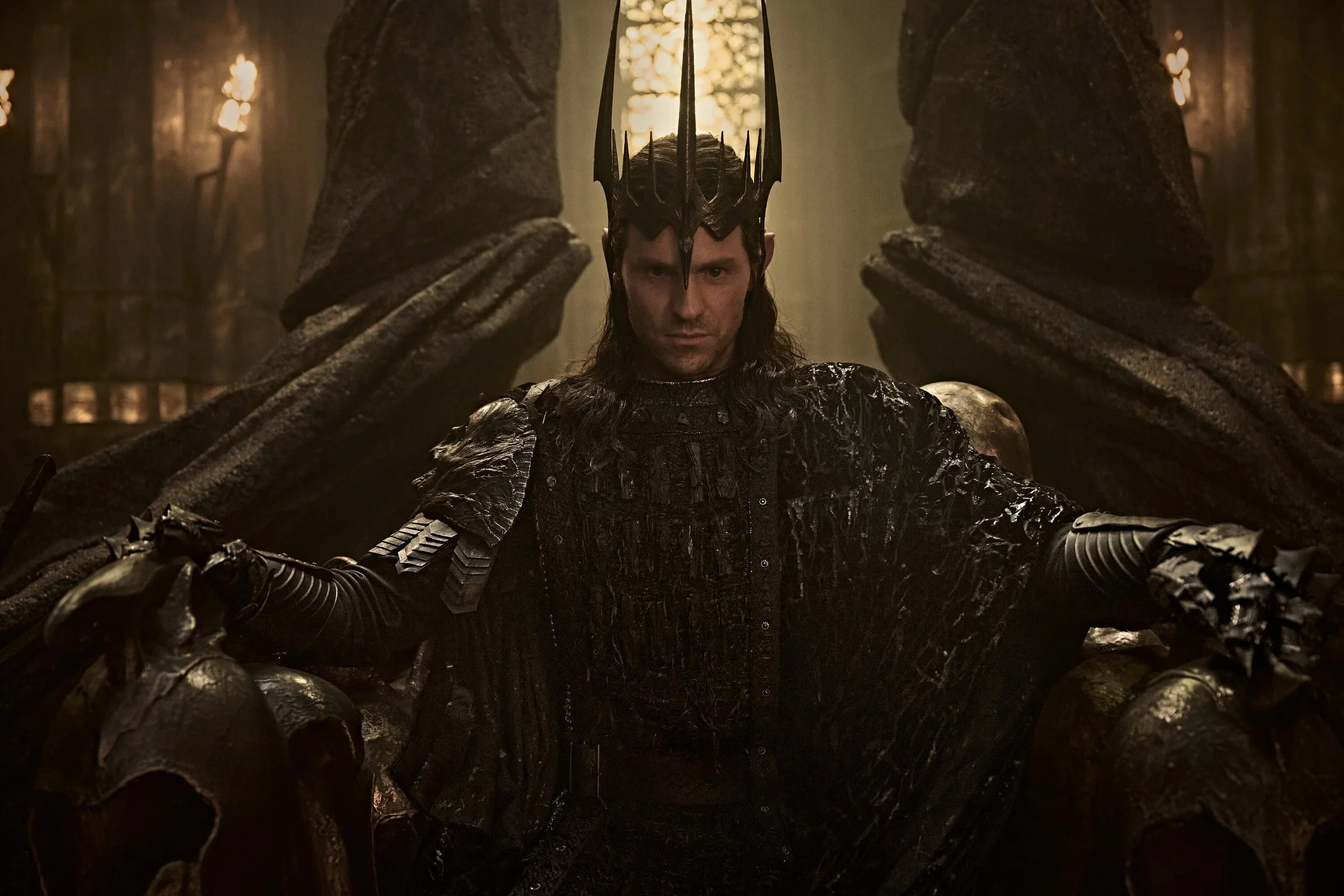
Charlie Vickers as Sauron in The Rings of Power
Which is why I can appreciate showrunners J. D. Payne and Patrick McKay and the task of making this complicated saga simple. In my chats with the cast of Prime Video’s The Rings of Power, Season Three, I asked Payne and the cast how they were they able to pull off this incredible work.
I started with his guiding principle in balancing the intricate lore with the demands of a television series.
“You need to do what is going to work for this medium,” he said.
Simply put – television isn’t a movie theatre. However, the production costs on S3 episodes are about $12.5 million (U.S.) per episode. While theatrical budgets are usually more, given an episodic nature of storytelling, a season can easily match a movie budget. Other than budget costs, what else works for this extensive story?
“It’s in the lore. Whatever you adapt doesn’t take away from the lore. If you loved it in book form, it’s there in book form. But there are certain things that need to evolve. For example, the timeline.
We talk about this all of the time. If we had adapted S2 as it was in books, then Annatar and Celebrimbor, there would have been hundreds of years. That works on a mythological level, but you would lose your audience after 400 years of asking, “Celebrimbor? What?”
As a scholar of the mythological mode of literature, I totally get that. I also appreciate the way that these characters have been presented so that we can comprehend them. It’s a hell of a task bringing these epic-scale characters to a relatable place, where Tolkien lore can still be appreciated.
Bear in mind, grandson, Simon Tolkien was a consultant on the series.
There’s a lot of responsibility and personal perspective in presenting these seminal and classic characters. Did the cast feel pressure performing them? Daniel Weyman who plays Gandalf, one of the most recognized characters in the series, had this to offer:
“I feel like you’re lucky as an actor when a part comes around as it lands with you and you grow into it, and it just feels right. I go back to my first rehearsal in New Zealand when I was on stage trying to get camera moves down. And it just felt this was the exact place for me and I had in me what was needed.
“We know the vastness of this universe and how much it means to people. We have within us what’s needed to being these characters to life.”
Cynthia Addai-Robinson who plays Queen Miriel added this:
“I don’t think I feel a sense of pressure. I don’t think I like that concept, but I do genuinely feel a sense of responsibility. Those are two different things.

“We know the meaning that this holds for people who have loved this for longer than we have been alive or doing this series. And to honour that and be in service to that audience is a privilege. So, I never see it as pressure because I think that can get in your head and get in your way.”
Of course, there’s the challenge that goes into preparation to present these characters. What about that?
“That’s a good question. I was lucky.” Weyman says. “I had an odd way into my character. He emerges as a blank slate at the beginning of the series. I loved how deep you can go with Tolkien. I wanted to give myself just enough to land.
“From then, I was going to use the scenes that J.D. and Patrick had written to build the character, and brilliantly as possible go into Season Three, when Gandalf emerges as an eternal being. Then I was going into all the writings of Tolkien to find those touchstones to present what makes Gandalf unique.”
What about Sauron, the Dark Lord himself, played by Charlie Vickers?
“There’s a lot to mine. You could study this work for the rest of your life and never get to the end of it. For me, it was the crafting of three different guises of Sauron and making them all fit into one character.
“You have Halbrand, who’s a human, and Annatar, who is actually a Maya, a god, but who has taken on the appearance of an elf. But then you actually have Sauron – Full Metal Sauron, if you like.”
Jamie Campbell-Bower (of Stranger Things fame) talked about playing Celeborn, husband to the Lady Galadriel.
“Celeborn is peppered throughout the work. There’s not a lot of detail and that’s a challenge because you have to take what is available and use that to build something.
“But there’s a lot of yourself in there too. When you have something like, ‘Here’s the manifesto, this is who they are and you have to fall into that somehow.’ That was really challenging, not to mention the sheer size and scale of the work. I mean, there’s a lot.”
Clearly, these performers take the work seriously. It’s a challenge to give it the respect and the honour it deserves, but the cast expertly pulls it off. There’s research, a love of the lore and its fans plus a true desire to see the resolution of the One Ring’s creation and to give form to the touchstones that are the bedrock of the Tolkien Mythos.
Vickers had this observation. “It’s a privilege to be a custodian of this world. To tell this story. It’s not like we are doing an origin story or a pre-cursor story – this is a standalone art of Middle-Earth that is its own story. As a fan myself, I feel the sense of expectation of everyone in the production as well.”
Finally, in answer to the original question of how they managed to tell this story. Vickers left us with this:
“I love this time period and I want this to be incredible. Everyone is pouring everything they have into this show.”
“You have to love it.” Campbell-Bowers agreed.
Simply put: it’s about the love of the work, my fellow nerds.
Lord of the Rings: The Rings of Power streams on Prime Video on November, 11.