
Original-Cin Q&A: Joan Chen on Learning French (and Freedom) in Montreal, My Beautiful
By Bonnie Laufer
Joan Chen has built a remarkable career bridging Eastern and Western cinema, delivering unforgettable performances both in front of and behind the camera. In her latest film, Montreal, My Beautiful, she takes on a deeply personal and emotionally layered story set against the vibrant backdrop of one of Canada’s most culturally rich cities.
Bonnie Laufer spoke with Chen, 64, about connecting to her character which IMDb describes as, “a Chinese immigrant mother in Montreal who breaks from duty and tradition when she falls for a young Québécoise woman, leading her to confront questions of identity and freedom.”
Montreal, My Beautiful — directed by Xiaodan He, recent recipient of the Jay Scott Prize for an Emerging Artist awarded by the Toronto Film Critics Association — opens Canada-wide February 13. Read our review of Montreal, My Beautiful.
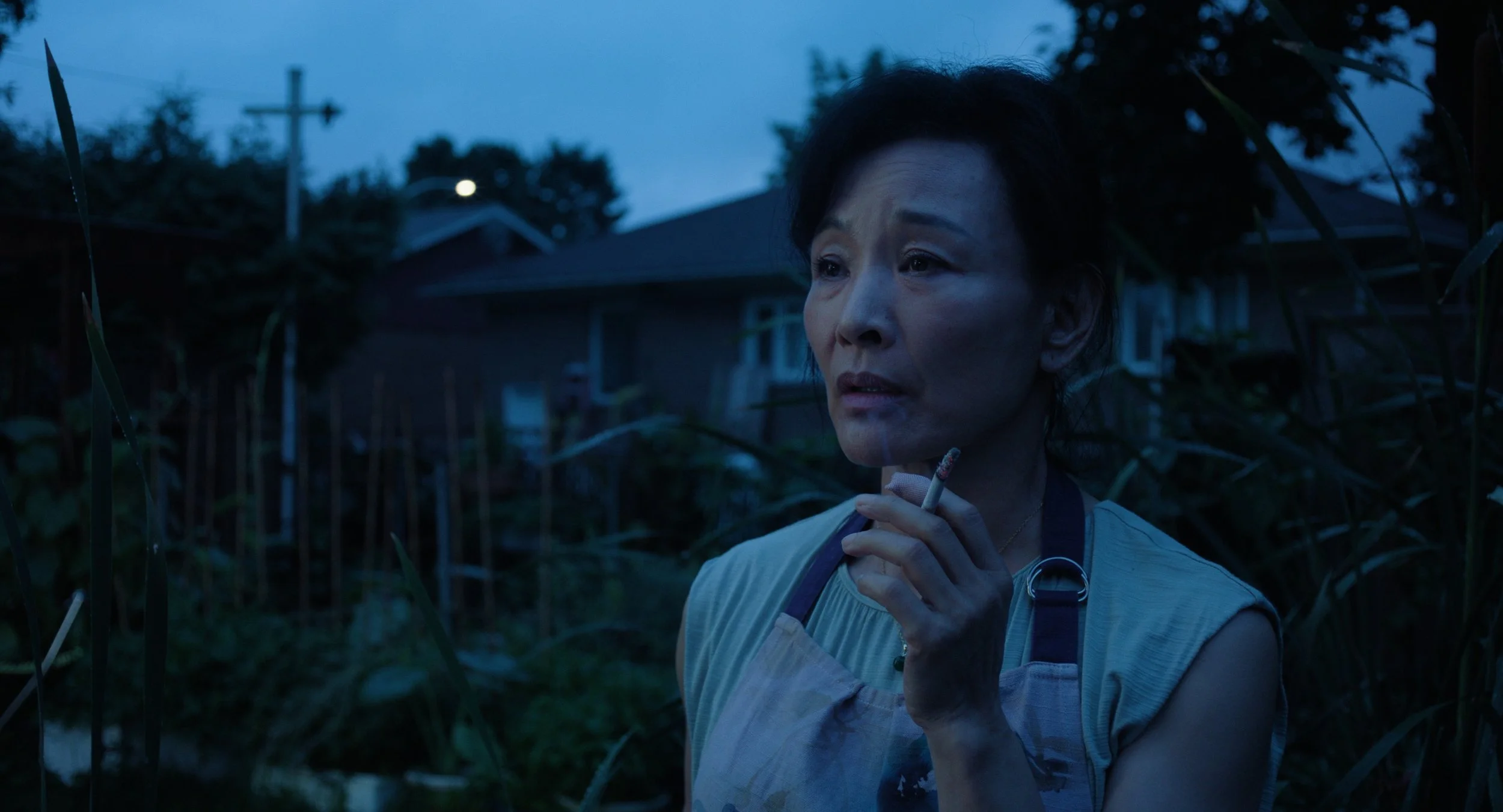
ORIGINAL-CIN: Your performance in this film is heartbreaking and stunning. I think it’s unlike anything we have seen from you before. How did this script come your way?
JOAN CHEN: I read this script, around four or five years ago. It took about three years of applications for the grants to become available to make the film, but I stuck to it. When I first read it, I thought, ‘Wow, this is a character that I really want to play.’ You are right, I have never played a character like this. She’s an immigrant woman who's lived within the bounds of tradition and social taboo who has never for a minute in her life had the chance to be herself.
It was hard to imagine what that must feel like but at the same time, I also know that for every one of us, we all have that side that we can't always be ourselves. Especially for me. I grew up being a famous actress at a young age and being in the public. Especially back when I started, I was set up to be this model youth. I had to dress a certain way, talk a certain way. I had to go make speeches in schools and that's completely not me. So, I understood what a tragic existence this character went through.
She found other ways for fulfillment. She raised a family. She worked in a convenience store with her husband, so that he and their family can have a good life, a comfortable life for the children. She has her friends and so she's learned to try to fulfill herself in other ways, but as we see it comes to a breaking point.

O-C: I think there are many people who can relate to this woman in so many ways. Just doing what society tells us to do and suppressing what we really want. What kind of reaction have you gotten from people who have seen the film?
JC: I saw the film at the Montreal Film Festival, and people did come up to me. They were mostly taken with the courage my character displayed of finally being herself, and the supreme difficulty of being oneself, especially for her and the huge price she must pay. She does love her family, so the kind of tension between being yourself and carrying on with responsibilities and not disappointing the other people you also love really resonates with people. Of course, it's such a hard decision.
O-C: Especially because she had suppressed herself for most of her life.
JC: What was attractive for me to play her was all those complex feelings that she must be feeling, but at the same time when she sees [her eventual lover] Camille, there is that beautiful simplicity. Their eyes meet, and she feels something. For the first time in her life her heart is beating and she feels alive. This is such a beautiful moment that any of us would love to feel. When you feel so alive, suddenly all the colours around you are more vibrant, the air is more fragrant. This comes late for her in life, but she finally has it. It’s lovely.
O-C: Your co-star Charlotte Aubin is wonderful as Camille. Did you immediately connect?
JC: We met before we started the shoot and we rehearsed our scenes. First just the dialogue and then we rehearsed with the director, the cinematographer and the intimacy coordinator of our love scenes.
It's such an integral part of the film, and Charlotte was very generous and very comfortable. When I play with somebody who is generous and comfortable and open, it makes it so much easier.
O-C: What was it like for you to shoot in Montreal and work in Canada?
JC: I love Montreal and summer there is magical. I had a good amount of time during the shoot to walk around the neighbourhood. I still have pictures on my cell phone, dozens and dozens. It's like a city of churches and murals, so beautiful and lovely. On lunch hours, I roamed around, taking pictures. I don't think I've ever actually made a film like that, because most of our lunches were walk-away lunches; we had about an hour-and-a-half so I took advantage of the time. I truly enjoyed it.

O-C: Many actors say that if a role doesn’t scare them, it’s not worth doing. Did you feel that way about this film?
JC: I'm always a little scared when I start something new. I’ve done this since the age of 14. I have insomnia before the first day of shooting. I'm always a little scared and nervous but you try to do the best you can. It's always a bit scary and obviously for this film, a big issue is that my character needed to be able to speak fluent French.
The other parts, for instance, the sex scenes, really didn't bother me all that much. I knew it was necessary. I knew that for the first time in her life, she was exploding, she was liberated, and that is an integral part of the character.
I've always believed that our body and our soul are one thing and when your body rejoices, your soul rejoices. When your body is soiled, your soul is soiled. And when her body was humiliated, her soul was humiliated. In a way, her body has gone through both in the film. She has endured all her life to have this relationship with her own husband, so the body has everything to do with her inner being.
I knew it was necessary. I was a little scared of how they were going to present it, but we did detailed research. We did a detailed rehearsal, and everybody was extremely protective and generous. That put me at ease.
O-C: You could have fooled me that you never spoke French before. How difficult was that for you? Picking that up as a 60-year-old woman? I don't think I could do it.
JC: Yeah, not easy. Especially French, I think it's the pronunciation that threw me at first. I just aimed at making myself understood. I repeated all the lines over and over until I memorized them. I started taking French lessons on and off during my spare time three months before we started filming. Pretty conscientiously learning all the lines and listening to the recordings and just repeating them whenever I could.
O-C: You ‘ve had an amazing career dating back to Bernardo Bertolucci casting you in The Last Emperor in 1987. But I was a Twin Peaks fanatic when that show aired. It has been a year since we lost the great David Lynch. What was it like to work with that genius?
JC: The first time I met him, I had seen his films, and I was expecting somebody maybe eccentric and a little off. But he was just so kind and normal, just such a nice human being. Obviously artistic, but he immediately put me at ease.
My character was written for an Italian woman, and when I first read the script, the name of the character was not Josie Packard. It was an Italian name, but he was open-minded enough to see me and talk to me and just instantly, we clicked. It was a fast decision, I got offered the role the next day and the rest, as they say, is history.