
Forlorn at Finch, Middle-Aged at Midland: Hong Kong Immigrants Struggle to Get By
By Liam Lacey
Rating: B+
As a rule, I expect a Canadian immigrant drama to be about young people, involve romance and possibly crime, have scenes showing generational tensions, traditional food, and be suitable to show in a social studies class. Happily, writer-director Timothy Yeung’s debut feature Finch & Midland is nothing like that.
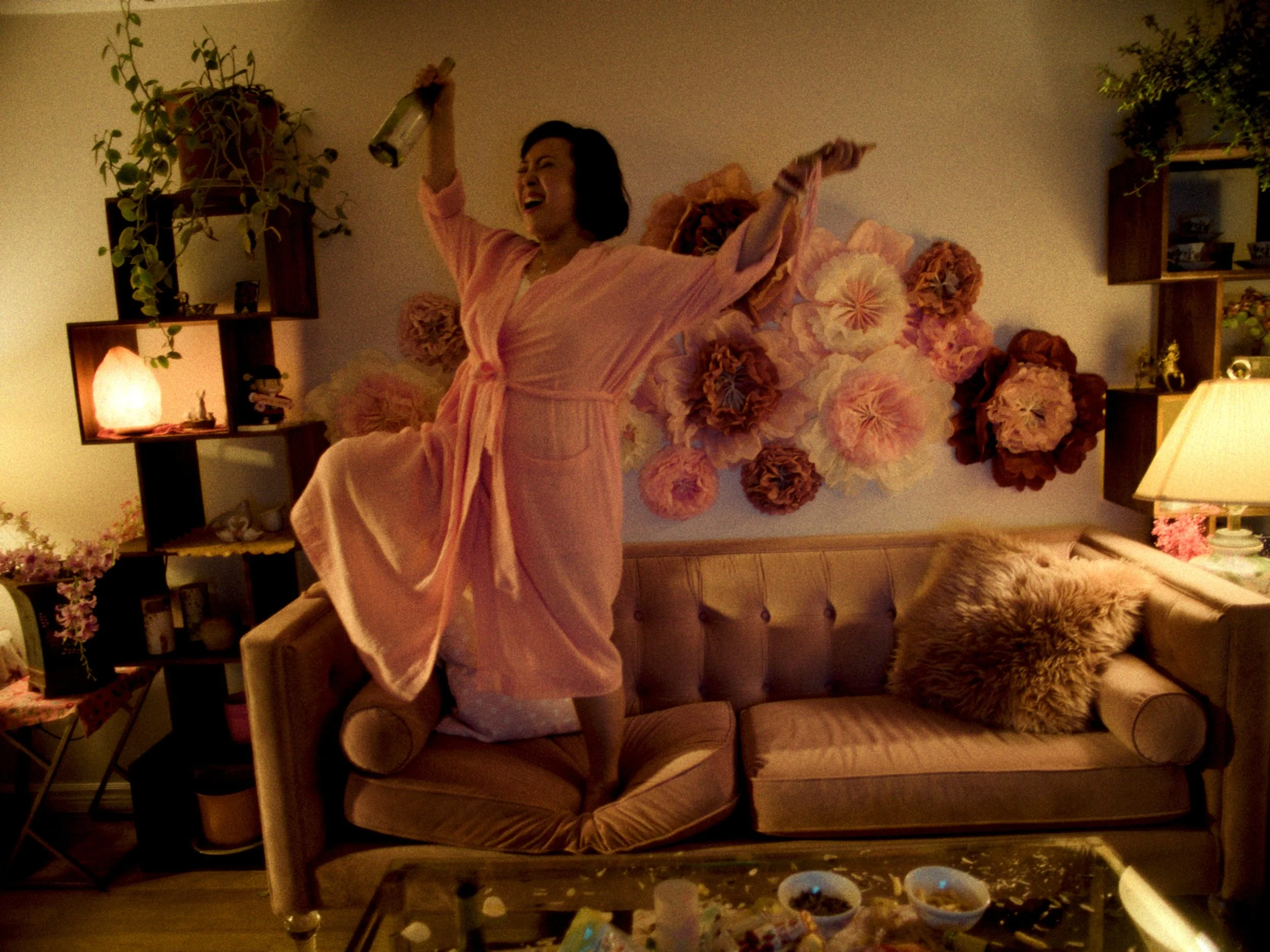
Harriet Yeung playing Eva in Finch & Midland.
Instead, this Hong Kong-Canadian co-production is an artful anthology film, a quartet of character studies from veteran Hong Kong actors (the film opened in Hong Kong last month.)
As the title suggests, Finch & Midland is set in a specific community: the Chinese-Canadian enclave in north Scarborough, home to two men and two women who left Hong Kong when they were young in the late eighties or nineties and are still struggling with loneliness and the burden of unfulfilled desires.
My Original-Cin.ca colleague Alice Shih reports that the original Chinese title literally translates as “We should be very happy today.” But the characters here aren’t happy, and there’s some real-world sociology that corroborates their mental health struggles.

In studies of Hong Kong immigrants both to Canada and the United Kingdom, respondents said that as well as taking cuts in pay and career changes, loneliness was a prime stressor in their lives.
Yeung was born in Toronto and has a film degree from the Singapore-based NYU Tisch School of the Arts Asia and has worked in both North America and Asia. His film feels steeped in Chinese art cinema’s themes of displacement and alienation, accentuated by the melancholy romanticism of the Cantapop soundtrack.
There’s even a teenaged boy (Jaden Kwan) in the film, who sneaks into a stranger’s home to vicariously experience their lives, recalling the clandestine occupant motif in the films of Taiwanese director Tsai Ming-Lang, cinema’s poet of loneliness.
Finch & Midland opens and concludes with an image of edge-of-town desolation, a nighttime shot of a man next to his car beneath one of the giant metal lattice hydro towers that are part of the Finch Hydro Corridor north of Toronto.

His name is Dan (Patrick Tam), and he used to be somebody, an Asian pop star in the late eighties. Dan kicks his car’s tire, then takes a red, sparkly jacket from the passenger seat, and walks past the garbage bins to the back entrance of a local banquet hall, where he emcees tour groups and weddings.
Otherwise, Dan drinks too much, and worries about connecting with his daughter, whose mother is now married to another man and will soon be leaving the country.
While faded pop star Dan is trapped in the past, Fan (Theresa Lee), a single mother of a smart, precocious adolescent daughter, is in the grip of future dreams. She works as a supermarket cashier by day, while masturbating strangers at a massage parlor at night for extra money. At the same time, she dreams about the life she will have when she wins her real estate license, motivated by the ads of a local real estate hustler.
Then there’s the irrepressible Eva (Harriet Yeung), unmarried, almost 50 and obliged to care for her bad-tempered chain-smoking mother (Nina Paw), who compares her daughter unfavourably to her absent brother. At her home, Eva fervently scans dating apps, drinks wine and dances alone. She lives on take-out food and is so desperate for love she frightens the pizza boy away.
The most conventionally successful of the four is “model citizen” Tony (Hong Kong star Anthony Wong of Hard Boiled and Internal Affairs fame). He’s a widower and factory foreman with a business degree who tries his best to fit in with the white employers by practicing golf at home.
Tony’s Chinese workers think he’s on their side, but his unctuous boss Michael (Dmitry Chepovetsky) uses him to hand them their pink slips, before eventually ending Tony’s own employment.
In a rare light-hearted scene, Tony recalls to a young CBC (Chinese-born Canadian) how, when he first came to Canada, he practiced half the night in the washroom how to order at McDonald’s so his son could get the Happy Meal with the free toy. (Wong earned a Best Supporting Actor nomination at Taiwan’s Golden Horse Awards for his performance here.)
Full credit is due to Yeung for a film filled with vivid performances and fluid, moody aesthetic, but with one reservation. The ending of Finch & Midland feels truncated rather than resolved. There are parallel culminating scenes of each of the characters, all of which involve a moment of physical touch. But we leave these four dreamers marooned between resignation and acceptance.
At best, they are a little wiser, if disillusionment is a form of wisdom.
Finch & Midland. Written and directed by Timothy Yeung. Starring Anthony Wong, Patrick Tam, Nina Paw, Harriet Yeung, Theresa Lee, Dmitry Chepovetsky and Jaden Kwan. In theatres February 13.