
"Wuthering Heights:" A Beautiful Brontë Adaptation, Stripped of Character Depth
By Karen Gordon
Rating: B
Oscar-winning writer/director Emerald Fennell’s “Wuthering Heights” is a visual stunner - the art direction, the set design, the cinematography, the haunting score and Celtic flavoured songs by Charlie XCX, the costumes, oh the costumes!
And then there’s the natural beauties: the Yorkshire location and the two leads, Margot Robbie and Jacob Elordi.
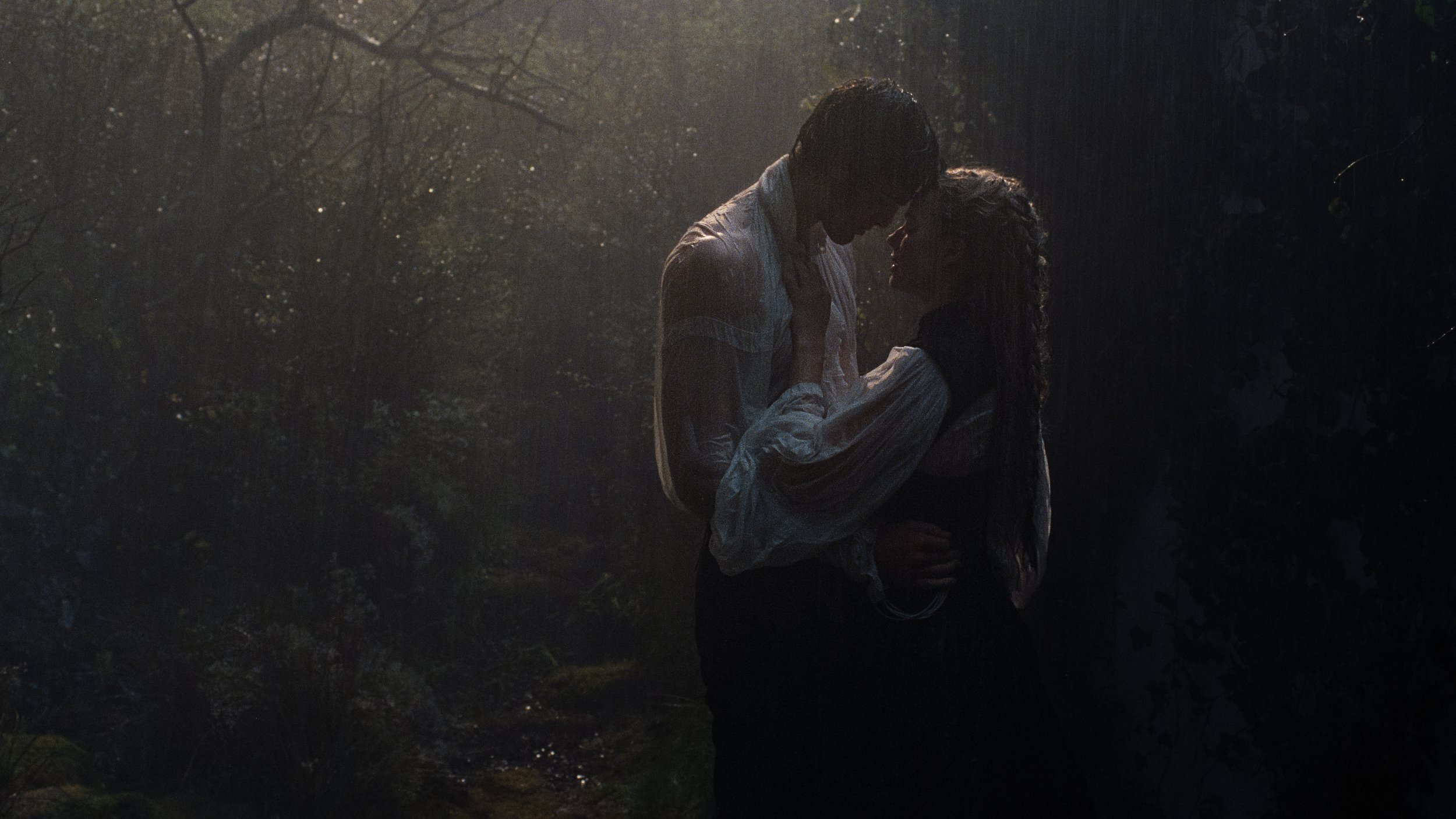
Heathcliff (Jacob Elordi) and Cathy (Margot Robbie) in love on the moors in Wuthering Heights.
Fennell is a brainy and deliberate filmmaker with a talent for conjuring mood and atmosphere. Her movies are always slightly subversive, beautiful to look at and entertaining at face value. They often deftly mix drama with moments of genuine humour. And there’s a darker undercurrent to her films, always something that might rattle you. Those elements are present here.
Wuthering Heights is a sensual feast. But, while there’s plenty to admire and lots of passion and heat, the film doesn’t quite add up in a way that brings the feels.
There’s yearning, desire, declarations of love, and of course passion and sex of various kinds, hinted at but never explicitly shown. But there’s something that’s missing. In a sense it’s a heavy breathing film about deep, irresistible passion that doesn’t completely connect us.
Some of the issues are down to down to the adaptation.
Fennell has been clear that this isn’t meant to be a faithful translation of Emily Brontë's timeless novel, but rather is based on what she personally likes about it. That’s why she uses quotation marks around the title. She's clear that she's not aiming to make a definitive modern adaptation.
Fair enough.

Based on what we see Fennell is anxious to get to what she clearly feels is the good stuff—the return of Heathcliff, and the unleashing of the passion between him and his beloved Cathy.
To do that, she’s dropped the narrator who frames the story, eliminated characters and left off the last quarter of the book. There are pros and cons to this, but, unless you’re a purist, none of these things are, on the surface, big problems.
What is problematic is that her adaptation has removed some of the connective tissue. We lose some of the information about who the characters are, and why they behave in certain ways, which makes some things feel a bit like they’ve come out of nowhere.
The film introduces us to young Cathy Earnshaw (Charlotte Mellington), a wild and somewhat untamable child, being tended to by Nelly, (Hong Chau). Her father Mr. Earnshaw (Martin Clunes) is a widower and a landowner. He’s also an abusive drunk with a gambling addiction.
Mr. Earnshaw comes home from a trip to Liverpool with a boy (Adolescence’s Owen Cooper), whom he’d found on the streets, impoverished and apparently unable to speak English. He presents him to Cathy as a “pet” for her, and of course a labourer on the property. She names him Heathcliff and they ultimately bond.
They grow up to be Robbie and Elordi, both beautiful, feisty, and aware of each other. But Earnshaw has run through the family’s money and their house is in terrible shape. So, when the beautiful Cathy gets a marriage proposal from their rich neighbour Edgar Linton, (Shazad Latif) who lives in a gorgeous mansion with his odd, childish sister Isabella (Alison Oliver), she takes it seriously.
Conflicted, she pours out her confusion to Nelly, including her confused feelings about Heathcliff. In the middle of the conversation she throws a cruel barb at Nelly which seems to come out of nowhere.
Heathcliff overhears a portion of the conversation where she appears to demean and dismiss him. He takes off without a word. Devastated. Cathy marries into the rich, comfortable, pampered but dull life, pushing her regrets down and accepting the quiet love of her doting husband. That choice, and the exchange with Nelly, will come back to haunt her.

Five years later, Heathcliff returns, in a fabulously romantic scene, emerging from the fog to meet Cathy on the moors where they ran free as children. He is now a rich and refined man, but, in many ways, neither are free. Time and distance have intensified the nature of their love, and resistance is futile.
As you’d expect, Elordi and Robbie are beautiful and deliver. But the script leaves some disconnects in the story itself that all of their star power can't completely overcome.
The stripped-down adaptation doesn’t give us enough of a sense of the characters. Cathy is supposed to be headstrong and untamable until she is given a quick look at refinement by the Linton family. But we don't see enough of how far that wildness goes in her to give us a sense of what's going on beneath the surface. There’s no real context for why she says something so cruel to Nelly.
Nelly’s role is underdeveloped so we have limited insight into her years-long processing of the insult. Healthcliff is meant to be unrefined and emotionally dysregulated with a simmering desire for revenge. But in this adaptation what we see is a man in control of himself.
To be fair, Fennell quite successfully uses the environment to give us a sense of some of the emotions. She has a vision for the world in which the characters move. Her film conjures a world of sensuality, where the corsets keep humans buttoned up, contrasted with the raw nature, the moors, the rain, the waves crashing, representing the uncontrollable nature of desire.
It's a visceral reminder that love of this intensity is a force of nature that pushes against the human will. When it is unleashed like this, it can't be contained. How can Cathy and Heathcliff resist when the natural world is pulsing all around them, mirroring their internal desires? These elements give the film a wonderful atmosphere.
Fennell has chosen to leave off the last quarter of the book, to focus on the relationship between Cathy and Heathcliff.
And while she's warned us that this isn't a definitive version, it arguably removes the mystical element that makes the book so powerful, and changes the nature of Bronte's Wuthering Heights. For many fans of the book, what makes it enduring is Cathy's ghost walking the moors, haunting Heathcliff who yearns to be with her. It speaks to the idea of soulmates, whose love is so powerful that not even death can separate them.
With that gone, the movie made me wonder why these two unconventional people, whose passion is so extreme, don’t behave in an unconventional way.
They're more modern than the Linton family, and deeply in love. So why don’t they just get on Heathcliff’s horse and ride off into the sunset together?
Wuthering Heights.” Written and directed by Emerald Fennell. Starring Margot Robbie, Jacob Elordi, Hong Chau, Charlotte Mellington, Owen Cooper, Shazad Latif, and Alison Oliver. In theatres February 13.