
Kokuho: Brotherly Rivalry in a Powerful Kabuki Epic
By Liam Lacey
Rating: A
Japan’s submission to the Oscars, and the bestselling live-action film in Japanese history, Kokuho — set in the world of modern-day kabuki theatre — is three hours long and truly remarkable.
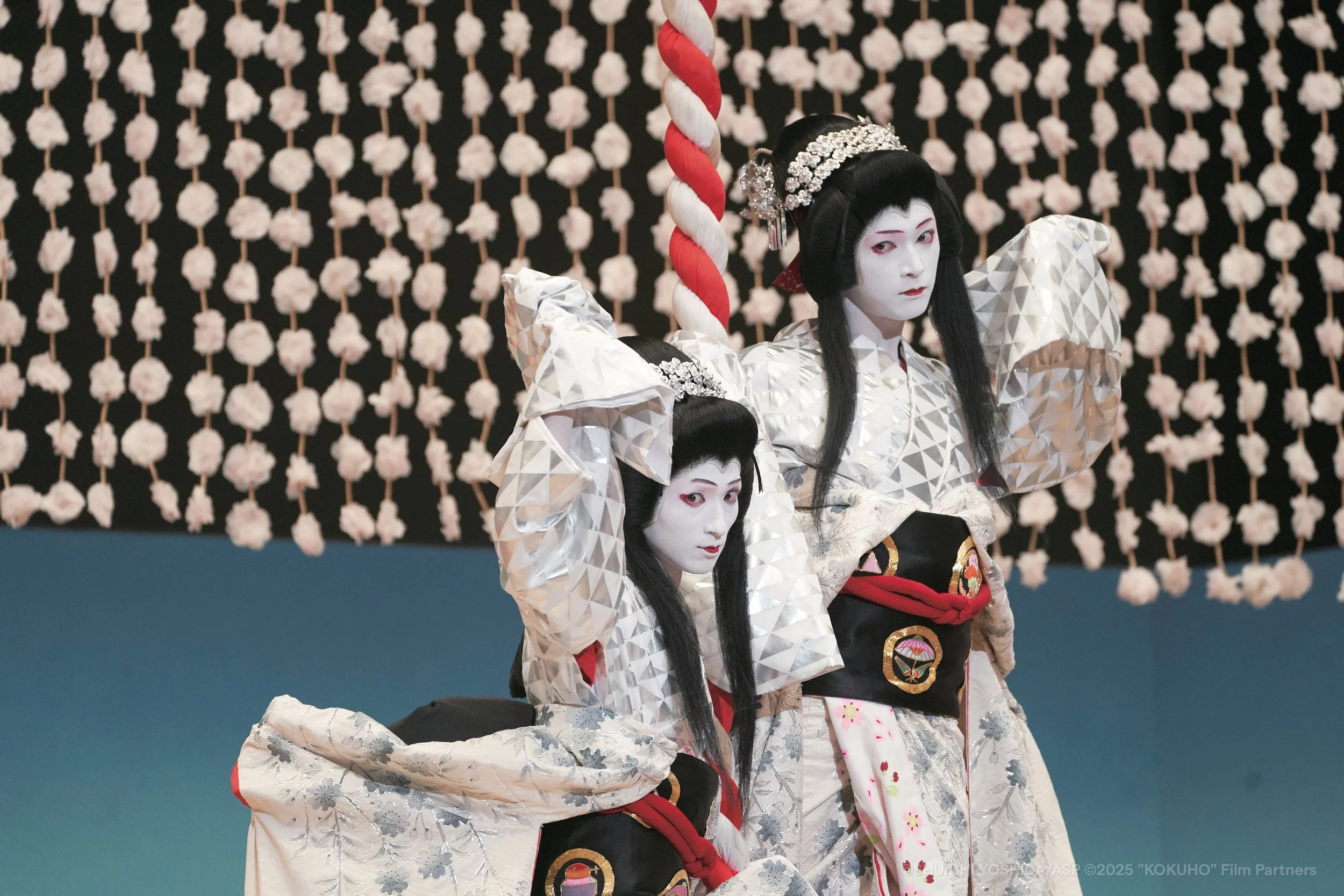
The story follows Kikuo, the son of a slain yakuza leader, who joins a legendary family-run kabuki troupe where he becomes the adoptive brother, friend, and rival of the troupe’s heir, Shunsuke, as they share the stage playing onnagata performances as female characters.
The film, which stretches from the early 1960s to 2014, is full of narrative loops following the vicissitudes of the two men’s lives, punctuated by a series of progressively more spectacular kabuki performance sequences.
The complex 400-year-old art form of kabuki, which prioritizes the skill of the performers more than the familiar narratives, includes singing, ritualistic staging, broadly gestural acting, emphatic facial expressions, gliding dances, twirls and frozen poses resembling woodblock paintings.
(Soviet filmmaker Sergei Einstein declared kabuki’s assembly of techniques “the acme of montage thinking.”)

Kokuho makes the performances accessible to non-Japanese audiences through onscreen text, which provide the title of such Japanese plays as “The Love Suicides of Sonezaki,” or “Heron Maiden” appears, alongside its English translation with a brief description of the story.
Kokuho, which translates as “national treasure,” is Japanese Korean director Sang il-Lee’s third adaptation of a novel by the prolific Shûichi Yoshida, following the crime dramas Villain and Rage.
The film is astutely cast, with Kikuo, played by Soya Kurokawa as a teen and Ryô Yoshizawa as an adult, and Shunsuke, played by pop idol Keitatsu Koshiyama as a teen, and a former pop singer Ryûsei Yokohama as an adult.
As a counterbalance to these androgynous male beauties, we have the gravitas of veteran Japanese star Ken Watanabe (Letters from Iwo Jima, The Last Samurai) as Hanjiro, a revered kabuki actor and head of the House of Tanban, a dynastic theatre troupe.
A dynamic opening sequence, set in a restaurant on New Year’s Eve in Nagasaki in 1964, kicks off the drama.
An actor, Hanjiro, is the obligatory guest of yakuza boss, Gongoro Tachibana (Masatoshi Nagase). There’s a small stage in the restaurant, where the boss’s 14-year-old son Kikuo performs in a kabuki scene, as a princess disguised as a courtesan acting out a kabuki scene on a small stage.
Shortly after the scene ends, the room erupts in violence in an ambush from a rival gang. The boy watches as his father is murdered.

A year later, Kikuo’s stepmother (Emma Miyazawa) sends him to Osaka to apprentice with Hanai, the current head of a renowned lineage of kabuki actors known as the House of Tanba-ya. Both Hanai’s wife, Sachiko (Shinobu Terajima) and teenaged son are skeptical of this junior thug in home.
Hanjiro, a tough, bordering-on-cruel coach, forces his son, Shunsuke, and adopted son, Kikuo, through daily rigorous body-wrenching exercises. He soon determines that the newcomer has a passion for theatre his own boy lacks.
There’s no question these boys are good-looking and, early on, a famous elderly onnagata, Mangiku (Min Tanaka) — an actor who is a designated “national treasure” — warns Kikuo that his beauty might get in the way of his art.
Watching the old man perform onstage is a revelation for Kikuo, cementing his commitment to reach “national treasure status.” That marks the end of the first section of the film, before we jump forward to 1972, where the adult actors replace the teens.
Shot by Sofian El Fani (Blue Is the Warmest Color), with vibrant production design by Yohei Taneda (Kill Bill: Vol. 1), Kokuho is a kaleidoscopic trip through the fashions and decor of the decades, marked by repeated mirrored images of the two men, performing together onstage, in the rice-flour make-up, speaking in the forced falsetto and moving with an exaggerated slow-motion delicacy, in freeze-frame poses.
Even background characters seem to glide across the stage on their knees.
Thematically, Kokuho evokes such classic Hollywood backstage films such as A Star Is Born or The Red Shoes, and themes about toxic fame and sacrifice along with the complication of inherited versus earned status.
At one point, Kikuo carries some of his yakuza father’s ruthlessness, loses his temper and assaults a businessman sponsor who predicts that a kabuki actor who is not part of a family destiny will never be accepted by the public.
Relations with Shunsuke grow increasingly strained when Hanjiro, after breaking his leg, picks Kikuo to take his place in the lead role. Years later, breaking tradition, he names Kikuo as his successor instead of his son.
Eventually, Kikuo’s longtime girlfriend Harue (Mitsuki Takahata) recognizes that his artistic ambition is all-consuming. There’s a powerful scene where she and Shunsuke watch Kikuo performs brilliantly in a play, and each recognize that night has changed all their relationships.
“I want to be a real actor, not a pretend one,” laments Shunsuke, and Harue’s consoling hug leads to the two leaving the theatre together, and later on to marriage.
Though Kikuo performs onstage with an exaggerated femininity, flesh and blood women aren’t that important to him. He romances one young woman because her father is wealthy and he has little contact with a daughter that he fathered with a geisha.
As a comeuppance for his misogyny, at a low point, he gets beaten by drunks at a bar, who were aroused by his performance and then enraged when they discover he’s a man.
As mentioned earlier, Kokuho is on the long side. The gender questions are open-ended and the sacrifices of the artist’s life familiar ground, but Kokuho truly comes alive in the performance sequences that evoke the deep roots of theatre, and the semaphore of emotions represented in gestures, poses, strange movements and painted faces that evoke feelings beyond words.
Kokuho. Directed by Sang-il Lee. Written by Satoko Okudera, based on the novel by Starring: Ryô Yoshizawa, Ryûsei Yokohama, Ken Watanabe, Soya Kurokawa and Keitatsu Koshiyama. In theatres February 20.