
Sway: A Contemporary Noir That Wields Words Like Weapons
By Thom Ernst
Rating: B
Sway opens like a punchline to a noir joke. A man wakes up on the balcony of his luxury condo in nothing but his underwear, arranged just carefully enough that, for a second, you half-expect him to start narrating from beyond the grave.
The film even toys with that idea—Sunset Boulevard, Double Indemnity, American Beauty—before the man stirs and ruins the fantasy. He’s not dead. He’s just waking up to the kind of morning that suggests the night before was a bad idea, possibly several bad ideas stacked on top of one another.
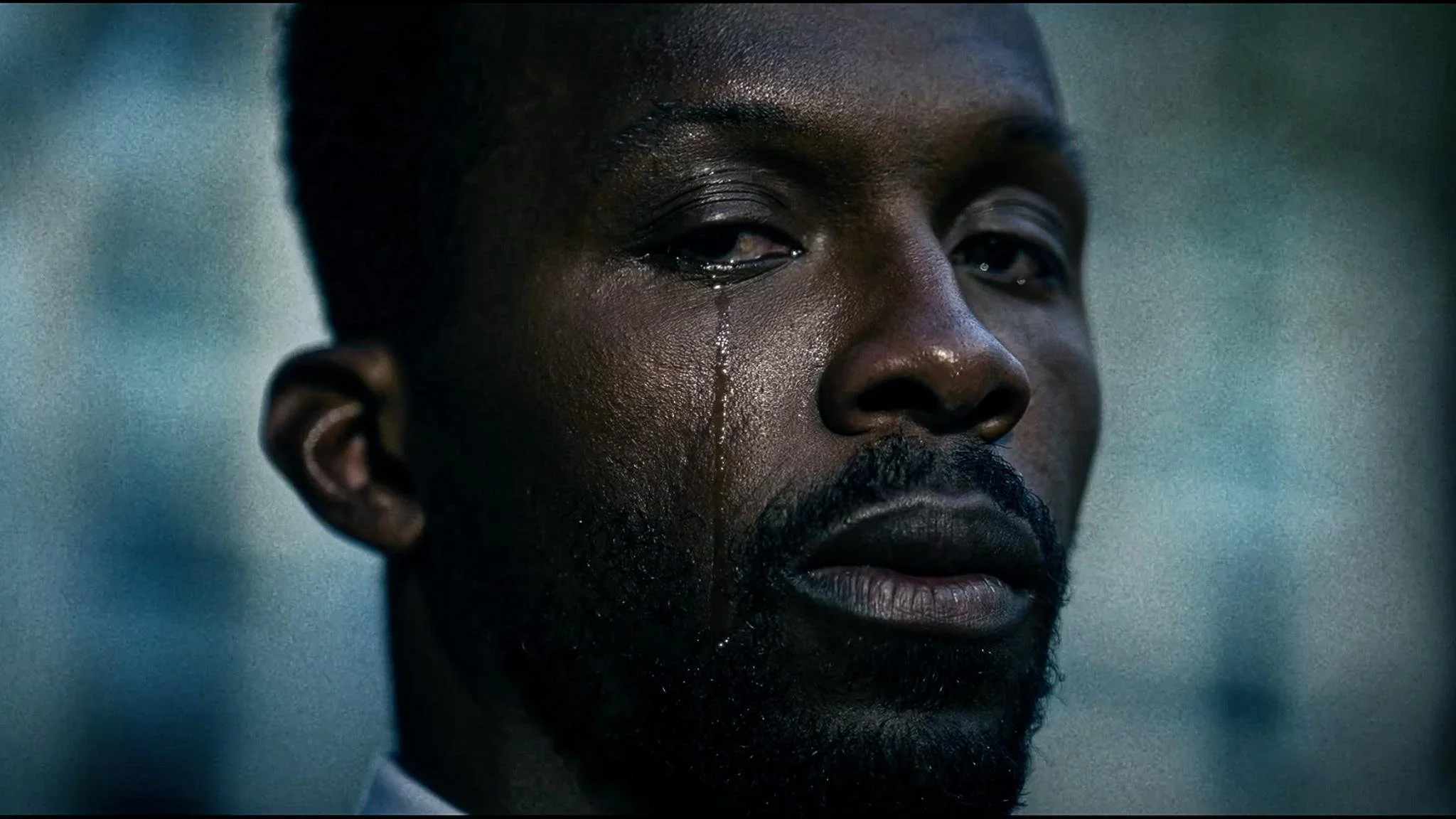
Emmanuel Kabongo in Sway
Things don’t improve much when he stumbles into the bedroom and finds a woman asleep in his bed. From there, Sway, directed by Charlie Hamilton and Zachary Ramelan, settles into a contemporary noir mode that understands two important things: confined spaces can be cinematic, and dialogue can be dangerous.
The Canadian film spends most of its time inside Sway’s penthouse condominium, and to the directors’ credit, the space never feels like a budgetary compromise. Rooms become pressure chambers. Hallways feel like trapdoors. Balconies suggest both escape and exposure. The setting tightens as the situation loosens.
Emmanuel Kabongo plays Sway, a successful entrepreneur and prominent Black community leader, a man fluent in public charm and private control. His brother, a pro football player riding the glow of a big win, has gone missing after a night of celebration that clearly slid off the rails.

This is already bad. It becomes worse when Sway learns about the disappearance mid-interview for a magazine profile—what should have been a soft-focus piece on leadership and community impact quietly mutating into something more interrogative, more pointed, and far less flattering.
Sway wants to be a noir where words replace weapons, and for the most part, that ambition pays off. The film’s tension comes less from what people do than from how they talk to each other.
Conversations function like camera moves—tightening, reframing, closing in. A smile lingers a beat too long. A question lands a little too precisely. It’s a clever trick, and while the film doesn’t always sustain that pressure as evenly as it might like, when it works, it works well. You find yourself leaning in, not because something is about to explode, but because someone is about to say the wrong thing.

Mishael Morgan plays Lisa, the journalist tasked with writing the profile, and she’s good at threading the needle between approachable and quietly predatory. Her questions begin gently enough, framed as curiosity, even admiration, before they start to carry real weight. There’s a low-key flirtation to the dynamic—more about power than romance—and Morgan plays that ambiguity nicely. She’s not there to destroy Sway, exactly, but she’s also not there to protect him. The interview becomes a subtle tug-of-war over narrative control: whose version of events gets to live on the page.
But the film’s real secret weapon is Lovell Adams-Gray as Richie, Sway’s man on the ground, the one who brings news from the streets and absorbs the fallout when that news isn’t what Sway wants to hear. Adams-Gray brings a warmth and groundedness to the role that the film badly needs.
Richie could easily have been written off as a functional side character—a messenger, a sounding board—but Adams-Gray gives him texture, intelligence, and an emotional life of his own. He takes the abuse Sway dishes out without turning Richie into a doormat. You get the sense that Richie understands the power dynamics at play, understands the cost of staying useful, and is quietly calculating his own position within them. It’s a performance that does more than the script strictly requires, and the film is better for it.
Sway is a smart, contained thriller with a social edge, even if it doesn’t always hit every note as sharply as it aims to. The noir trappings are sometimes more aesthetic than structural, and the film occasionally leans a little too hard on the idea that tight spaces automatically equal high tension.
Still, when the dialogue crackles and the performances carry the weight—particularly Adams-Gray’s—the film finds a compelling rhythm. It’s not a reinvention of noir, but it is a thoughtful, contemporary riff on the genre, one that understands that in 2026, the scariest thing in the room is often a well-phrased question and someone brave enough to ask it.
Sway . Directed by Charlie Hamilton and Zachary Ramelan. Starring Emmanuel Kabongo, Mishael Morgan, and Lovell Adams-Gray. In select theatres February 5, and now available on select streaming platforms.