
What Does That Nature Say to You: Hong Sang-soo’s Polite Cruelty
By Liam Lacey
Rating: A-
Korean director Hong Sang-soo proves it’s possible to produce work that’s good, fast, and cheap.
Beginning with his 1996 debut, The Day A Pig Fell into the Well, Hong has released 33 features, earning festival awards and international critical veneration. His films have an average budget of around $100,000, with Hong doing his own writing, directing, cinematography and composing, relying on a loose repertory company of naturalistic actors.
His latest, What Does That Nature Say to You, comes to theatres this Friday — and if you like this one, he has another film due out later this year, and yet another in post-production.
The catch is that Hong is sometimes described as one of those filmmakers like Eric Rohmer or Woody Allen: making variations on the same film. Hong’s films, set in realistic domestic settings, typically feature a blinkered, vain artist character, a romantic entanglement, an embarrassing drunk scene, long takes full of philosophical but realistic dialogue, and an overall tone that blends humour and melancholy, cringe comedy, and heartbreak.

“But to accuse Hong of repeating himself misses the point,” argued Denis Lim in a 2022 New Yorker essay. “Repetition in his films is both subject and structuring device, and, like any artist who works with this formal strategy, Hong finds meaning in the subtlest variations, coaxing compelling moral dramas from prosaic scenarios."
What Does That Nature Say to You checks the usual boxes, in eight untitled chapters that start slow, build to an emotional climax, and descend back to resonant after-effect.
In the film’s opening scene, Donghwa (Ha Seong-guk), a thirty-something self-described “poet” drives up to the end of a long drive to drop off his girlfriend, Jun-hee (Kang So-yi) at her parents’ home. Though the couple have been dating for three years, he has never met her parents and doesn’t intend to on this day either. But impressed and surprised by the grandeur of her family’s custom-designed home set against a mountain backdrop, he stops to check out the view and smoke a cigarette.

Unexpectedly, they run into Jun-hee’s handsome middle-aged dad, Oryeong (Kwon Hae-hyo) who could not be more welcoming. Oryeong expresses admiration for Donghwa’s 1996 Kia with its quaint cassette deck and asks if he can take it for a spin. Later, he offers Donghwa a tour of his grand garden and shots of his rice liquor supply before sending the younger man and Jun-hee out for lunch and a visit to a local temple.
They are accompanied by Jun-hee’s homebound older sister, Neung-hee (Park Mi-so) who, unlike her charming father, is disconcertingly blunt. She knows that Donghwa’s father is a famous and wealthy attorney.
Why, she asks, does Donghwa drive such an old heap? What does he actually do for a living instead of poetry? He admits he’s an assistant to a wedding videographer. Neung-hee’s questions needle Dongwa but he holds it together until dinnertime where he meets with the family’s impeccably gracious matriarch Sunhee (Cho Yun-hee), also a poet though wealthy enough not to need a job.
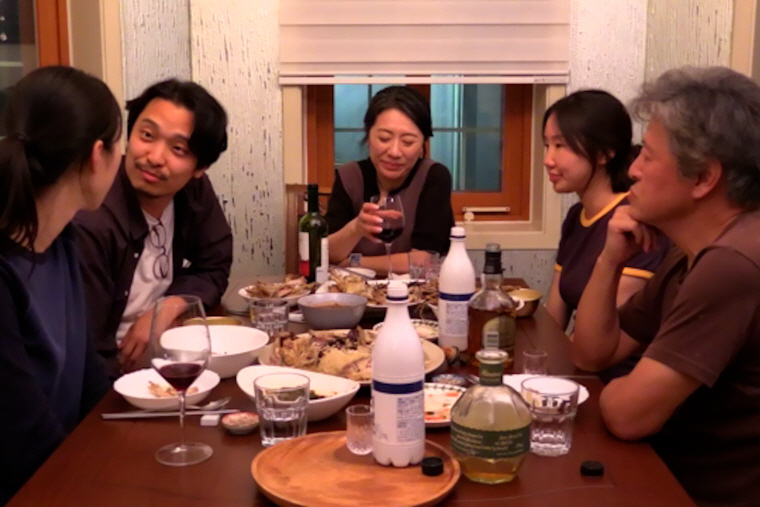
In the long single-take dinner scene, the conversation and drinks flow. Oryeong keeps filling Dongwa’s glass, following red wine with whisky. Predictably, Dongwa gets drunk and eventually loses it, verbally attacking the older sister for asking about his father.
After spoiling the dinner, he passes out and is put to bed. Later, Oreyong, quietly strumming a guitar while chatting to his wife, opines on the impracticality of poetry as a career and speculates that Donghwa is probably sexually obsessed.
What is “that nature” referred to in the title? Here is the part where Hong is a visual storyteller, not just a disciple of the dramatist Anton Chekhov, one of his acknowledged influences.
During a mid-dinner break, the family decides to walk up the mountain to see the sunset, which causes Donghwa to begin to attempt to wax poetic, as he did earlier when gazing at an ancient ginkgo tree. What we actually see looks slightly smudgy. The beautiful natural setting that Donghwa talks about is only fleetingly suggested on camera.
We learn, in passing, that Donghwa is shortsighted but too vain to wear glasses and the film’s low-resolution video conveys his myopia as a metaphor for his character flaw. It’s a bit of a stunt, though a clever one.
What Does That Nature Say to You concludes the morning after the dinner debacle, when Donghwa is literally wounded, with a bloody gash on his arm from a drunken fall during the night when he decided to go up the mountain to admire the moon. He says goodbye to Jun-hee, who is concerned about his injury but stiffens at his embrace, before he drives off. A few miles later, his car breaks down.
By the end, we have the sense of witnessing a blackly funny social encounter, but watched a heroic fable in reverse, in which the clueless Donghwa, instead of a hero-conquering the dragon and saving the princess, has been politely demolished, chewed up and spit back out.
What Does That Nature Say to You. Written and directed by Hong Sang-soo. Starring Ha Seong-guk, Kown Hae-hyo, Cho Yun-hee, Kang So-yi and Park Mi-so. Opens on the following dates in Canadian theatres: Montreal: Cinémathèque québécoise (March 20, 21, 22-25) and Cinéma Moderne (March 20, 21, 27); Québec City: Cinéma Beaumont (March 20, 21, 27); Vancouver: The Cinematèque (April 2,4,6); Toronto: TIFF Lightbox (April 2); Halifax (Carbon Arc, April 11,17); Toronto, Revue Cinema (April 17).