
Undertone: Placing Sound over Matter
By Thom Ernst
Rating: B+
There’s a particular confidence to Undertone that doesn’t announce itself with spectacle, but with restraint. It’s the confidence of a film that knows exactly how little it needs to show you in order to get under your skin.
Produced in part out of Black Fawn Films — one of Canada’s most reliable champions of the genre — Undertone feels like a natural evolution of that mandate: a Canadian horror film that trades in atmosphere over excess, suggestion over spectacle, and lingers long after it’s over.
It will likely be filed under “prestige horror,” that increasingly crowded shelf where films promise something more elevated than a body count. But unlike many that confuse ambiguity with depth, Undertone earns its unease.
It’s closer in spirit to The Wicker Man (the original, and shame on you if you thought otherwise) and The Blair Witch Project than anything built on jump scares. It’s a slow, deliberate tightening of dread that waits you out rather than chases you down.
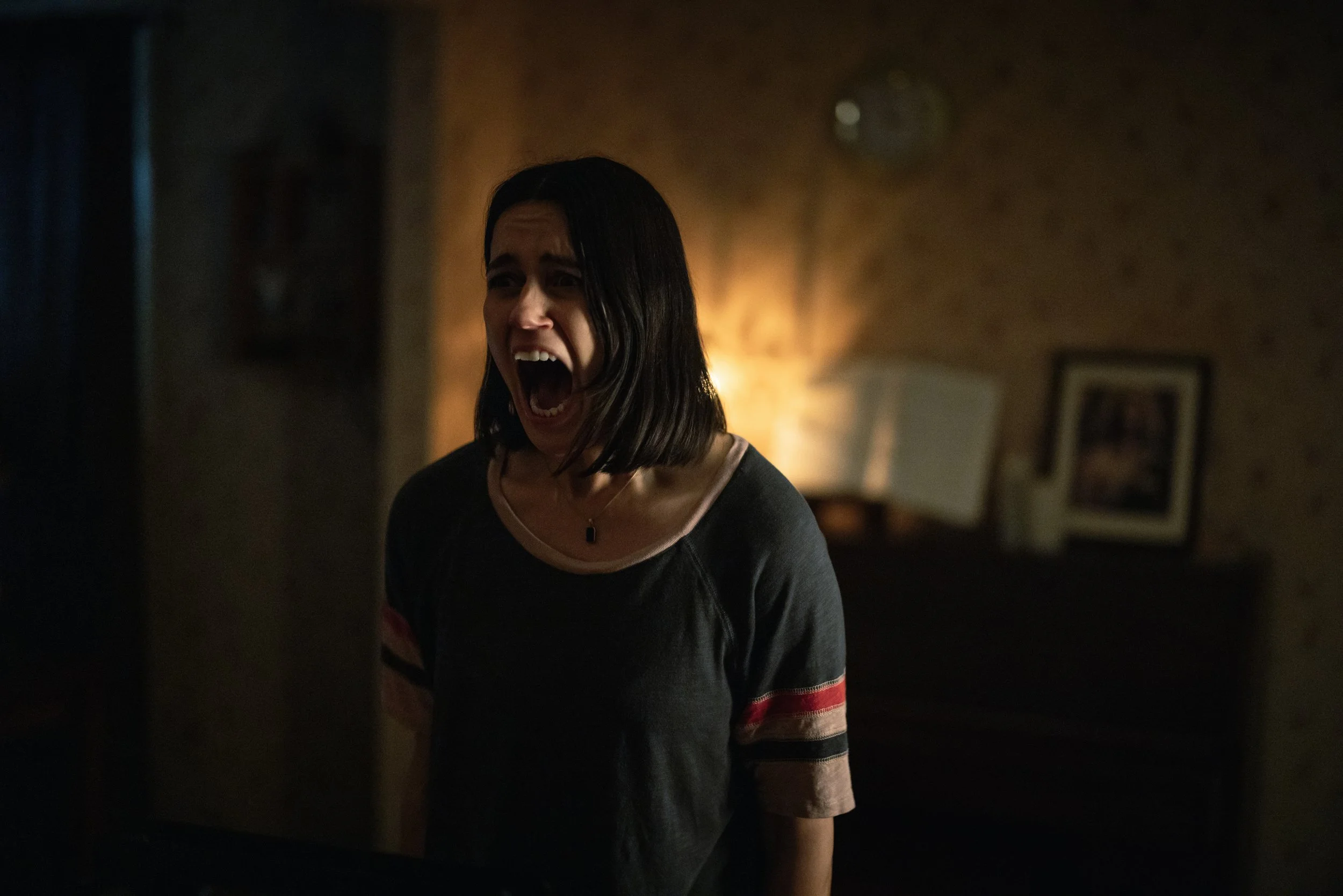
At the centre of it all is Evy (Canadian actor Nina Kiri, in what amounts to an almost one-woman performance) holding the film together with a performance that never overreaches. Kiri grounds Evy in intelligence and skepticism, which makes the slow erosion of her certainty all the more compelling to watch.

The setup is deceptively simple. Evy is a co-host of a paranormal podcast. Evy is one half of a dynamic built not on gendered friction but on belief versus skepticism. Evy is the skeptic. Logic is her shield, and she wears it defiantly.
She’s also alone in her childhood home, sitting vigil as her mother (Michèle Duquet) lies dying upstairs. “Mama,” as she calls her, has turned the house into something resembling a shrine with religious iconography crowding the walls.
Time seems stalled somewhere decades in the past. It’s less a home than a mausoleum with slightly better lighting. And at 3 am, when Evy tapes the podcast, even that feels negotiable.
Writer-director Ian Tuason, in his feature debut, makes sparseness feel like design rather than limitation. The film unfolds across a handful of rooms — a bedroom, a bathroom, a dining space — and features only two on-screen presences.

And yet, through voice, recording, and suggestion, the world feels populated. Conversations with Evy’s podcast partner Justin (Adam DiMarco), her drifting relationship with boyfriend Darren (Ryan Turner), and even a visiting nurse who is never fully seen, all carry the weight of fully realized characters.
But Undertone isn’t driven by what we see. It’s driven by what we hear.
The film leans hard — and effectively — into one of horror’s most reliable devices: the corruption of the familiar.
In this case, it’s the creeping unease of recorded sound. What begins as something almost playful — an audio tape of a husband, Mike (Jeff Yung) recording his wife Jessa (Keana Lyn Bastidas) talking in her sleep — mutates into something far more sinister.
The voices on those tapes don’t escalate so much as shift, moving from the benign to the uncanny to something that feels deeply, disturbingly wrong.
Tuason understands the power of the “creepy children’s song” trope — the way innocence, once distorted, becomes unbearable. There’s a musicality to the horror here, a rhythm that unsettles. It’s not loud. It doesn’t need to be. It gets in quietly and stays.
What’s most impressive is how confidently the film sidesteps the traditional “show-don’t-tell” rule. Undertone tells, and in doing so, lets your imagination do the heavy lifting. The result is a film where the tension accumulates in the mind rather than on the screen.
Undertone is a reminder that horror doesn’t need to be loud to be effective. Sometimes it just needs the audience to be patient. And sometimes, the scariest thing isn’t what you see.
It’s what you can’t unhear.
Undertone. Directed and written by Ian Tuason. Starring Nina Kiri, Michèle Duquet and featuring the voices of Adam DiMarco, Ryan Turner, Jeff Yung and Keana Lyn Bastidas. Now playing.