
The Canadian Film Fest at 20: Organ Transplants, Bearded Women, and One Trauma After Another!
By Liam Lacey
“Eyeballs Up!” is the motto for the 20th annual Canadian Film Festival, this year happening at Toronto’s Scotiabank Theatre March 24 through 29.
It’s a clever wordplay on the patriotic “elbows up” slogan. Problematically, it immediately evokes the image from Stanley Kubrick’s Clockwork Orange of Alex (Malcolm McDowell) strapped to a chair with clamps on his eyelids, forced to stare at stomach-turning violent movies as a form of aversion therapy.
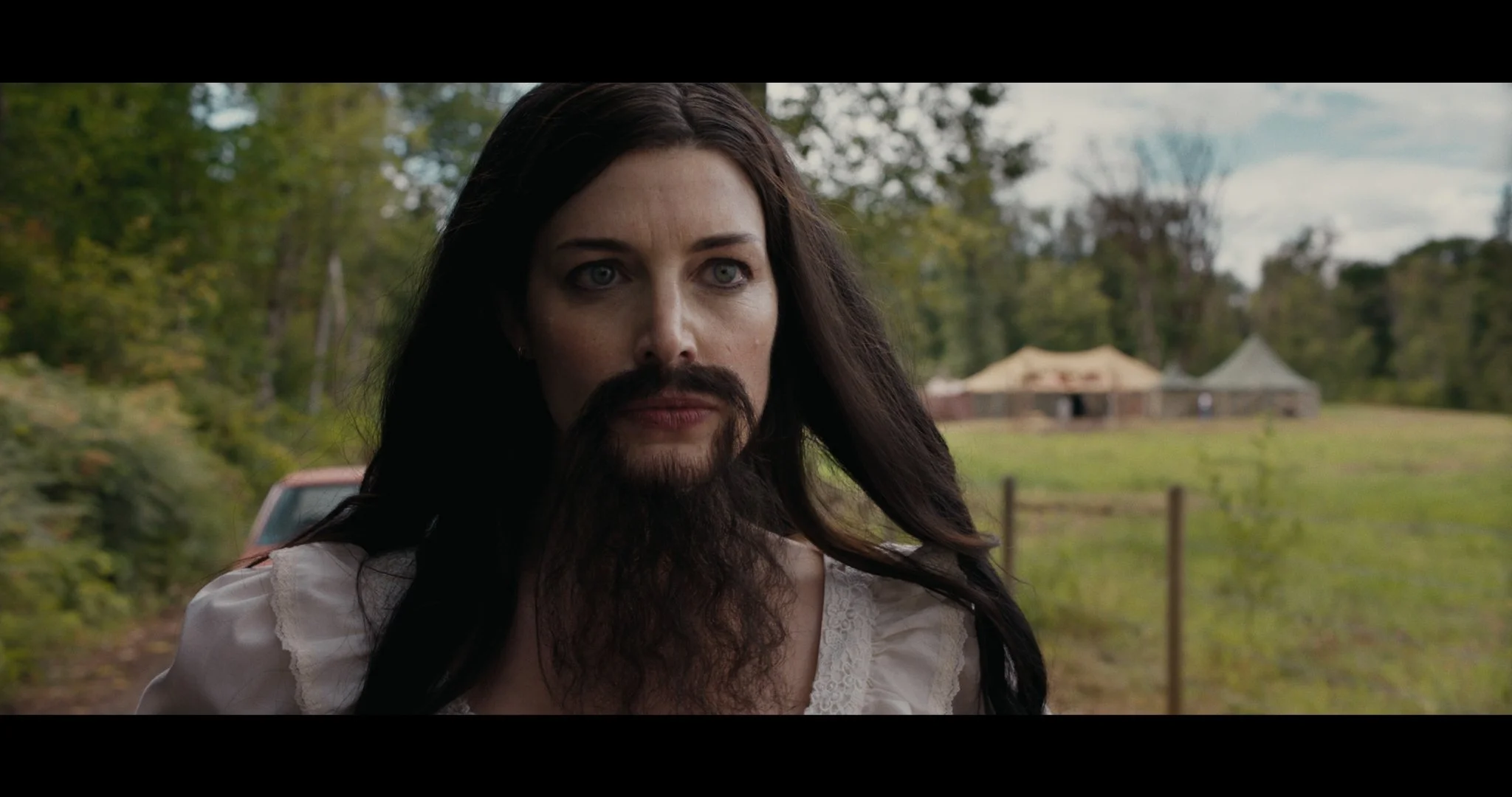
A scene from The Bearded Girl
Change the phrase “aversion therapy” to “immersion therapy” and you catch something of the distinctly therapeutic trend of this year’s 16 feature films as well as its 40 shorts. There are also industry programs over its six days.
The rise of the trauma drama is not a uniquely Canadian trend but saturates the moving-image world in this post-#MeToo, post-COVID era, when audiences seek PTSD remedy from fictional movies and find mindless escapism in reality television. For a complete lineup of films and ticket information, go to the Canadian Film Festival website.
Here’s a quick critical guide to the 16 feature films.
Plan C (director Scott Anthony Cavalheiro), Tuesday, March 24, 7 pm.
“We got a narrow fucking window and a long-ass drive,” declares Claire (Claire Cavalheiro) in Plan C, a pedal-to-the-metal thriller, the debut feature from her spouse and producing partner, Scott Anthony Cavalheiro. Claire is on the road to save the life of her older brother (Daniel De Santo) by means of an extra-legal organ transplant. The film includes Vivica A. Fox as an annoyed nurse who gets taken hostage, dialogue full of F-bombs, and a plot that has more twists than a small intestine. Recommendation: Eat before, rather than after, the screening.
It Comes in Waves (director Fitch Jean), Wednesday, March 25, 3:30 pm.
The debut feature by Fitch Jean explores the multiple psychological after-effects of the 1994 Rwandan genocide on one refugee family living in Ottawa. While there’s a catalogue of family and community woes depicted here, the film holds together with its convincing performances, led by Adrian Walters as 17-year-old high school track star Akai, who finds himself obliged to care for his younger sister. At Toronto’s Reelworld Film Festival, the film won five awards, including best feature.
Mihnea (directed by Mike Doaga), Wednesday, March 25, 6:30 pm.
Here’s another immigrant story, this time about a Romanian Canadian university student, Mike (played by director Mike Doaga) whose father is pushing him to go to medical school as he works as a driver at his dad’s car service. The overbearing immigrant patriarch, the intergenerational mental health issues, and a tidy resolution feel conventional, but the central character is an original — sweet, awkward, and self-contradictory enough to be interesting.
James (director Max Train), Wednesday, March 25, 9 pm.
In a refreshing break from the trend toward excessive backstory, the character of James (co-writer Dylan Beatch) offers no explanation for his hard-drinking, street-fighting, bad-tempered behaviour before the discovery of a junk-heap bicycle frame becomes his vehicle back to a purposeful existence. Max Train’s debut feature, shot in black and white in downtown Vancouver and full of deadpan humour and stealth cinematic sophistication, is a punk homage to Vittorio de Sica’s 1948 neorealist classic, The Bicycle Thieves. The film won Best Film and the Audience Award at the Oldenburg Film Festival, and Best Debut Feature at Raindance.

Nesting (director Chloé Cinq-Mars), Friday, March 26, 1:45 pm.
Quebec director Chloé Cinq-Mars’ Nesting follows the trend toward recent films of post-partum derangement (Die My Love, If I Had Legs I’d Kick You, Night Bitch). Here, new mother Pénélope (Rose-Marie Perreault) witnesses a variety store robbery that triggers memories of the death of her younger sister years before in flashbacks and hallucinations that veer into stylishly bewildering horror territory. Nesting won the Best Canadian Director Award at the 2025 Fantasia festival.
#Vanlife (director Trevor Cameron), Friday, March 26, 7 pm.
Carlsen (Justin Derickson) and Vanessa (Dakota Ray Hebert), a pair of nomadic YouTube influencers, meet up with the wrong sort of strangers in Trevor Cameron’s genre-mixing comedy-horror film mixed with family trauma and Indigenous history. A runaway plot is held together by lively performances, with Tahmoh Penikett and Michelle Thrush as members of a sinister cult.
Hangashore (director John Oakey), Friday, March 26, 9:30 pm.
This Newfoundland-set drama mixes working-class realism with a gothic survivalist drama. The framing story sees Icelandic artist Vera (Hera Hilmar) travelling to a Newfoundland village in search of the spirit of her father. There she begins a relationship with brooding seal hunter Jack (James Frecheville), who has a decrepit boat and a dangerous crewmate (Stephen Oates). Ace work from cinematographer James Klopko (The Sleeping Giant) alternates between fog-bound claustrophobia and epic landscapes, as the film grows increasingly abstract in the final third.
What Comes Next (director Alex Caulfield), Friday, March 27, 4:30 pm.
This observational, sexual coming-of-age drama follows teenage Tanya (Alison Thornton) who, egged on by her polyamorous girlfriend, starts a summer affair with a handsome middle-aged Grant (Aaron Ashmore) who — unbeknownst to her — was once her mother’s extra-marital lover. Meanwhile, Tanya’s younger sister endures a far worse experience in the pursuit of sexual knowledge. Meaningful subtext note: Mom, who is on the verge of a divorce from Tanya’s angry dad, is played by Mena Suvari, coincidentally the underage object of Kevin Spacey’s pervy attention in American Beauty.
Best Boy (director Jesse Noah Klein), Friday, March 27, 7 pm.
Funerals, family reunions, and the reading of wills are stock elements in dramas, raised to a boil in Jesse Noah Klein’s new psychodrama, evocative of the family-unfriendly films of Luis Buñuel or, more recently, Yorgos Lanthimos. Three adult siblings — Philip (Caroline Dhavernas), Lawrence (Aaron Abrams), and Eli (Marc Bendavid) — retire to a family cabin with their mother Anne (Lise Roy) after their father’s funeral. There, to gain their inheritance, they engage in an absurd tournament created by the mean old man years before, involving pointless physical challenges and ritual humiliations. Everything here — from cinematography to music clues and spin-on-a-dime performances — feels precisely calculated and wildly over-the-top.

Lucid (directors Deanna Milligan, Ramsey Fendall), Friday, March 27, 9:30 pm.
The winner of the audience award at this year’s Victoria Film Festival follows art student Mia (dynamo Caitlin Acken Taylor) who is suffering from a creative block which will cause her to be kicked out of school if she can’t complete her self-portrait project. A local drag-queen/witch provides her with a magic pill called Lucid, which will unlock Mia’s frozen past, revealing dream-hallucinations of scary monsters, blocked memories, and eventual emotional liberation. Lucid parodies everything from artspeak clichés to New Age woo-woo and, while it has a bit too much of everything, a lot of it is pretty funny.
A Breed Apart (directors Adam Belanger, David Lafontaine), Saturday, March 28, 3 pm.
Suggestive of meditative period dramas such as Kelly Reichardt’s First Cow or Clint Bentley’s Train Dreams, Adam Belanger and David Lafontaine’s A Breed Apart is an elegantly crafted pioneer story — set in Ontario in the 1850s — about grief, fathers and sons, golden sunlight and Hereford cows. English farmer Sidney Tomkins (Joshua Close) struggles to connect with his nine-year-old son, Emmet (Isaac Highams) after the death of his wife, but gets help from friendly neighbours the Penders. The humour, like fine wine, is rare and dry. Mrs. Pender: “Emmet, do you know the book of Job?” Emmet: “No.” Mrs. Pender: “Well then, we’re in for a treat today!”
Akashi (director Mayumi Yoshida), Saturday, March 28, 6 pm.
A Japanese artist, played by writer-director Mayumi Yoshida, returns to Tokyo from Canada for her grandmother’s funeral, learns some family secrets, and meets with an old lover. The influence of director Yoshiru Ozu hovers over this marital infidelity drama, mostly shot in black and white, with frequent use of the Japanese master’s trademark seated “tatami” shots and tone of anguished restraint, juxtaposed with the film’s looser, romantic impulses. In any case, it’s a crowd-pleaser: Yoshida’s autobiographically inspired story has won awards at film festivals in Toronto, Whistler, and Vancouver
Ballistic (director Chad Faust), Saturday, March 28, 9 pm.
The plot follows the quest of a grieving mother (a progressively more intense performance from English actor Lena Headey) on a round of confrontations seeking to discover if the bullet that killed her son in Afghanistan was made in the munitions factory where she works. Though the story about the trauma of war and guns could have easily been set in Canada, it’s set in the American northeast, where the market for guns, war, and movies on these subjects is greater.
A Farewell to Youth (director Adam Jack), Sunday, March 29, 2 pm.
A busy Judd Apatow-style dramedy about late-maturing man-child Jack (director-writer Adam Jack), who discovers himself caring for a teenage daughter who’s expecting a baby. If the plot elements feel contrived, the characters are warmly imagined. The best scenes involve the verbal banter between Jack and his best friend Matty (Matty Cardarople), a standup comic-turned-drama schoolteacher, feeling the pressure of impending fatherhood and disappearing youth.
Los Ríos (directors Ryan Fyfe-Brown, Dale Bailey), Sunday, March 29, 5 pm.
The only documentary among this year’s features sees filmmakers Ryan Fyfe-Brown and Dale Bailey travelling with a Honduran mother and her three children in the notorious “caravan” of refugees that Donald Trump demonized in his 2019 election campaign. The technique here is simple but effective, as the film filters in radio and television pundits from around the world from different political perspectives, contrasted with the practical human struggles of the mother and children on the ground, fleeing from violence to an uncertain future.
The Bearded Girl (director Jody Wilson), Sunday, March 29, 7:30 pm.
A theatrical parable about gender differences, The Bearded Girl follows a young woman (Anwen O’Driscoll) who runs away from the circus to join the local rubes rather than inherit the bearded lady role from her overbearing mother (Jessica Paré). The fly-your-freak-flag message is a bit muddled — the circus feels more like a dynastic cult than a place of free expression — but production values and costumes are inventive, especially the women’s beards. Paré’s sports a full-on Jason Mamoa-style bush, while O’Driscoll’s is more of an executive-appropriate length. Could this catch on?