
The Dinosaurs: Spielberg Goes Genuinely Jurassic with Delightful Documentary Series
By Karen Gordon
Rating: A-
Even if you don’t know your Jurassic from your Triassic, anyone — child or adult — who is dinosaur-curious will enjoy the informative and delightful new Netflix four-part series, The Dinosaurs. This might be your next cuddle-on-the-couch-and-chill experience.
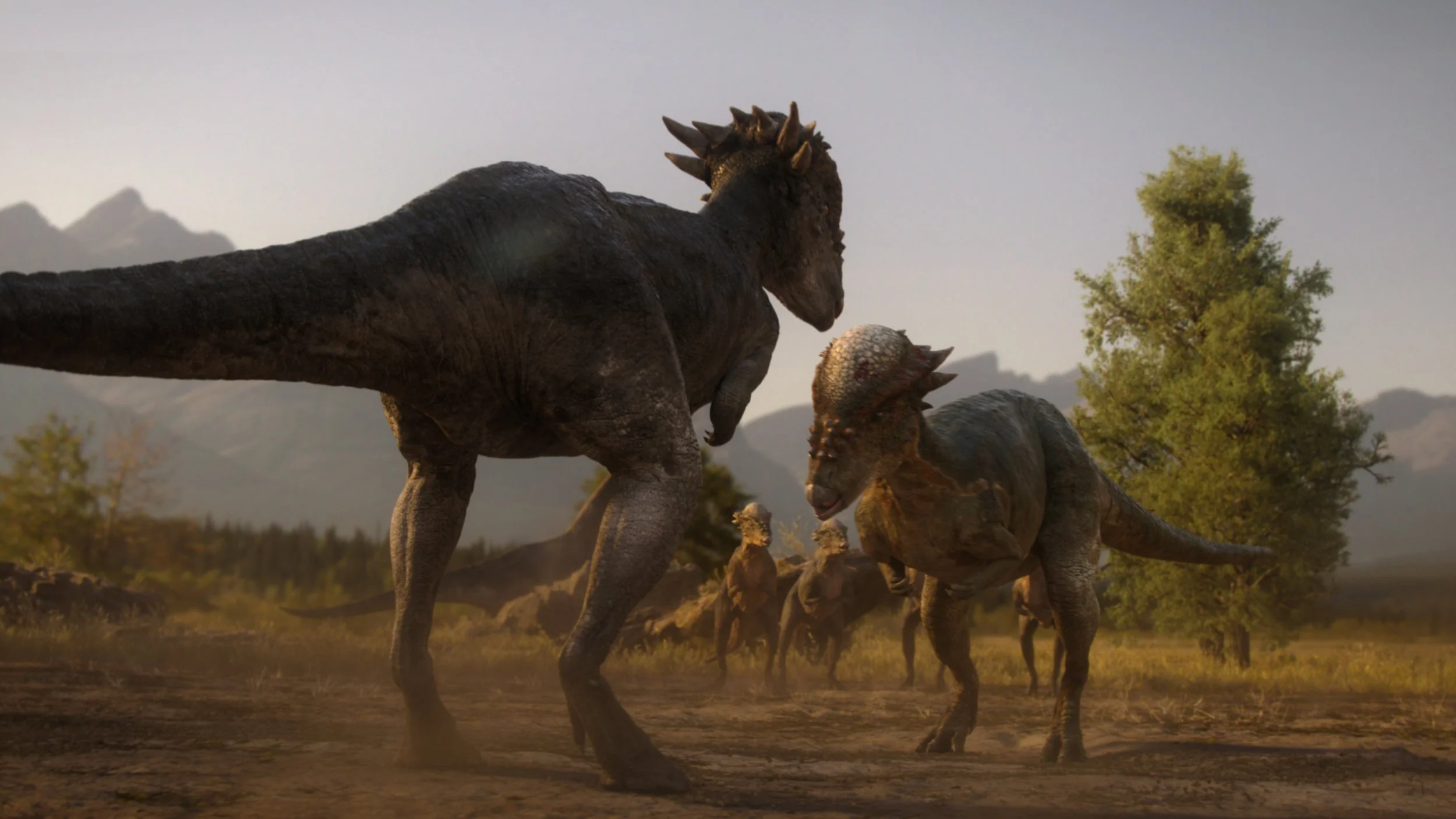
Netflix describes it as “an epic journey into a lost world,” and try as I might, I don't think there's a better way of describing it.
The series is executive produced by Steven Spielberg, Amblin Studios, Silverback Films, and Industrial Light and Magic, and directed by Nick Shoolingin-Jordan and his team (Life on Our Planet). It traces the story of the dinosaurs through hundreds of millions of years of evolution — theirs and our planet’s.
The Dinosaurs is fascinating and factually rich with wonderful visuals. The series moves at an easy pace, voiced by the great Morgan Freeman whose reassuring, honeyed tones guide us through the series. Natural history never sounded so good.

We are living in what is considered a “golden age of fossil discovery.” Technological advances have given palaeontologists a massive advantage over their predecessors.
They are finding more, often well-preserved fossils in locations and are able to go deeper with their investigations, giving us a better idea of who they were, and how they lived, what they ate, how they mated, what their territory looked like, and how they died.
This has shaped the storytelling in The Dinosaurs, which turns those fossils and what we know about their life cycles into a dynamic series that gives us a taste of what our world probably looked like when dinosaurs had the run of the place. And thanks to the wizards at ILM, our Earth comes vibrantly to life, along with its reptilian and dinosaur inhabitants.

From tiny dinosaurs about the size of a mouse to the giants, the creatures snarl, growl, squeak, chirp, and hum their way through the series, which in various episodes cover the terrestrial dinosaurs species, those that developed in the oceans including the deadly pliosaurs, and the terrifying pterosaurs that swooped down on their prey from the skies.
Along the way, physical changes in our ever-evolving planet make changes, sometimes major, that affect the development of various species, like massive volcanic activity that poisoned the air. Or an early frigid winter that caught the entire species by surprise, causing their deaths. Those same conditions enhanced the world for the feathered Yutyrannus, a.k.a. the Snow King, an early cousin of T-Rex.
The series starts us off in the Triassic Period, 235 million years ago, when Earth looked more like the surface of Mars. This was the age of the reptiles, some terrifyingly huge giants. At this moment in history, the first known ancestor of the dinosaurs was the size of a medium-sized bird. As the episode unfolds, Earth changes begin to shape and reshape the planet’s giant continent Pangea with lush green forests.
Life begins to flourish, setting the stage for the dinosaurs to begin to evolve. Some stay small, but in this period we see the rise of the giants, chowing down on tons of leafy vegetation every day. Millions of years go by in this age of the reptiles, but then comes a massive natural disaster known as the end Triassic mass extinction. And the dinosaurs survive.
For them, the best has just begun. Next up, in episode two, is the Jurassic period.
Well-structured, cleverly written, accessible, and entertaining, The Dinosaurs focuses on engaging storytelling without compromising the science.
For the dino-curious, it’s very rewarding. And so engaging that it might just inspire some young viewers to want to learn more about the things that shaped and continue to shape our planet.
The Dinosaurs. Now streaming on Netflix.