
Original-Cin Chat: Little Lorraine's Sean Astin on Why He's a Professional Good Guy
By John Kirk
If life always turned according to plan, we wouldn't need each other so much.
This is a collective instinct most keenly felt by small communities. Which is why Little Lorraine, (directed by Andy Hines, starring Stephen Amell, Matt Walsh, Rhys Darby, et. al.) is a poignant film about desperate men in a Cape Breton village falling afoul of the law after disaster closes the local mine. (The movie opens in Canadian theatres Friday, April 17.)
The community’s reaction reminds us of this real connection with each other and touches us deeply.
Original-Cin was lucky to sit down with Sean Astin, who plays the local priest, Father Williams in the film, to talk more about the film, that premiered at TIFF 2025.
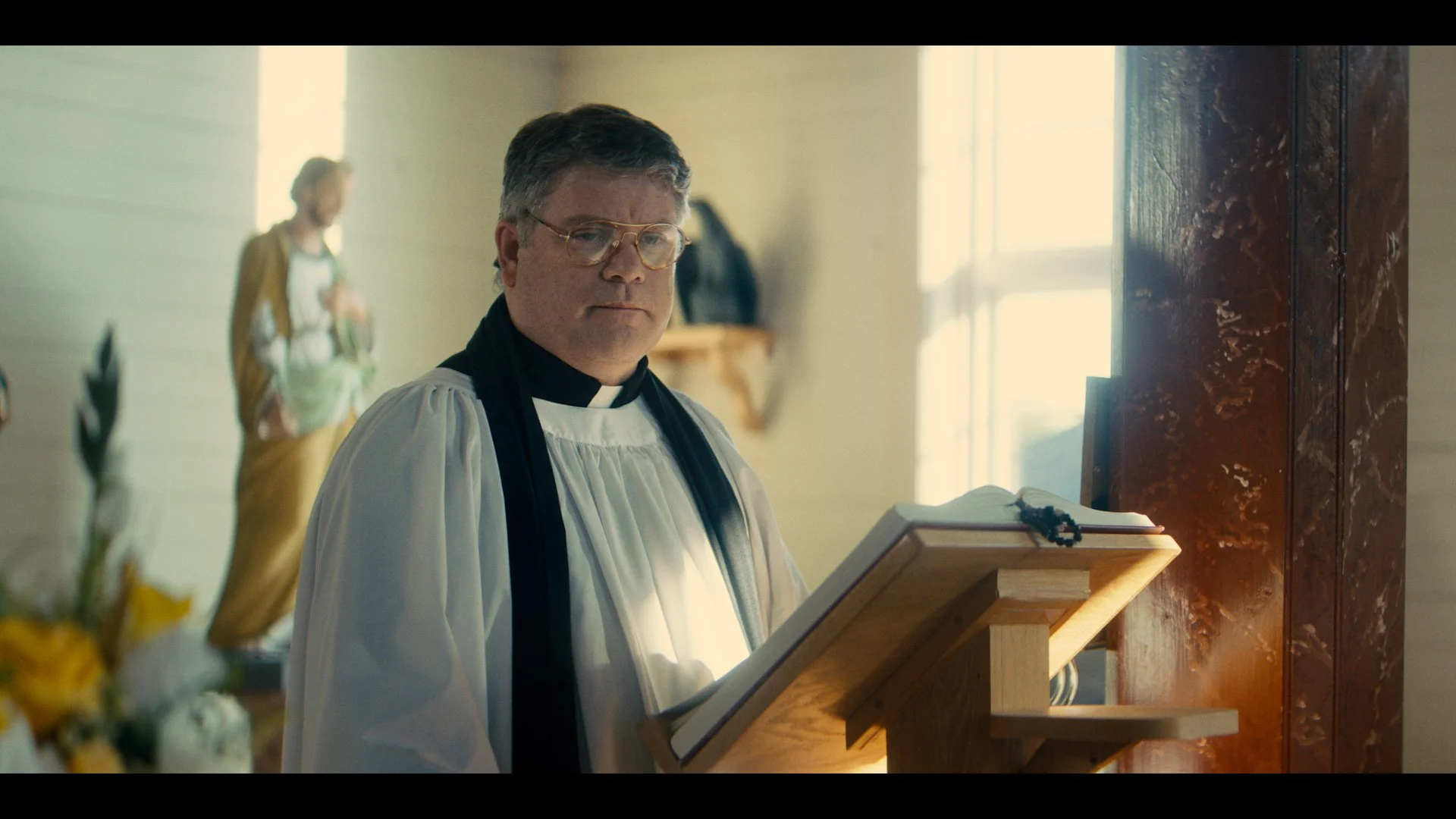
Sean Astin as Father Williams in Little Lorraine
"My agent is trying to find me a bad guy part. We can’t find the right one." He joked.
Sean Astin as a villain just wouldn't work. He's been so many trusted and beloved characters - Sam Gamgee, Rudy, and poor Bob from Stranger Things come to mind - it's only natural to see him in the role of someone who cares for others.
Sean has said in the past that he has been grateful to have roles that have “showcased the good in him.” We asked how he found this one.
“I don’t have any expectations of my roles. It’s not really been the way my career has played out. I’ve been with my agent and manager for decades now. When they send me something, I’m like tabula rasa. They will push me if they have an affinity for it.”
In other words, seeing the good in him.
“My relationship with this movie starts and ends with the way the world impacted with me. It’s the setting.”
By “world,” Sean is talking about the small mining community of Little Lorraine, Nova Scotia in 1986. It’s a small community that currently has a population of 62 people, according to Wikipedia, but as there were no proper census records for it in 1986, who knows what the population was? However, one thing for sure is that they had to have been close and the catholic priest knew every one of them.
“The priest is a tone in the community. When the movie takes off, these people have all been in that noise before: grief. They all know grieving and It’s a mining town and a community. In that noise, the priest is a tone of calm, a steady hand dealing with those moments for them.”
The role of the local priest is a common one, to be sure, but it’s one that is recognizable. It’s a trusted source of connection, especially in small communities like the one we see in this film. Instantly, we know to trust him.
“As a Catholic, I think I’m mindful of Catholic influences. Tolkien was a Catholic, Rudy was in a Catholic home. My Mum died in 2016 and the priest was doing rounds in the hospital late at night. And she was scared of the priest coming in to do last rites.
“My step-dad and I flagged him down before he walked in there. She was dying and the priest was struggling, but he was balancing his beliefs with the comfort of the family. You could see it in his face.”
A difficult story to relate but Sean continued.
“She grew weak. The priest went in and took her arm. He started to say ‘Anna – I’m going to …’, but as soon as he started talking, she was gone. So, he did the last rites and blessed her.
“It was quiet and I looked at my step-dad and I said: ‘We’re not alone right now.’ I looked at the priest and he nodded but I was sure that the presence of the priest allowed for that moment. When we think of priests and all the drama and stuff, we forget about that place, that role they have to comfort the community.”
The key to understanding the power and poignancy in this film is understanding the close ties of community kinship. There’s a darkness in the story that can only be justified by those who have that value, that understanding of it and its importance. Sean gets that. When you think of the roles he has had in the past, it makes sense that he should appear in this one.

But what is needed in those moments of darkness?
“I think calm and confidence. When you lose someone, it’s un-nerving. It happens in this community (in the film) over and over again. It’s a mining town. But the comfort of being told that God is here with you is so important.
“There’s nothing worse than being in shock. You’re not sure who to talk to, you don’t know where to sit, or what to even do. But the priest’s job in this story is to reflect spiritual calm. It’s such a simple thing but so important.”
While Father Williams is a background character, he is an authentic one. He belongs there and like the majority of Astin’s roles, he is needed. That authenticity is a hallmark of Sean’s acting and we talked about how that was needed in this story.
“My knack for being authentic in new settings is part of that. Even when I show up for parts, I have to get to know new people, suss out the filmmaker, it’s part of who I am. The vision for this film was very clear. That’s who was needed, so you put on the face and you’re there, in that moment, lending whatever it is that makes us human to be a part of that story.”
The judgment of a priest, and in this case, of Father Williams, is one of those pivotal points on which a community rests, especially in this story.
“There’s a moment though, when he [Father Williams] looks at the guy [Hughie, played by veteran Canadian actor, Stephen McHattie] and bitingly says there isn’t enough space in the confession booth for all of his sins.
You don't expect the priest to have an edge. But if you’re in a small community, there’s a lot the priest knows. He has a lot in his head. When that confessional door slides open, there could be anything coming into that room – abuse, rape, murder … Sometimes that comes out and the scene in the confessional booth was important to me to show the importance of that. I felt passionate about that scene.”
Of course, we had to ask what it was like working with such a talented cast.
“Oh, Matt Walsh and I are buds now. Stephen and I are buds now. But Stephen Amell is such a talented physical actor. His expertise in fight choreography? He knows what he’s doing. He put me at ease in one second. Great working experience.”
But if there was an experience that Sean will never forget, it’s this one.
“It’s the mining chorus the film starts with. Those guys are real – they’re actual former miners, retired, in their seventies and eighties. That was their career and now they sing. Their words, their tone – you’re crying as you’re listening to them singing, surrounded by the pictures of the guys who have died. You think about how they’ll never see the sun again.
“When they sing, they turn their helmets lights on. And the glow? It’s like they’re surrounded by the spirits of the guys who have died. It’s powerful connection with people who work for a living. I was raised to respect hardworking ethics and values.”
The idea of tone came out again in this recollection and Sean expanded on it further for us.
“To be next to them. There is a tone – a vibration when they sing and it’s a physical connection. You share their spirits. As the priest, I had to stand next to them while they sang, but to be permitted to stand with them? To be accepted as a part of that, as part of something bigger than yourself. That’s community. That’s a privilege.”
Sean’s beliefs in the working ethic are part of his character. On a personal note, he is campaigning for the national presidency of SAG-AFTRA, his own community. Being a part of a community means being of service.
“My dad (actor John Astin, who’s still with us at 96) raised me to believe that we should always try to do the right thing.”
Sean Astin finds himself in roles that not only showcase the good in him, but the good that is needed for the production. In this case. Father Williams is instrumental in not only providing for the care of a community haunted by the spectre of illicit drug traffic, but also in knowing how to be present within it. Knowing his role and knowing how to care are just parts of Astin’s make-up.
“When you’re surrounded by people who lived this, who sing about the spirits of their departed workmates, it’s real. This is why you act. When you are surrounded by the experiences of others, the spirit of their lives, it’s not acting any more. Like when my Mum’s spirit entered in the room – it’s like that.
“It’s real.”
So is Father Williams and Little Lorraine.