
Original-Cin Chat: Pioneering Trek Prop-Master Emily Hyde on Strange New Worlds' Objets d'Art
By John Kirk
An important part of my coverage of Star Trek in all its incarnations is talking to the production crew as well as the cast. Their role in the creation of stories is just as important.
Case in point: the items the actors use are often stories in themselves.
That brings us to a conversation with Prop-Master, Emily Hyde, who has the distinction of being the first female Prop-Master in Star Trek history. We asked how that came about.
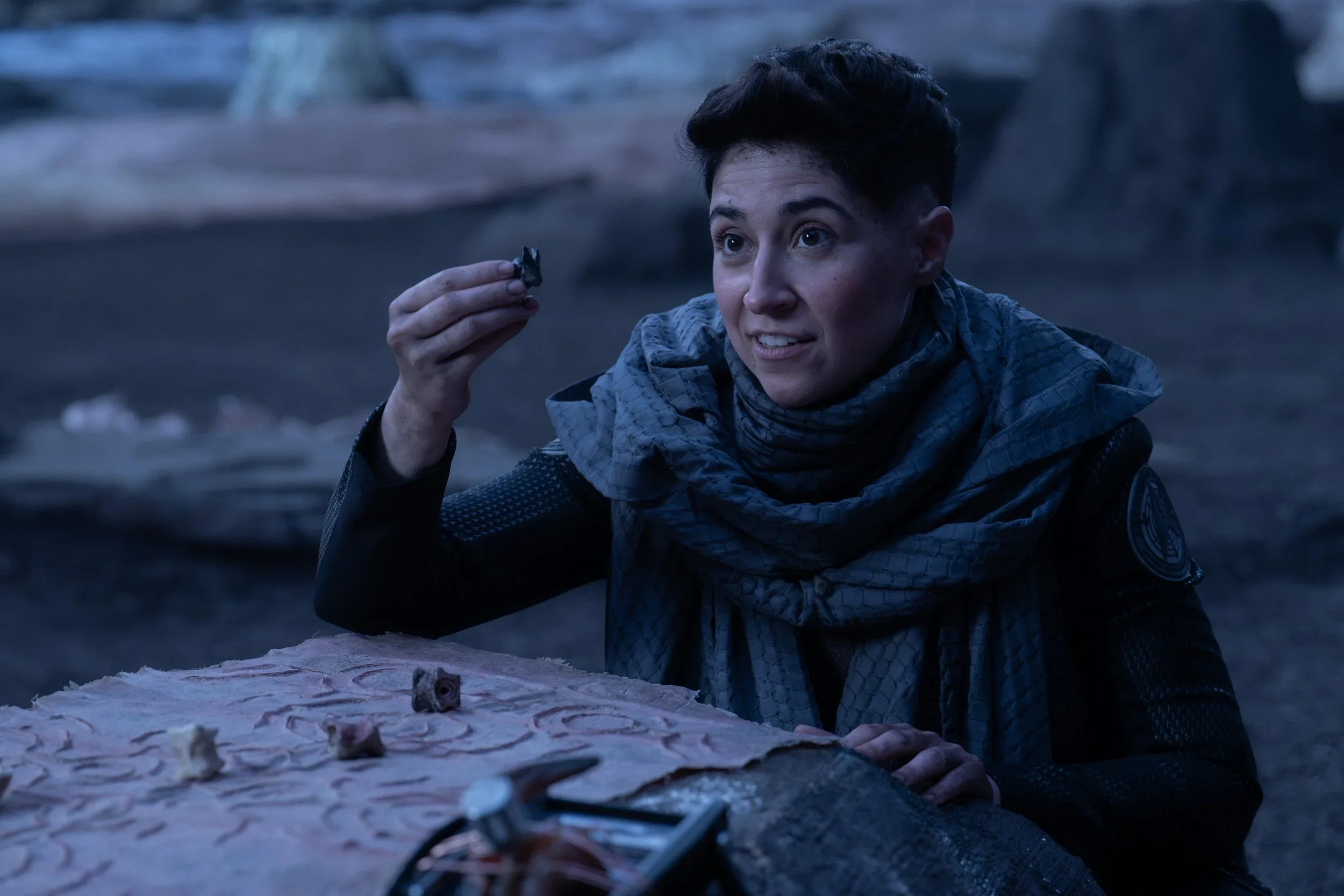
Ensign Ortegas (Melissa Navia) plays a Gorn board game in Star Trek: SNW
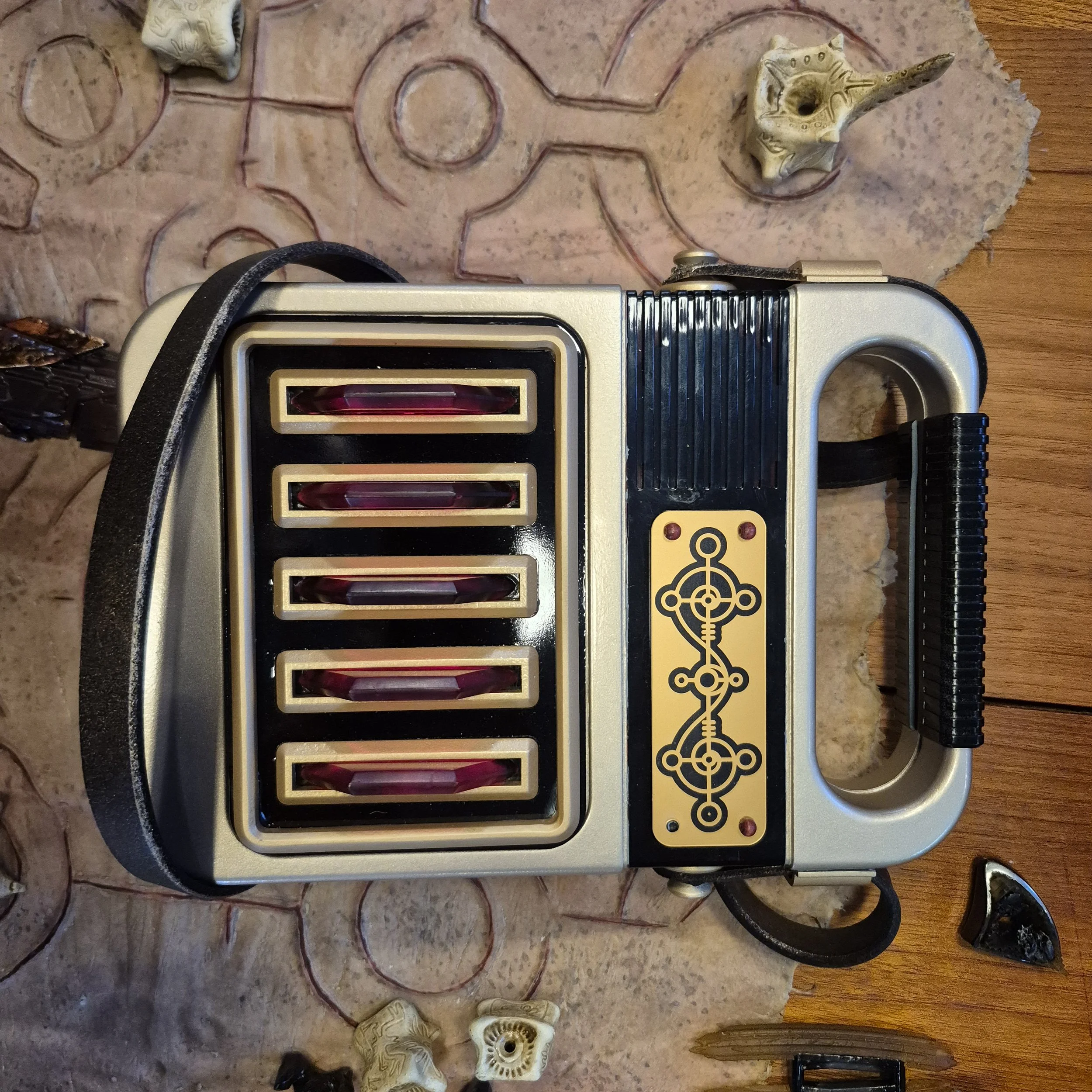
The board game and a makeshift translator
“Yeah! Well, when we were doing an EPK (Electronic Press Kit) at the end of Season Three, it as part of the dialogue of me starting Star Trek, it came up that there hadn’t been a woman in this role. We did the research, checked with John Van Citters (the VP of Star Trek, Brand Development for Paramount/CBS) and went through all the shows. There have been prop buyers but not a Prop Master.”
That’s a cool badge to wear.
“What I love about that is that I love what I do. I wasn’t hired because I was a woman; I was hired because of my skill, my dedication to my craft and the fact that I love what I can do for this brand. It’s Star Trek!”
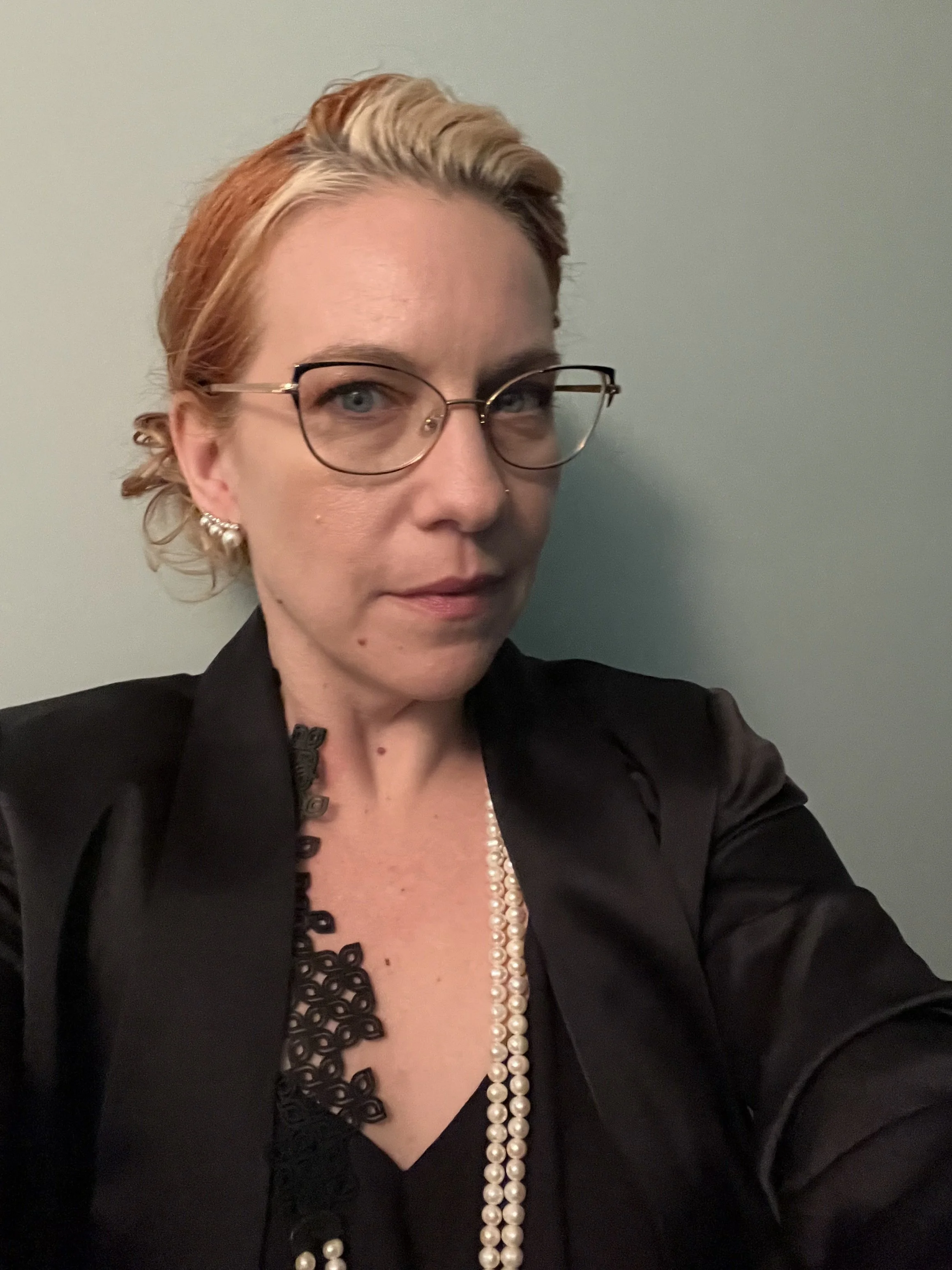
Star Trek: SNW’s Prop-Master Emily Hyde
Emily was also kind enough to use her super-powers to trot out props from Season Three of Star Trek: Strange New Worlds and tell us not just about their own stories in fabrication, but also the role they played in helping to tell the story of the episodes. We’ll talk about some of those.
‘I like to make the joke that I was drafted,” Emily says. Her entire family was in the business. Her father was a construction engineer in set design, her god-uncles were all in paint and construction, and her step-mom was also a key scenic designer. With her background at Etobicoke School of the Arts as a Drama major, the die was cast in her favour.
“When I was a teenager, my dad said I was done with camp and that I was going to work with him. Specifically, I was to work on the Denzel Washington film John Q as a headshot paint labourer. “
With an origin story of working on a production with the likes of Denzel Washington, Robert Duvall, James Woods and a particular favourite of mine, the late Anne Heche, it was quite a start for a career in the cinematic arts.
“He got my foot in the door, but the first thing he said to my boss was, ‘If she does not do her job, fire her.” That stuck. I was held to a very high standard. Even at the age of 16, it was impressed upon me to always assert more than 100%.”
Once both feet were in the door, a series of events led her to the U.S.S. Enterprise. “Well, I guess there were two things that happened. Jim Murray (the previous prop master) was moving on to (the Stephen King series) It: Welcome to Derry and I had just finished The Umbrella Academy and the timing was just right.”
Having a background with shows like The Umbrella Academy and her present work with the post-apocalyptic comedy series Twisted Metal seems a natural shift for sci-fi props design. But, it’s integral to know Star Trek. We asked Emily how versed she was in the franchise.
“I’m well-informed. I mean, I’ve been able to watch TNG from when I was a kid. But if you are working on a show, you NEED to know that show’s history. I watched Voyager, I did Deep Space Nine. I mean, my job is research. My job is to respect this franchise.”
And then there’s the all-important responsibility of maintaining the canon.
“If it isn’t broke, don’t fix it. But we also have to ask if it’s one of those things when we have to take the next step in the evolution of what it is in our present time.”

Which makes sense. After all, the 1960s aesthetic of the bucket chairs on the USS Enterprise in The Original Series doesn’t hold true to our current time. It does make sense to advance the design to reflect of current television.
The pieces Emily was kind enough to showcase were mostly from Season Three, where we saw a lot of interaction with the Gorn (the carnivorous alien adversaries that date back to the TOS episode Arena), involvement with the Klingons, and even some archeological discoveries. Specifically, the episodes in question were Episode 303 “Shuttle to Kenfori”, Episode 305 “Through the Lens of Time” and Episode 309 “Terrarium”. She was able to describe the process in which these items contributed to the episodes’ stories and the aesthetic decisions behind their making.
We should mention that Original-Cin featured interviews with the principal members of the cast of those episodes.
We began with what had to be my favourite prop in the collection was the Starfleet Survival Knife. I enjoyed this prop because of its simplicity. We see this used by Ensign Erica Ortegas in Ep309, marooned on a planet with a Gorn scientist for company. She has an entire survival kit, including this knife.
“It’s fabricated out of milled aluminum.” Emily says as I felt the heft on the knife. “It’s important to have that solidity to give the actor something to work with. Also, I had originally designed this to be a flip blade, but (producer) Akiva Goldsman had to tell me that ‘THAT WASN’T STARFLEET’!” she said with a laugh.
We asked about the timeline for prop creation.
“There’s a process. We get our drop-dead date, our lead time, how big is the prop? Does stunts require hands-on with the prop? Does it go to lighting? We usually have about four weeks to build the prop and then it usually it goes to Chris Fisher, our Creative Producer. After it’s good with him, we present it to Henry Alonzo Meyers or Davey Perez. Then the writers look at it. So, after the notes, then Akiva.”
In terms of experts, we asked who has the main approval on the appearance of the prop.
“It’s the writers. They have their contacts for research, most of the time. But in terms of the creation timeline, we need to follow the chain of communication but if there’s something that needs to be discussed, the joke is that I have a big personality!”
We looked at the Chimera Flower from Ep303 “Shuttle to Kenfori”, in which a flower on a planet in Klingon space needs to be harvested to cure Marie Batel.
“I like to talk about the chimera flower as it was one of the first things I took over when I came on set. We had two versions. It’s silicone and the colours had to be beautiful and threatening. We have here the one that was growing on the tree and the other in the lab case. We also had to have a bud that was in her hand. The tree version had to be bisected because when M’Benga uses his laser scalpel to cut it from the tree, it had to detach easily and visual effects made the cut effect, but he had to seamlessly remove it.”
We looked at the case.
“We created this container for the actors to store the flower for when it got picked. But as you can see, it is vacuum sealed for easy access and storage, it has a handle but the lid also has Starfleet flare for presentation. But it looks tech enough to sit in a lab.”
Episode five, “Through the Lens of Time” introduced fans to Dr. Roger Kory, Nurse Christine Chapel’s love interest. In this episode, we were able to look at alien archeological artifacts that controlled access to different parts of the ruins in different dimensions.
“I wanted the hourglass aesthetic reflected in the piece. But what was fun about this is that this was a chance for my experience and talent as an artist to come out. I love paint, and aging and all of the physical elements that go into scenery.”
Out of the cast, is there a favourite cast member to work with?
“Ethan Peck.” (A.k.a. Spock).
Which tracks. Jim Murray (the former Prop Master for SNW) made a similar comment in a previous interview. Ethan himself told me that he loved seeing what the Props teams came up with.
“I love Ethan. He is a wonderful human being. But I love him as a professional. I have tied him up, strapped him down, fed him by hand, and given him every prop that he has had to carry. He never complains and puts up with everything that I do to him! I know he appreciates my work!”
The Gorn Board Game was definitely a fun prop. Given that in Episode 309 “Terrarium” it became a medium of communication for the Gorn and Ortegas, it was important for the details to shine through.
“This was made to reflect that the worms on the planet were everything for Ortegas and the Gorn. It was made out of the skin of the worm, cut by the Gorn talons and even the pieces were like vertebrae. The main piece is shaped like the Gorn ship and you can see that all the striations on the silicon sheet look carved by her talons.”
It was a very realistic piece, designed to depict the survivalist nature of the story as both Gorn and Ortegas were stranded on the planet and had to cooperate to survive as well as cohabitate. In true Star Trek fashion, both became possible. The game, which even has rules, reflected that.
“If you’ll notice the pieces fit into each other. They chase the ship around, and it has to get to the centre of the board. There are Gorn dice, made out stones, carved by the Gorn’s talons (which shows you how insanely sharp they are!) and if the pieces catch the ship, they fit into it.”
What I love about this conversation is that EVERY Star Trek fan can get behind this type of storytelling, regardless of their favourite iteration of Trek. Props creation is the soul of visualizing the essence of the story.
But when you get into their fabrication, you’ll find they actually have their own story and they’re stories that sees directors, writers and performers rely on artists like Emily to tell.