
Lorne: A Painfully Reluctant Subject, And a Light-But-Not-Slight History of SNL
By Jim Slotek
Rating: B
Early in the documentary Lorne — a de facto history of Saturday Night Live masquerading as a biography of the man who created it — an SNL writer warns director Morgan Neville that this would be the most boring documentary of his career.
The reason: Lorne Michaels is notoriously unforthcoming in interviews, particularly on personal matters. The very fact that he has somehow consented to be a documentary subject is uncharacteristic.
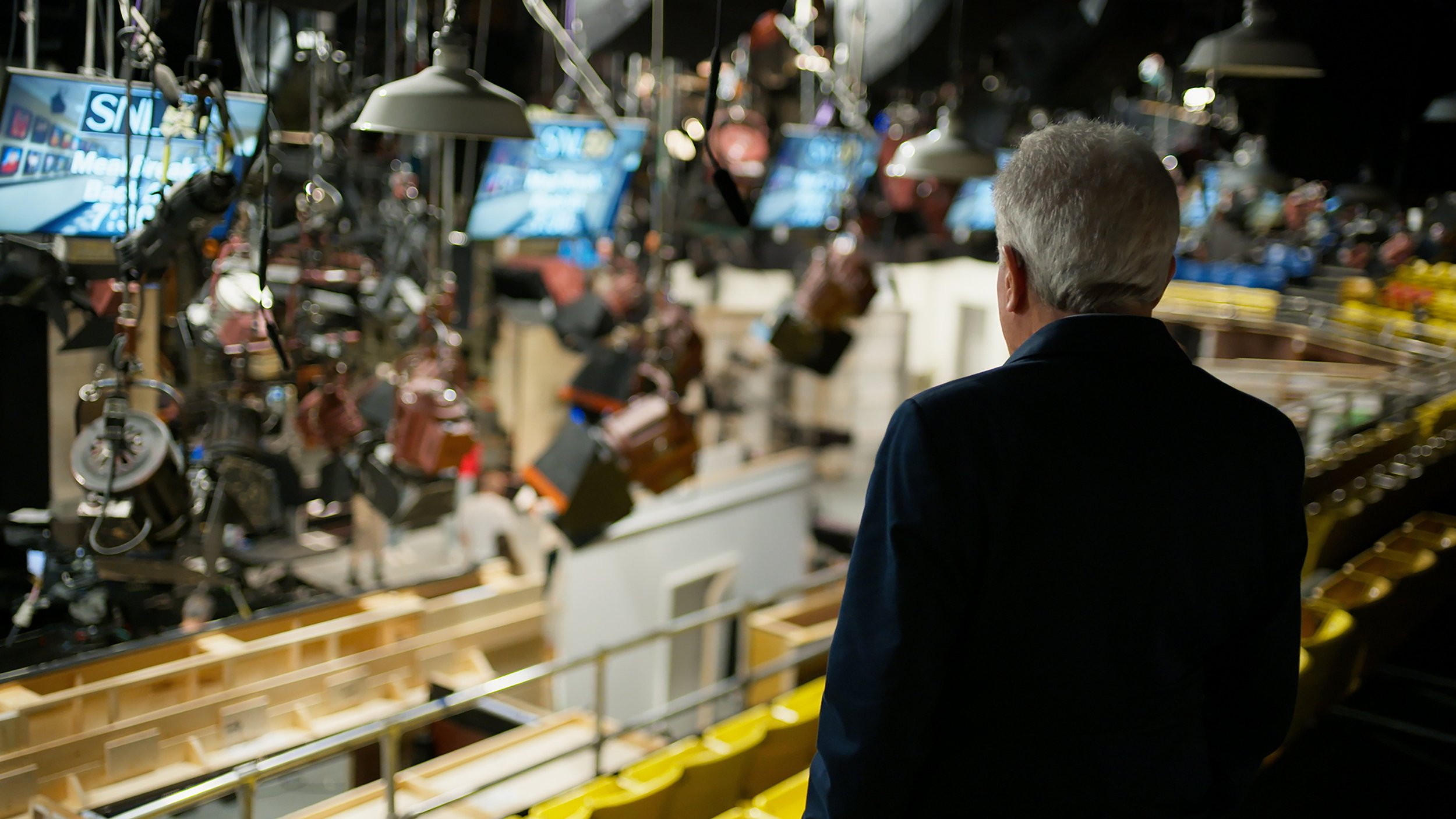
Lorne Michaels surveys his kingdom in 30 Rock’s Studio 8H.
His thought process as he ponders ostensibly funny things has never been pinned down behind his deadpan pensive gaze. And none of the more than 100-plus cast members who’ve done their best to amuse him over the past 50 years seem to know much about him.
They all do impressions of him though, from Mike Myers to Mark McKinney to Maya Rudolph.
To his credit, Neville (Won't You Be My Neighbor?) takes what he can get from the Toronto-born Michaels about his private life (his early life Toronto/L.A. segments are short and sketchy), and does a very SNL workaround to flesh out the rest. He renders chapters of Michaels’ career in the Hanna-Barbera-ish cartoon style used by the brilliant Robert Smigel in his pre-produced SNL bits Saturday TV Funhouse.
Some of the animated bits are set to Michaels’ voice. Others are set to Smigel’s impression of him. Again, Michaels turns out to be easy to mimic, if not to “get.”
Still, other than a pastoral tour of his Maine home, plenty of sphinx-like extended close-ups of Michaels lost in thought, Neville has gaps to fill. He does this with a tour of casts and their influence on particular eras of the show, wrapped around the lead-up to a December 2023 episode hosted by Emma Stone (her fifth time hosting the show).

It’s quite a historical ride, from the ‘70s Not Ready For Primetime Players, their eventual implosion as Hollywood beckoned, Lorne being fired for five years leaving behind a hit-or-miss program that constantly flirted with cancellation (the movie doesn’t mention it, but SCTV was under serious consideration as a replacement at one point).
There was his disastrous return in 1985, when he thought it a good idea to hire a cast of movie stars (Robert Downey Jr., Anthony Michael Hall, Joan Cusack, Randy Quaid) whose comedy chops were dubious. Neville pointedly doesn’t run any footage from that failed experiment, though I recall Quaid doing an impression of Sarah Ferguson in a “Royals” sketch that was surreally bad but worth watching ironically.
There’s the Eddie Murphy years, the Will Ferrell years, the Adam Sandler/Chris Farley/Norm Macdonald years, the latter of which was effectively brought to an end with extreme prejudice by NBC exec Don Ohlmeyer.
As a chronology, this is where Lorne makes its one sore-thumb omission. The loss of Sandler and company made way for the promotion of Tina Fey to head writer. She considered the previous cast’s humour to be directed primarily at teenage boys, and it was under her aegis that Maya Rudolph and Amy Poehler became stars in the former boys’ club, paving the way for the Kristen Wiigs and Kate McKinnons to come. It’s fair to say Fey played a big part in bringing SNL into the 21st century.
But her main contribution to Lorne is a segment on 30 Rock, and the transition of the real life show to primetime fiction.
Overall, the tone of Lorne is light, punctuated by roundtable interviews with the likes of Andy Samberg, John Mulaney, Conan O'Brien and Chris Rock. They produce much banter, some of it funny, if not overly illuminative.
If Lorne really is “the most boring” doc of the Oscar-winning Neville’s career, it’s only because his career bar is high. As it is, Lorne is a terrific backgrounder for devout fans of Saturday Night Live. Fairweather fans, on the other hand, might find it like an overlong sketch.
Lorne. Directed by Morgan Neville. Stars Lorne Michaels, Chris Rock, Robert Smigel et al. In theatres April 17.