
Lee Cronin’s The Mummy: This Tomb It’s Personal
By Thom Ernst
Rating: B
A family losing a child while stationed in a foreign country is horrifying. But for the Canon family, losing their eldest daughter, Katie, is only the opening act.
The real horror arrives later—patient, composed, and far less interested in closure than in what comes after it.
Doesn’t sound much like a reimagining of The Mummy, and yet that’s the promise attached to Lee Cronin’s The Mummy—a title that raises a small but reasonable question: who, exactly, is Lee Cronin, and how did he manage to wedge his name in front of a property where even Boris Karloff didn’t get pre-title billing?
Backed by the reliably thunderous marketing arm of Warner Bros., The Mummy keeps the brand name intact while quietly stepping away from the Brendan Fraser adventure rides and the Tom Cruise misfire—which, depending on your tolerance, may still be best left unwrapped. Cronin, an Irish-born director whose résumé includes the gleefully punishing Evil Dead Rise, brings with him a very specific sensibility: children are not off-limits, domestic spaces are not safe, and if there’s a mundane object nearby, it will be weaponized against your comfort.
Charlie Canon (Jack Reynor), a television journalist stationed in Cairo, lives with his pregnant wife Larissa (Laia Costa), their daughter Katie (Emily Mitchell), their son Sebastian (Dean Allen Williams), and the children’s grandmother (Veronica Falcón), whose devotion to faith is matched only by her commitment to presentation. When Charlie lands a coveted morning anchor job in New York, his attention drifts just long enough for Katie to disappear into a sandstorm.
Cronin understands that moment—the exact second distraction turns into consequence. It’s a parental fear so elemental it barely needs staging. The sandstorm is just Cronin showing off.
Years later, the Canons have rebuilt into something resembling a functional unit, affectionate, competent, practiced at carrying absence without letting it define every moment. And then Katie returns. Not as resolution, but as escalation.

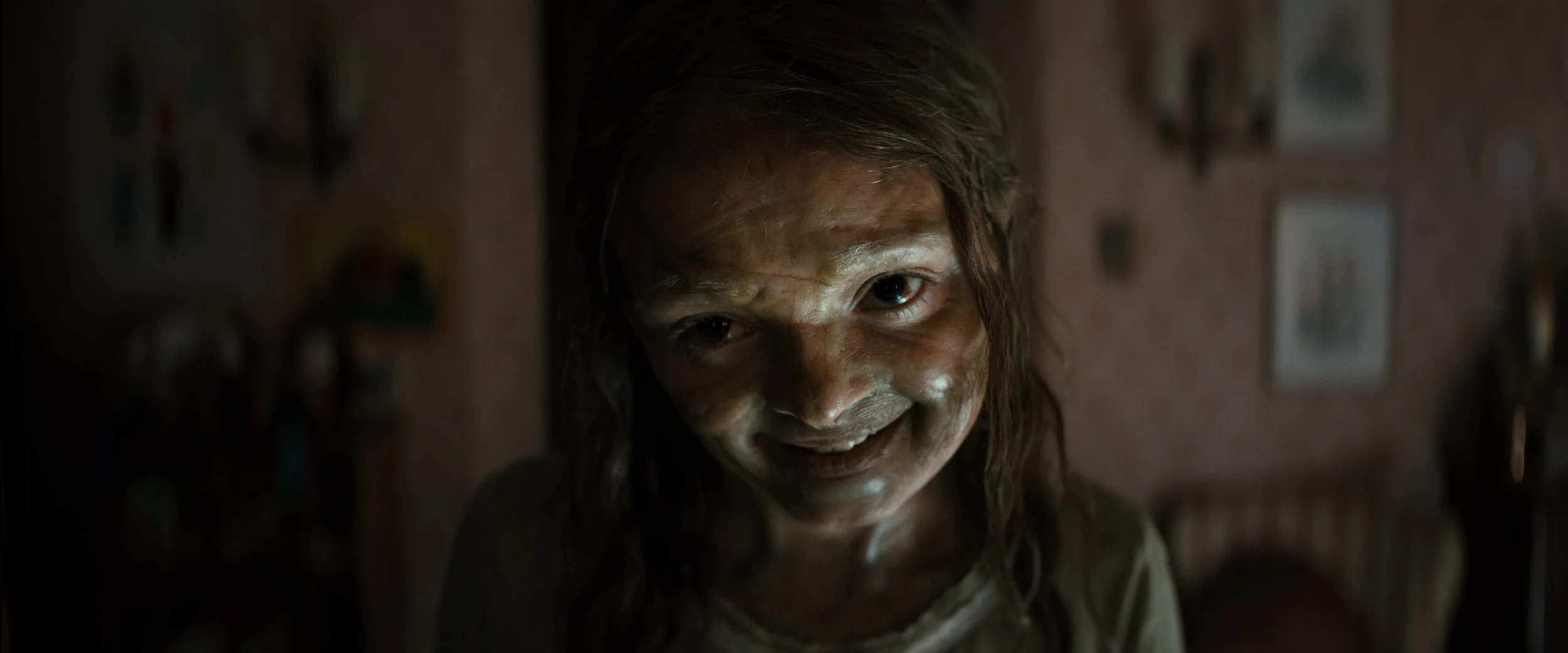
Natalie Grace’s older Katie is one of the film’s most unsettling achievements. Her being has abandoned the agreement of being human. Whatever has taken hold—some ancient Egyptian demigod with very little interest in subtlety—wears her like a suit that no longer fits. The result is a body in quiet revolt: skin drawn and decaying, movements either eerily absent or violently erratic.
When she does move, it’s with a kind of dislocated intention; clawing, biting, twisting herself into shapes that suggest the skeleton is optional. There’s something ancient in the way she occupies space, but nothing patient about it. This isn’t a slow, creeping unease. It’s a contained rupture.
You don’t watch her the way you watch a stranger who knows your name—you watch her the way you watch something that shouldn’t know anything about you, and yet does. And worse, seems to be figuring out what to do with that knowledge.
And Veronica Falcón’s grandmother—equal parts piety and poise—anchors the film in something resembling human resistance. She carries the weight of religious belief like it’s both a shield and an obligation, tending to her granddaughter’s needs without judgment or concern, despite being at the receiving end of the child’s wrath.
Cronin’s nods to the 1932 original are thin but deliberate echoes of pacing, fragments of dialogue, the mysterious Magician (Hayat Kamille), who feels like she wandered in from a different, older film and decided to stay. But this isn’t a film interested in honoring its predecessor. It’s more interested in quietly dismantling it.
And then there’s the body horror.
If Evil Dead Rise made audiences reconsider their relationship to kitchen utensils, The Mummy quietly ruins the pedicure. There’s a scene—already notorious—where a mother attempts to trim her daughter’s toenails. It should be nothing. It is not nothing. Cronin stretches the moment until it becomes unbearable, turning a banal act of care into something closer to a test of endurance. It’s not just grotesque; it’s invasive in a way that feels almost rude, like the film has crossed a boundary you didn’t know you had.
And then a boundary is crossed, in a scene that brushes so close to being exploitive that it seems like a gross invasion of privacy.
This is where Cronin’s Evil Dead credentials stop being a résumé line and start feeling like a warning label. He understands the mechanics of escalation—how to take something ordinary, apply pressure, and refuse to release it until the audience either laughs, winces, or surrenders. Often all three. There are moments here that feel less like homage to The Mummy and more like quiet auditions for whatever Exorcist reboot is inevitably waiting in the wings—scenes built on possession, restraint, and the creeping realization that the body is no longer operating under its original management.
Cronin doesn’t just show you something disturbing—he insists you sit with it until it becomes personal.
Gone, for the most part, are the grand tombs and righteous curses. Those elements linger at the edges—dust storms, and cryptic texts. Dialogue feels slightly off, like it’s been rehearsed by something that understands language but not quite how humans use it. but the real horror is domestic. Crawlspaces replace catacombs. Movement becomes erratic, insect-like. The Mummy doesn’t lurch—it adapts. At times, it scutters across the floor with a speed and playfulness that feels less supernatural than deeply, fundamentally wrong.
Lee Cronin’s The Mummy—and in this final mention I’ll allow the possessive—doesn’t so much reimagine the classic as relocate it. It takes the mythology out of the tomb and places it squarely in the home, where the rules are supposed to be understood. Cronin’s particular talent is in suggesting that those rules were never as fixed as we thought.
What he did for cheese graters, he now does for toenail clippers.
And if that sounds like a joke, it is—right up until the moment it very much isn’t.
Lee Cronin’s The Mummy. Directed by Lee Cronon. Starring Jack Reynor, Laia Costa, Natalie Grace, Emily Mitchell, Dean Allen Williams, Veronica Falcón, and Hayat Kamille. In theatres April 17.