
Palestine ’36: An Epic about the Revolt that Preceded the War
By Liam Lacey
Rating: B
If you have the impression that there are suddenly more films about Palestinians, you are right.
In January of last year, the International Documentary Association reported on the challenge of getting pro-Palestinian or anti-Israeli films into theatres, including the Oscar-winning No Other Land.
But, with the historic shift in American pro-Palestinian sympathy since the October 7, 2023 Hamas attacks and Israel’s devastating response, things have changed. By December, The Hollywood Reporter declared that “Palestinian Films Are Suddenly Everywhere.”
Though “everywhere” is an exaggeration, no fewer than three features about Palestine were shortlisted for Best International Feature at the 2026 Academy Awards.
These included Jordan’s All That’s Left of You, Tunisia’s The Voice of Hind Rajab — which made the final selection of nominees — and Palestine’s entry, Palestine ‘36, which had its world premiere at the Toronto International Film Festival last September to a 20-minute ovation and returns to the TIFF Lightbox this week.
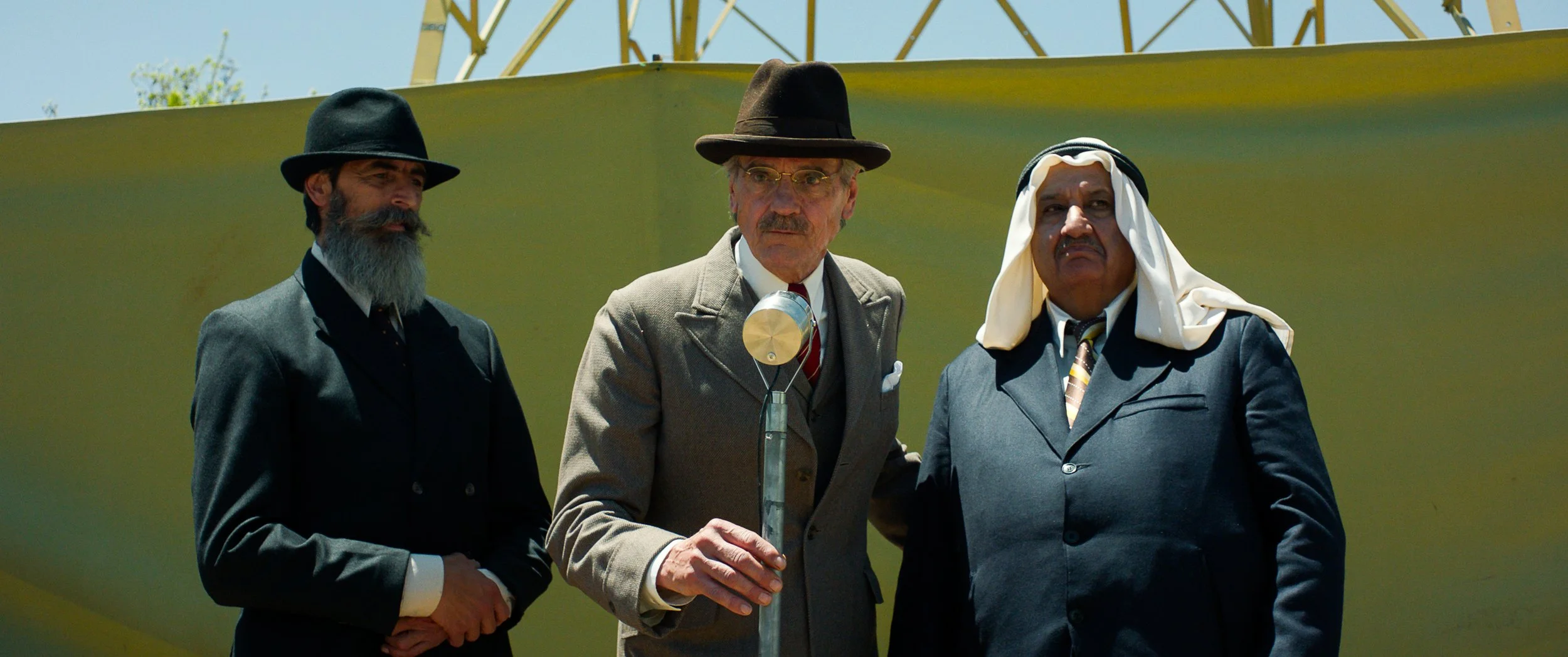
The fourth feature from Annemarie Jacir, Palestine ’36 is a panoramic multi-character old-fashioned historical drama about the forging of a national identity.

The scope and impressive production values of the film belie the challenges of its creation, which began production in early 2023 in the Palestinian territories, moved to Jordan after October 7 Hamas attacks on Israel, and returned to the territories in 2024 to finish its shoot, becoming the first feature from Palestinians since the beginning of the war.
One of the Jacir’s most inspired touches is her use of colourized and restored archival footage in long and medium shots, integrated with the new footage. The scenes in bustling city streets and seaside scenes remind us that Palestine was very much a land with a people. But as Palestine ’36 expands from the archival footage to big screen epic mode, things start to feel not just wide but thin.
There is a long mini-series worth of characters here, with barely time to develop any of them over its running time. For some reason, Jacier chose one of her least interesting characters to be the film’s protagonist, the shy young Yusuf (Karim Daoud Anaya), a village youth who takes the train to Jerusalem as a chauffeur for wealthy Arab publisher Amir (Dhafer L’Abidine).
Amir, who has political ambitions, belongs to the newly formed Muslim Committee, takes Zionist kickbacks on the side and dines with British brass. Meanwhile, his beautiful Oxford-educated, chain-smoking, occasionally cross-dressing wife, Khuloud (Yasmine al Massri) condemns the Mandate in her newspaper articles, written under a male pen name. (Why on Earth was the movie not about her?)
The broadly drawn British contingent includes two historical figures, with Jeremy Irons as the condescending bureaucratic General Arthur Wauchope, Britain’s high commissioner for Palestine, and the zealously anti-Arab Captain Windgate (Robert Aramayo), who seems to have been as much of a sadist in real life as he’s depicted here.

There’s one good Brit: Wauchope’s fictional assistant Thomas (Billy Howle), who is sympathetic to the Palestinians, partly because of his interest in the comely journalist, Khuloud.
Back home in the Christian-Muslim village of Al-Basma — modeled on the historic site of Al-Bassa, site of a massacre in 1938, and again in the 1948 war, when the town was razed and its population expelled — the villagers gradually realize they are under siege.
Jewish settlers, enabled by the British administrators, are buying up land and burning formerly Arab farmers’ fields. The Jewish refugees here have only a shadowy presence but, implicitly, are also tools of British imperialism. As Captain Wingate, who conflates Bible prophecy to British rule, declares: “The Zionists provide the key to preserving the empire.”
Yusuf’s neighbhours include young widow Rabab (Yafa Bakri) who lives with her adolescent daughter Afra (Wardi Eilabouni), and grandmother Hanan (Hiam Abbass).
Afra is a playmate with shoeshine boy Karim (Ward Helou), the son of an Eastern Rite Catholic priest, Father Bolous (Jalal Altawil), who serves to remind us that Muslims and Christians were on the same side in the conflict.
Predictably, the accumulation of abuse suffered by his family and the villagers leads the mild Yusuf to take up a gun and join the resistance. Unrelated to this either the city characters or the villager, the script includes another Palestinian, Khaled (Saleh Bakri) a dock worker in Jaffa, who becomes radicalized when he’s cheated out of his salary at work and sees the Brits overlooking weapons smuggled into the country by Jewish settlers.
The presence of an antique Turkish pistol in Arab hands becomes a motif that ties several characters together and arrives late in the film with a Chekhovian flourish.
Palestine ‘36 is at its most moving in the scenes of archival footage, and most provocative as an illustration of how England’s imperial tactics of pitting national groups against each other and terrorizing civilians (characters refer to similar approaches India and Ireland) became the template for Israeli’s ongoing military domination of the Palestinian territories.
The argument is unlikely to change fixed hearts and minds, but it is difficult to ignore how familiar it seems.
Palestine ’36. Written and directed by Annemarie Jacir. Starring Karim Daoud Anaya, Billy Howle, Jeremy Irons, Hiam Abbass, Kamel Al Basha, Yasmine Al Massri, and Liam Cunningham. In theatres released April 3 at Toronto’s TIFF Lightbox and Ottawa’s the ByTowne Cinema; April 10 at Charlottetown’s City Cinema and Edmonton’s Metro Cinema Society; and April 17 at Vancouver’s VIFF Centre.