
Hokum: The First Psilocybin-Fueled Horror Film… I Think
By Thom Ernst
Rating: A-
Hokum continues the march of a new generation of promising horror filmmakers, including Oz Perkins, Zach Cregger and now, Damian McCarthy. It may also be the first psilocybin-tested horror film.
Hokum is McCarthy’s third feature film, which for me means I’m working backwards through his catalogue, aside from catching his previous film, Oddity.
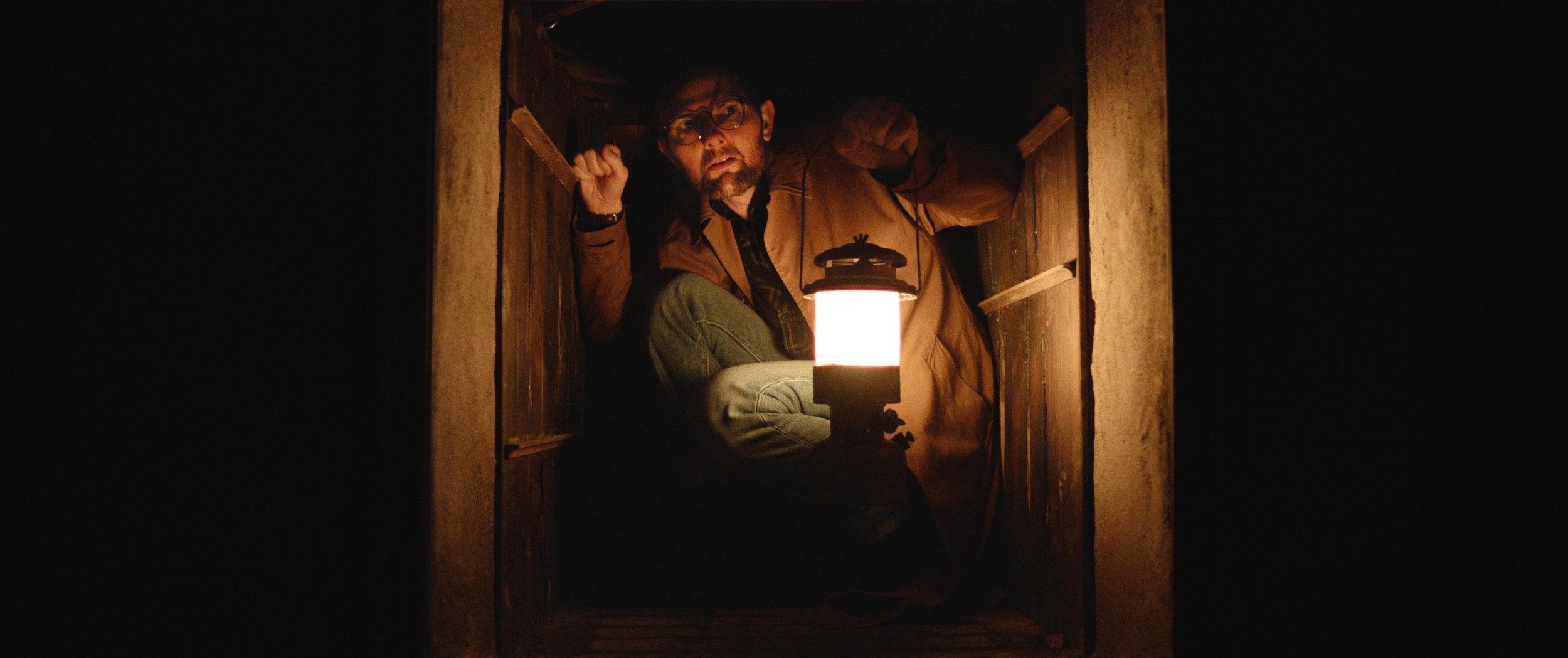
Adam Scott feels the walls close in, in Hokum.
Hokum is a risky title. But McCarthy, who gave us the unnerving Oddity, leaves just enough doors open to dare you to use the title against him. This brand of horror—part murder mystery, part supernatural intrusion—feels like it could splinter into its own subgenre. Both Oddity and Hokum play like long-lost episodes of The Twilight Zone or The Outer Limits—only stretched, patiently, into feature-length dread.
McCarthy stages an authentic setting at an Irish lodge that houses the apparent spirit of a vengeful witch—one that lures, traps, and punishes with a kind of storybook cruelty that feels closer to folklore than horror cliché.
Author Ohm Bauman (Adam Scott) is a globally recognized writer of what appears to be a wildly successful young adult series. But Bauman himself is anything but accessible. He’s a jagged-edged misanthrope, casually dismantling aspiring writers, brushing off admirers, and asserting his superiority with a cruelty that feels less confident than compulsive.
Scott, so often cast as the affable, slightly anxious nice guy, makes a sharp and satisfying turn here. Bauman isn’t just unlikable—he’s corrosive. Watching him interact with Alby (Will O'Connell), an eager bellhop desperate for validation, or Fiona (Florence Ordesh), who meets his cynicism with a quiet, unnerving steadiness, becomes its own kind of slow-burn discomfort. Even Mal (Peter Coonan), the inn’s manager, seems to orbit Bauman cautiously, as if proximity alone carries risk.

Bauman’s arrival isn’t about fame or retreat. It’s obligation. His parents honeymooned here, and despite a fraught history, he’s come to scatter their ashes at a place that mattered to them, if not to him. It’s a gesture that hints at guilt more than grief.
But McCarthy isn’t interested in a redemption arc. Those emotional threads are bait—just enough to get Bauman through the door. What takes over is the inn itself, and the story it carries: a witch, a locked room, and a history no one agrees on but no one ignores.
From there, Hokum builds with quiet precision. The inn shifts from rustic charm to something isolating, then hostile, then inescapable.
At the midpoint, McCarthy delivers a turn—one best left unspoiled—that doesn’t so much change the film as it recalibrates the people inside it. He pulled a similar maneuver in Oddity: the story stays intact, but your understanding of everyone shifts just enough to make every prior moment feel suspect.
And threading through it all is psilocybin. Not as a gimmick, but as a suggestion. A possibility. The woodsman, Jerry (David Wilmot), with his mind-expanding habits, the visions that may or may not belong to Bauman, the creeping sense that perception itself is negotiable. McCarthy never leans on it as explanation, but he plants it often enough that you start to wonder whether what we’re watching is supernatural intrusion—or simply the mind, unmoored and overreaching.
That’s where Hokum finds its footing.
McCarthy’s emerging style isn’t about blurring reality and fantasy into confusion—it’s about placing them side by side and letting them quietly undermine each other. The characters may know what they believe is real, but belief, in Hokum, is a fragile thing. Easily influenced. Easily broken.
Which makes Bauman the perfect guide. A man so certain of his own intellect, his own control, that he never considers the possibility that he’s the easiest one to deceive—by others, by memory, or by his own expanding mind.
If Hokum proves anything, it’s that McCarthy isn’t just part of this new wave of horror filmmakers—he’s carving out his own narrow corridor within it. A place where folklore, psychology, and just enough chemical suggestion collide.
Call it hokum if you want.
McCarthy seems to be betting you won’t be entirely sure.
Hokum is directed by Damian McCarthy and stars Adam Scott, David Wilmot, Peter Coonan, Florence Ordesh and Will O’Connell. Hokum is currently playing in select theatres.