
The Wizard of the Kremlin: Paul Dano Nails His Portrayal of the Man Who Picked Putin
By John Kirk
Rating A-
Back in my long-ago Russian history class, my professor made the piquant observation that if studying history is like paddling a canoe down a river, then Russia’s history is like shooting rapids in a lifejacket.
Violent, shocking, and sad, the history of Russia is a fascinating study.
Olivier Assayas’ The Wizard of the Kremlin presents audiences with an insightful glimpse of the spasmodic nature of Russian history. That history is a series of sudden and violent events that propel the country in one direction, only to have another jerkily turn towards another extreme. In this case, the story begins with the collapse of the Soviet Union.
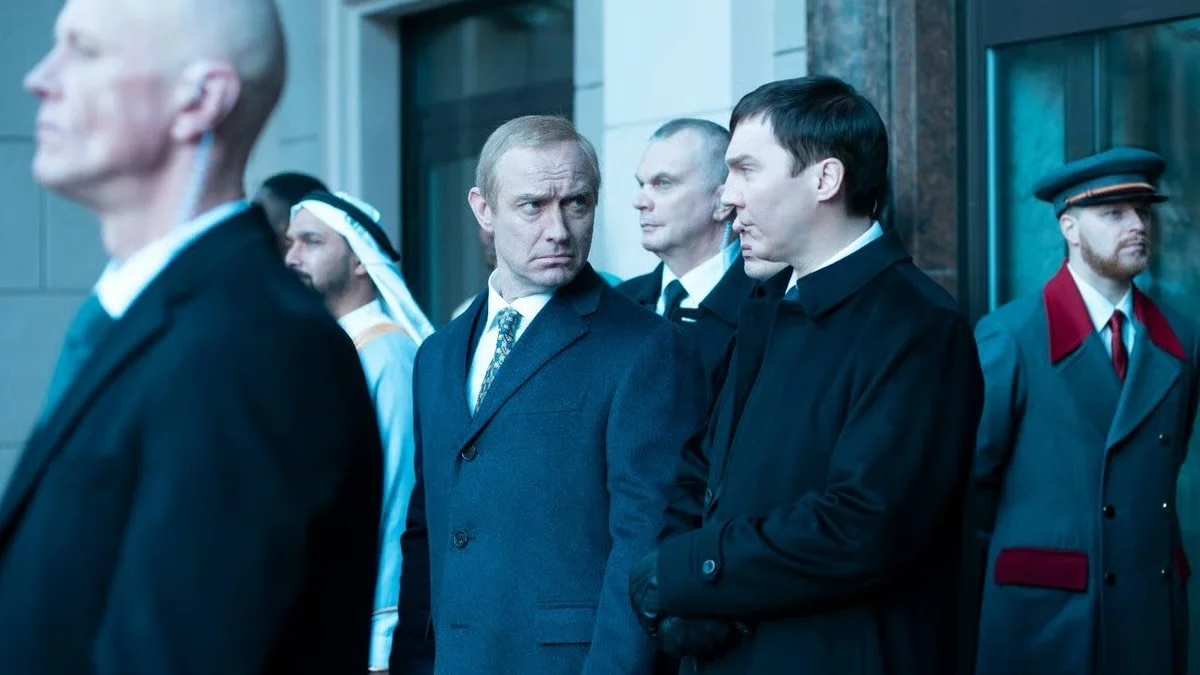
Putin (Jude Law) and Baronov (Paul Dano) in The Wizard of the Kremlin
Based on the novel Le Mage du Kremlin by Giuliano da Empoli, the fictionalized story of Vadim Baranov (Paul Dano), a former theatre student turned TV PR executive who helps guide events from the decline of Boris Yeltsin to the rise of Vladimir Putin (Jude Law). It provides a sharply accurate explanation for Putin’s rise to power.
Read our interview with filmmaker Olivier Assayas
In the 1990s, Baranov finds himself intertwined with movers and shakers: young and savage entrepreneurs who smell blood in the chaotic flooding of capitalism that overwhelmingly floods Russian culture. A son of two generations of Soviet-era politicians, he learns to operate within the shadows. He is an adviser who guides and shapes his generation.
He shares his story with an American academic, Rowland, played by the always-welcomed Jeffrey Wright. A like-minded scholar whose curiosity matches the nature of the audience for who the film is intended.
The Wizard of the Kremlin is one of those rare dramatized histories that seamlessly blends facts with fiction. For instance, the character of Baranov is loosely based on Vladislav Surkov, the Deputy Prime Minister of Russia from 2011-2013 and Assistant to President Putin from 2013-2020. A spin doctor supreme, nicknamed “the Grey Cardinal” of Russian politics, the comparisons between his fact and Dano’s fiction are difficult to miss but entertaining to note.

Both came from humble origins but were immediately noticed for their quick grasp of situations and - illustrating one of the dominant themes of this film - their ability to invent new realities.
There are two Russian realities in this film that explain the reasons for Putin’s rise to power.
One: The two axes of Russian government. On a graph, the vertical measures autocracy. The horizontal measures social freedoms. The collapse of the Soviet system introduced a massive number of freedoms that its culture was not prepared for. This gave rise to both Surkov and his fictionalized counterpart’s observation that the next president of Russia needed to apply more “verticality” - ie. one-man rule - by any means necessary.
Two: Sovereign Democracy. Essentially, Russia first.
Dano gives a skillful performance as the incredibly intelligent and creative Baranov. He is constantly on edge, concentrating 18 hours a day, candidates throughout the corridors of Russian power. Oligarchs and politicians alike, Baranov assesses their potential.
His wife Ksenia (Alicia Vikander) is his relief. Epicurean by nature, she lives for the delights that come with privilege, and teaches Baronov how to (initially reluctantly) enjoy life.
When Baranov discovers Vladimir Putin, the head of the FSB (Internal Federal Security), he sees him as a modest man of few words. Seemingly unconcerned with power, as the head of the FSB, he already sees and knows everything. It seems Baranov can offer him nothing more than he already has.
But when Baranov presents him with the idea of Russian national and cultural values manifesting themselves in government, he gives him a new ambition. Law’s portrayal of Putin is calculatingly accurate.
Putin wants people to think his ideas are their own. Manipulation is a finely developed political skill in Russian politics and Putin turns out to be a grand master.
An over-simplistic explanation of the premise of the film is that power corrupts. But this is a story of finding a politician to manipulate who has the power to match the Russian people’s demands for a “Russia first” autocrat. In the end, Russian politics seldom goes well for those in power … or for those who hope to share in it.
Like Putin’s Rasputin, Baranov … or Surkov. Whoever you prefer.
Oh, those Russians.
The Wizard of the Kremlin. Directed by Olivier Assayas. Written by Olivier Assayas and Emmanuel Carrere. Starring Paul Dano, Alicia Vikander, Tom Sturridge, Will Keen, Jeffrey Wright, and Jude Law. In theatres May 15.