
Mārama: Māori Meets Brontë in a Vivid Anti-Colonial Payback Drama
By Liam Lacey
Rating: B+
Set in 1859, Mārama follows young Māori woman Mary Stephens (Ariana Osborne), raised as an orphan by European guardians. She is working as a teacher in New Zealand when she receives a letter from a man named Thomas Boyd, inviting her to England to learn the secrets of her parents and family history.
After a lengthy sea journey to North Yorkshire, she discovers that the letter-writer, Boyd, has recently died. In his place, she is greeted by the middle-aged Sir Nathaniel Cole, the lord of the gloomy mansion who lives with his drunken widowed son Arthur (Jordan Mooney) and nine-year-old granddaughter Anne (Evelyn Towersey). Sir Nathaniel promptly suggests that Mary stay on as Anne’s governess which, with some trepidation, she accepts.
If the synopsis suggests that Mārama — the debut film from London-based half-Māori filmmaker Taratoa Stappard — is an act of an anti-colonial reappropriation, you are on the right track.
Perhaps the best-known examples of the connection between colonialism and the Gothic imagination are two of the Brontë sisters’ most famous characters: the possibly dark-skinned Heathcliff in Emily Brontë’s Wuthering Heights and the mentally ill Creole woman, Bertha Antionette Rochester, in Charlotte Brontë’s Jane Eyre.

(Stappard hides his sources in plain sight. Sir Nathaniel’s home is called Hawsworth Manor; the Brontë sisters were raised in their father’s Haworth Parsonage).
Once the now-adult orphan is loose in the dark corridors of the manor, the revelations come fast and injurious. Sir Nathaniel, who made his fortune as a whaler, an animal sacred to the Māori, collects all manner of cultural objects to display around his home.
He has even constructed a wharenui or traditional Māori communal lodge in his garden, which is suspiciously locked up. His granddaughter Anne even speaks some Māori learned from Jack Fenton (Erroll Shand), Sir Nathaniel’s Māori manservant.
Soon, Mary recognizes that Sir Nathaniel’s fascination with Māori culture is less about admiration and respect than the colonist’s parasitic fetishization for those he has exploited. Mary (her Māori name is Mārana) is the granddaughter of a Maōri seer, and through a bewildering series of mirror images, visions, dreams and flashbacks she begins to understand that the manor holds the grim secrets of her family history.
Tensions come to a head in the film’s outstanding sequence, Sir Nathaniel’s decidedly tasteless Māori-themed birthday party when the servant Jack performs a grotesque parody of a warrior dance to amuse the guests.
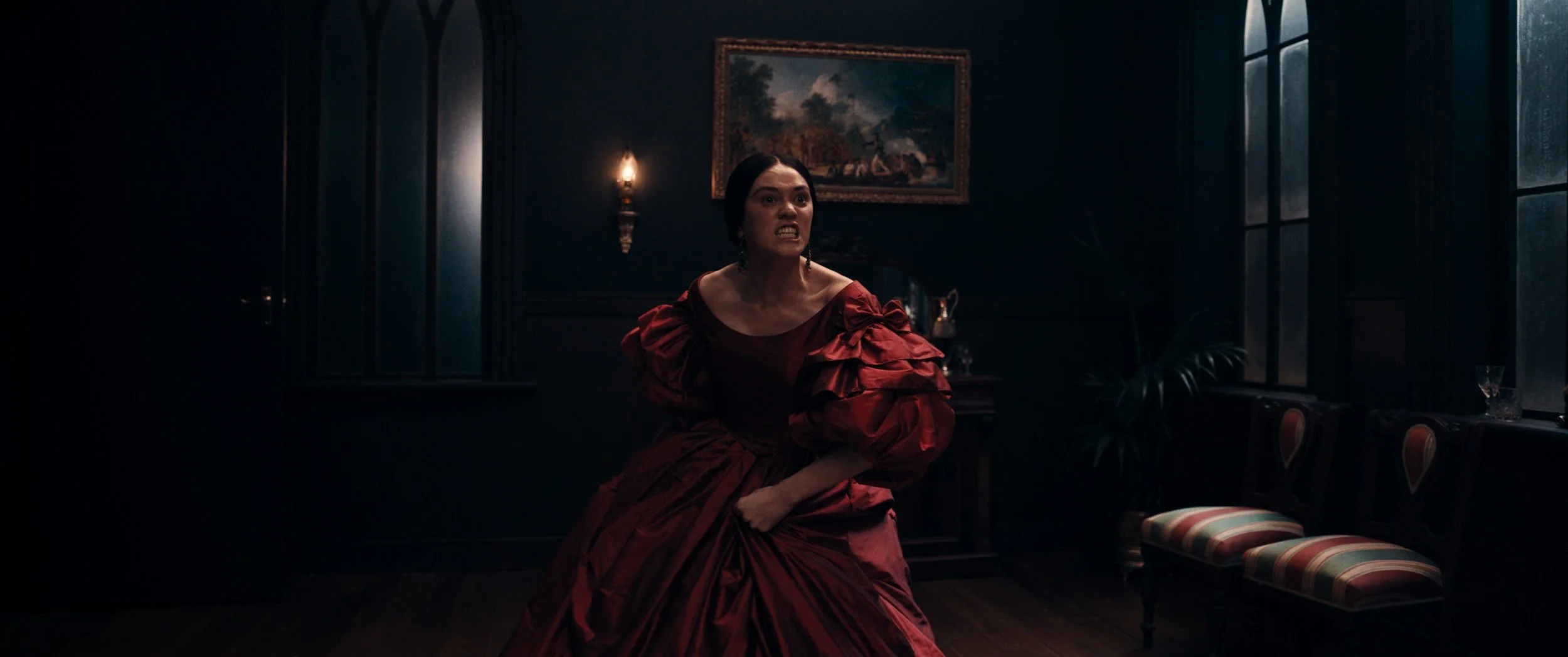
Mary, resplendent in a puffy red ballgown, finally has enough. She explodes in response with a hair-raising haka dance, a combination of stamping, chanting, grimacing and gesturing that previews the upcoming vengeance she unleashes on her family’s tormentors.
Heavy-handed but memorable, Mārama favours impact over nuance in illustrating its theme. Osborne brings a tense, fiery commitment to her performance. In another stand-out performance, Shand as the clownish servant Jack is a memorable ethnic grotesque.
Gil Loane’s cinematography, shot in studio-built interiors with crimson splashes against velvety dark backdrops, creates a sense of heightened, almost ceremonial moments. Neither exactly a horror movie nor a costume drama, Mārama stakes out its original narrative ground as a kind of cathartic pageant or imaginary exorcism of history’s ghosts.
Mārama. Directed by Taratoa Stappard. Starring Ariana Osborne, Evelyn Towersey, Toby Stephens, Jordan Mooney, Umi Myers, and Erroll Shand. Now playing at Toronto’s TIFF Lightbox. Opening May 15 at Vancouver’s Park Theatre and May 21 at Saskatoon’s The Roxy.