
Silent Friend: Beautifully Shot Time-Travelling Drama Connects Eras and Imaginations
By Alice Shih
Rating: A
"The walls have ears" might be a cautionary salvo but “the trees have ears” could mean a new dimension of communication, according to Hungarian director Ildikó Enyedi (Berlin Film Festival Golden Bear winner 2017, Of Body and Soul).
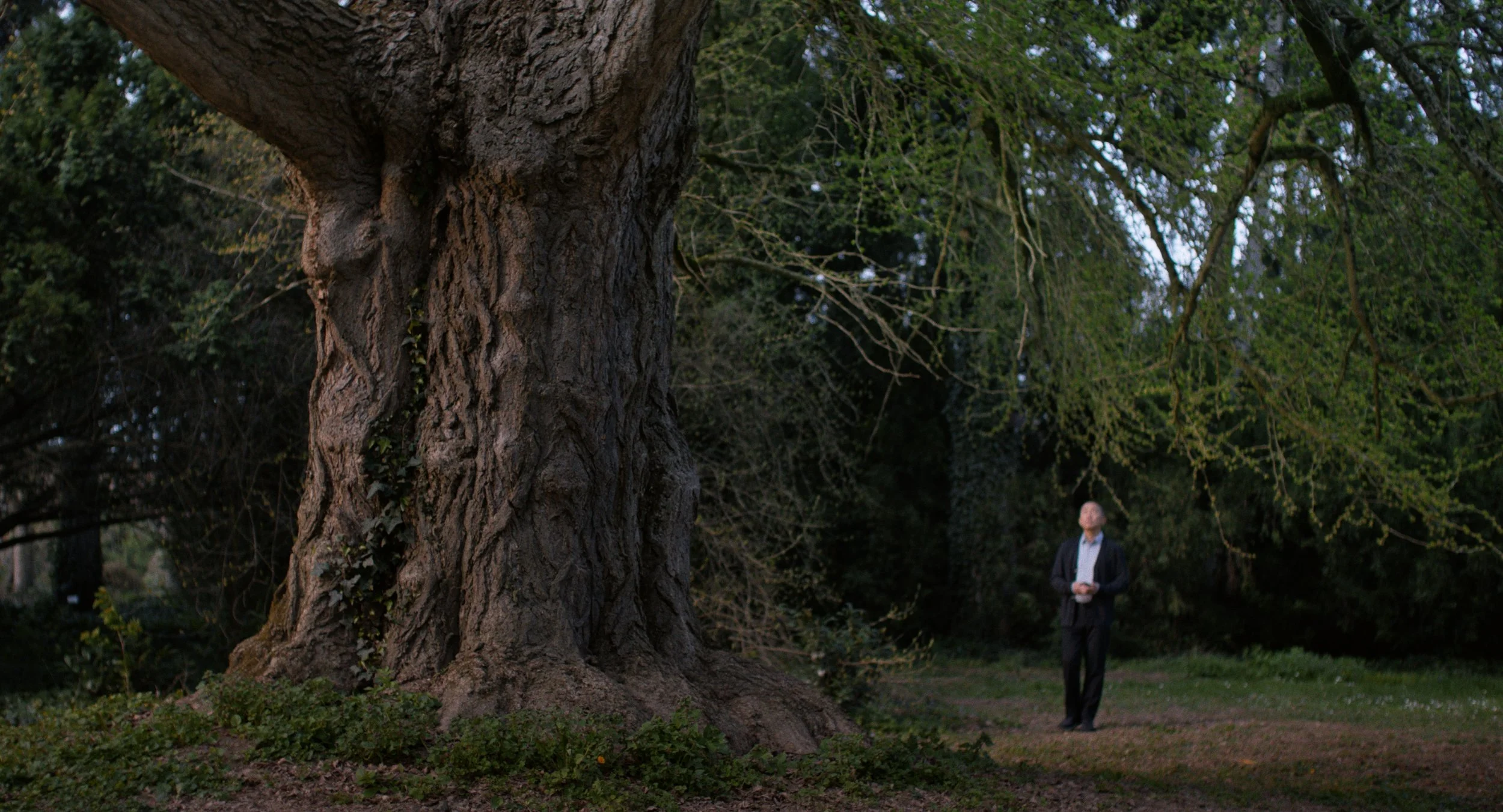
Silent Friend spans a century of stories as observed by a majestic ancient Ginkgo biloba tree planted in the botanical garden at Philipps University of Marburg, German. Enyedi and master cinematographer Gergely Pálos bring us a triptych of tales in three separate time frames, employing individual cinematic formats for each. Viewers can differentiate their corresponding time periods right from the colour and texture on the screen.
In 1908 (shot on black and white 35mm celluloid film), a female applicant (Luna Wedler) is grilled by a condescending, all-male university admission panel, with full-on sexual innuendo not only to dismantle her academic achievements, but also to reduce her from a scholar to a woman merely worthy of domestic duties.
Unshaken, her brilliant responses turn the tables as she succeeds, becoming the first and only woman student on campus. Unfortunately, sexual prejudice continues to challenge her college life. With unwavering determination, she nurtures an interest in photography for closeup documentation of the test subjects to assist her academic journey as witnessed by the ginkgo tree.

The timeline then jumps to 1972 (shot on grainy colour 16mm film) and there are students of both sexes taking shades under our tree. A botany student (Marlene Brown) experimenting on a geranium has to go on a trip. Her friend (Enzo Brumm) — who was a farm boy before university but who is now tired of groundskeeping — is asked to help water her garden at 4 am each morning.
He is specifically asked to take care of her geranium, which is hooked up to a polygraph-like apparatus measuring its physiological reaction to stimulations. He reluctantly agrees to the chores hoping to please his crush.
He genuinely thinks it is absurd at the beginning but later finds out that the geranium does have responses. Overjoyed, he enthusiastically perfects the apparatus into a functional gadget. He has found real passion for the flower upon establishing an unexpected connection.
Time shifts again to 2020 (shot on crisp, sharp digital), the pandemic isolation period. A visiting neurologist from Hong Kong (Tony Leung Chiu-Wai) is alone with a caretaker (Sylvester Groth) on the empty campus.
His expertise is correlating baby brainwaves to their perception and feeling. With no trial subjects available except himself, he turns to the internet and gets intrigued by another scientist (Léa Seydoux), who suggests plants actually have the ability to communicate threats between the trunk and its branches, or detection of other sexed pollens around.
Admiring our grand ginkgo tree in front of his dwelling, he decides to put sensors and conductive wiring around it to document wave patterns when the tree is subjected to weather changes among other variables.
The characters are well-defined as channeled through their distinctive voices, most evidently in the witty exchange in the 1908 section. Venice Film Festival Young Actress Award–winner Luna Wedler is exceptional as the pioneering student. The rest of the cast also excel, especially the tenacious but gentle professor played by Tony Leung Chiu-Wai, who Enyedi wrote this role specifically for. His eyes alone could convey the unspoken.
The scientists all demonstrate their thirst for research breakthroughs; but the main protagonist of the film is our silent friend, the Ginkgo tree, from which point of view we witness and also shared the solitude of our three lonely protagonists. To study botanical consciousness is one way to unlock new means of communication, striving to open a dialogue with other seemingly non-expressive entities.
Times have indeed changed as the world speeds towards a lightning AI age, but Enyedi’s cinematic journey allows the viewers to immerse themselves in the stories at a comfortable pace, like soaking in fresh scent of trees on a morning stroll.
Maybe Enyedi is trying to tell her audience how important it is to slow down, connect and comprehend, especially when the other party does not seem to be readily communicable. The impasse might be due to our own inability to recognize other methods of correspondence.
Can science and technology close that gap? Communication might be the only answer to end conflicts, or even wars.
Silent Friend. Directed by Ildikó Enyedi. Written by Ildikó Enyedi, Tina Kaiser and Corinne Le Hong. Starring Tony Leung Chiu-Wai, Léa Seydoux, Luna Wedler, Marlene Brown and Enzo Brumm. In theatres May 15.