
Obsession: A Horror Film You Just Have To (No, Really Must) See
By Thom Ernst
Rating: A+
Obsession needs no introduction in the literal sense. Its title tells you exactly what kind of story you are walking into, and at first the film seems almost too willing to embrace familiar territory.
The opening stretches through recognizable beats of romantic frustration, missed signals, wounded longing, and the quiet humiliation of wanting someone who appears just out of reach. For a while, it feels as though the movie might simply coast on genre shorthand.
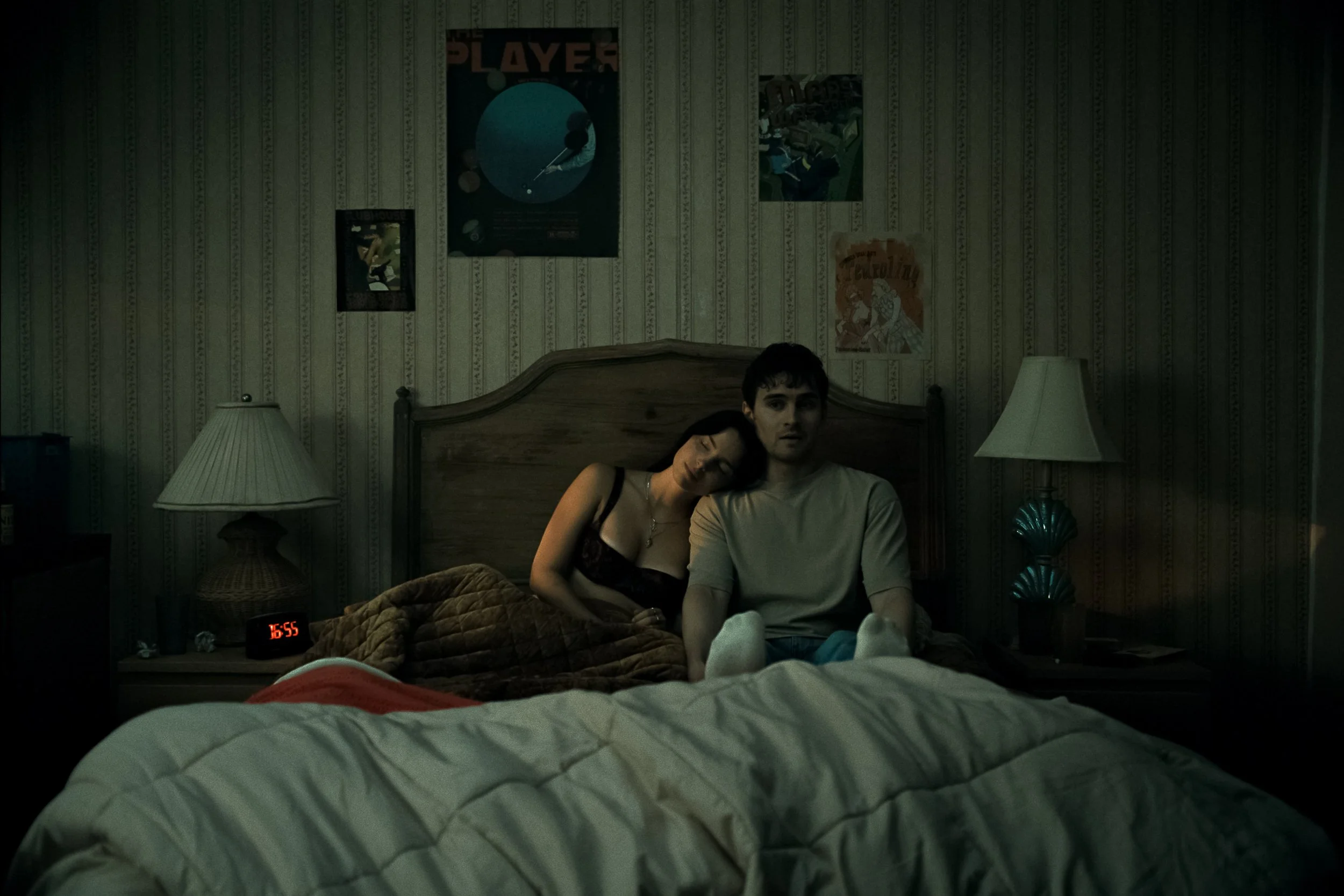
But that familiarity is precisely the trap that writer-director Curry Barker lays for the audience. He uses the conventions of obsession thrillers and supernatural morality tales like a checklist followed with rigid precision, only to feed the list through a paper shredder once the story reaches the apex where certainty should exist.
What emerges is not a routinely shaped horror film about unhealthy desire, but a deeply cynical and unexpectedly emotional examination of greed, fantasy, and the cowardice that often hides beneath romantic longing. And Barker manages to make all of that funny.
Barker understands that obsession is rarely about love. More often, it is about control — about wanting reality rewritten into something safer and more flattering than life actually allows. That idea gives Obsession its unsettling power.
The film follows Bear, played by Michael Johnston, a lonely young man whose inability to confront rejection leads him toward a seemingly harmless novelty item capable of granting wishes. The setup immediately recalls The Monkey's Paw, the foundational horror story in which desire itself becomes a curse.

Like Jacobs’ famous tale, Obsession understands that wishes are not dangerous because they fail, but because they succeed in the worst possible way. Horror has returned to this idea for decades, from Wishmaster to Hellraiser, where desire becomes a gateway to suffering, and even films like Christine or The Fly, where fixation consumes identity itself.
Barker’s film belongs comfortably within that lineage, though it feels more intimate and emotionally poisonous than many of its supernatural cousins. What separates Obsession from lesser morality plays is the way Barker manipulates audience expectation.
Traditionally, stories about cursed wishes revolve around pathetic men chasing unattainable women, with the object of affection reduced to a symbol rather than a person. Barker initially appears to be following that exact formula before executing a sharp narrative reversal that reframes the emotional dynamics entirely.
The film becomes less about whether Bear gets what he wants and more about the damage created by believing another person can complete the emptiness inside you.
That shift works largely because of Inde Navarrette’s extraordinary performance as Niki. She is easily the film’s secret weapon. Navarrette avoids every cliché associated with the “obsessed woman” archetype and instead builds Niki into someone volatile, wounded, loving, terrifying, and heartbreakingly sincere all at once.
There is a rawness to her performance that makes the emotional violence of the story land harder than the supernatural horror. She does not play Niki as a villain, nor as a victim, but as someone collapsing under the unbearable weight of unchecked feeling.
In lesser hands, the character could have become caricature. Navarrette instead turns her into the emotional centre of the film, grounding Barker’s more outrageous turns in something painfully human.
Johnston deserves equal praise for understanding exactly who Bear is supposed to be. His performance wisely resists making the character sympathetic in easy ways. Bear is weak, passive, and often frustrating, but Johnston plays him with enough vulnerability that his bad decisions never feel artificial.
He captures the particular sadness of someone who mistakes fantasy for emotional bravery. Bear does not pursue love because genuine love would require risk, honesty, and the possibility of rejection. The cursed wish offers him something easier: control without vulnerability. Johnston makes that emotional cowardice painfully believable.
Barker’s direction amplifies these performances with impressive confidence. Once the film locks into place, the pacing tightens like a vice. The horror escalates naturally from emotional desperation rather than arbitrary shocks, which gives the violence and psychological unraveling genuine momentum.
Even when the film leans into familiar genre mechanics, it does so with enough conviction and thematic clarity that the material feels revitalized rather than recycled.
What lingers after the credits is not simply the horror imagery or the supernatural premise, but the film’s bleak yet comical understanding of desire itself. Obsession argues that wanting can become its own form of self-destruction when disconnected from empathy or self-awareness.
Like The Monkey’s Paw, it suggests that people rarely understand the true cost of getting exactly what they ask for. Barker updates that old moral lesson for an era shaped by loneliness, emotional avoidance, and the fantasy that fulfillment can somehow be engineered rather than earned.
By the end, Obsession proves itself far smarter, crueler, and more emotionally devastating than its straightforward title initially suggests.
What begins as a familiar cautionary tale about desire transforms into something uglier and more honest: a horror story about people so consumed by longing that they lose the ability to recognize love even when it is standing directly in front of them. And that’s a pretty cool trick for a horror-comedy to pull off.
Obsession. Directed by Curry Baker. Starring Inde Navarrette, Michael Johnston, Cooper Tomlinson, and Andy Richter. Now playing in theatres.