
Inside Out Festival ’26: A Polyamory Drama That Isn’t by the Numbers
By Liam Lacey
The showcase Centrepiece Gala of this year’s Inside Out 2SLGBTQ+ Film Festival, running May 22 through 31, is a Canadian first feature called I Come Home, directed by Glen Wood and written by Andreas Vatiliotou.
The film is about a topical subject — three people living in an intimate domestic arrangement, popularly known as a “throuple” or triad.
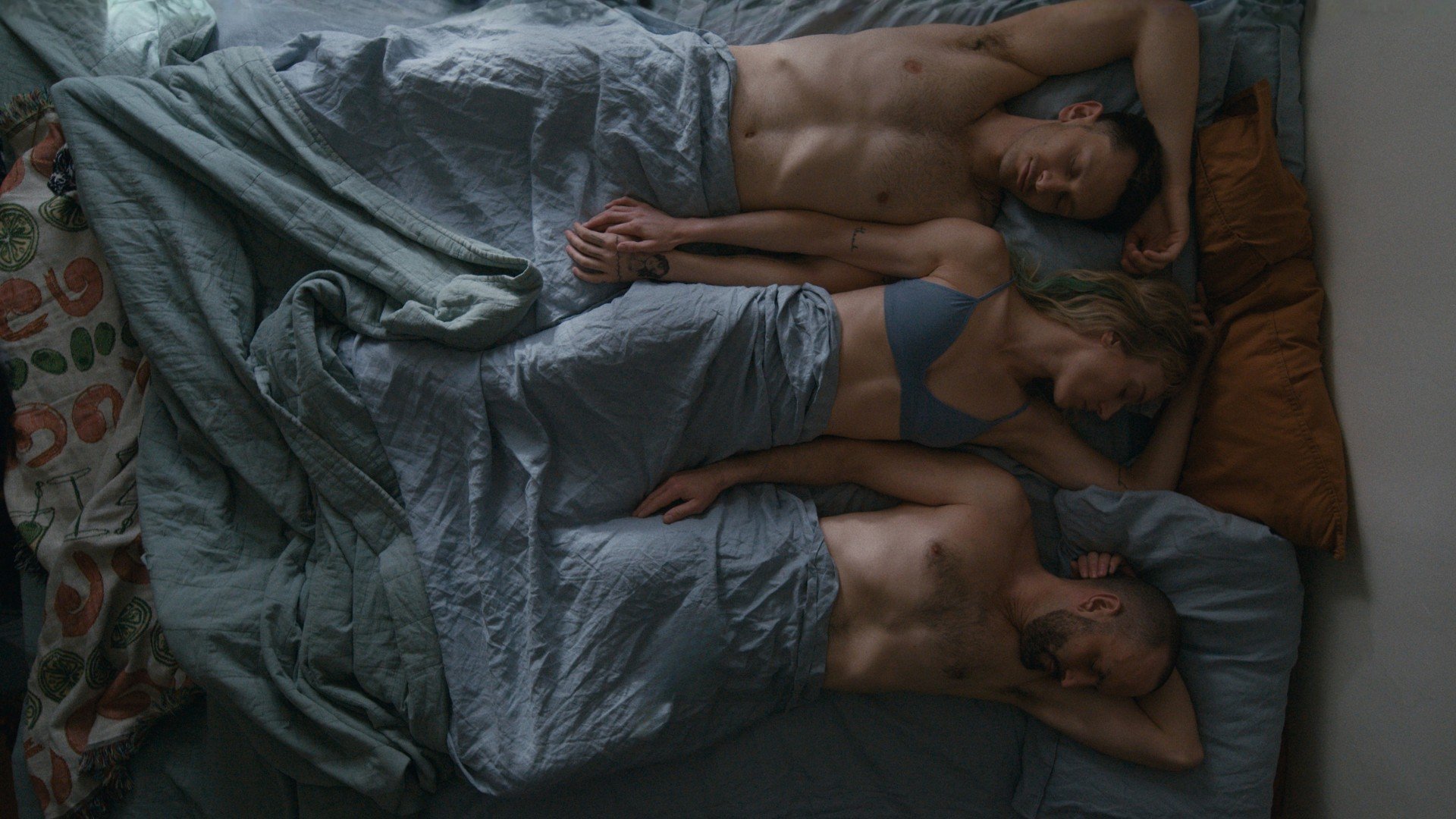
A scene from I Come Home
Public fascination in various forms of consensual non-monogamy or polyamory has spiked in the last two decades, first through internet groups and social media and then on mainstream television.
Witness a 2020 House Hunters episode with three people looking to cohabit; and a U.S. reality dating show, Couple to Throuple. Not to forget the finale of Riverdale (2017–2023), with its four leads, Betty (Lili Reinhart), Jughead (Cole Sprouse), Veronica (Camila Mendes), and Archie (KJ Apa), involved a quad relationship for their final year in high school.
Seriously, a polyamorous Jughead?
I Come Home — a thoughtful drama about three slightly bohemian, young adults struggling to make a living, stay healthy, and enjoy sexual companionship — is rooted in real-life details.
Christine (Hannah Cheesman) salvages and restores furniture and has been on a medical leave after surgery for endometriosis. Stephane (Ryan Ali) custom bakes pastries and delivers food to clients working from their kitchen in Toronto’s Trinity Bellwoods neighbourhood. Alex (Carlos Gonzalez-Vio), the family go-getter, travels frequently, raising funds for a national chain of barbershops.
The complication, true to the tradition from Hamlet to Meet the Fockers, is about awkward homecomings and generational tensions. Shortly after Christine discovers that she is pregnant, she is invited to the second wedding of her younger sister (Jordan Hayes) in Huntsville.
She takes along Stephane as her plus one to support before facing her judgemental parents (Sonia Smits and Paulino Nunes), who see the world through the angry lens of their own bad marriage. Complicating things, Alex decides to show up at the wedding, turning Christine’s plus one into a disruptive plus two.
I spoke with writer Andreas Vatiliotou by telephone this week about the film, which has its world premiere May 26 at the festival. The interview is edited for length and clarity.
ORIGINAL-CIN: Was there something specific that inspired you to write this script?
ANDREAS VATILIOTOU: There were a few things, actually. One of them was sitting with friends at dinner one day, and we were talking about relationships, and someone brought up a couple that we know who recently brought a third person into their marriage, and I was sort of surprised by how this mixed group of straight people and gay people, singles and couples, all seem to sort of agree that it was a red flag that this relationship was in trouble. That seems so strange to me. I wanted to write a film that looked at polyamory, I think, in a more neutral or even optimistic sort of way, because I don't think we've seen that many relationships that are polyamorous on screen that aren't seen as a kind of joke or a red flag of a relationship in crisis.
O-C: Or as a titillating curiosity?
AV: Yeah, or just like a detour on the road to look at couple finding the way back to each other, like I think it's used as a device, as like an obstacle, right, where someone else comes in and they sort of have to realize that they just belong together, that this third person isn't necessary for them to be OK.
O-C: I understand that there are analysts who say that polyamory doesn't really fall under the LGBTQ umbrella, because it’s more of a lifestyle choice than a gender or sexual orientation. How do you respond to that?
AV: Well, just to give it a bit more context, I mean, in terms of the festival, the throuple within our film is bisexual, and so it's two men and a woman, and so I think sexuality plays a role in their relationship. The men in this film are with the woman and with the men, like they all are in this relationship together. I know, in some cases of a throuple or polyamorous relationship, perhaps the woman is with each man, and the men aren't together. In this case, all parties are sort of involved in both the romantic and the sexual part of the relationship. I think that's where it fits within the context of the festival itself.

O-C: In the film, Christine's parents' marriage is miserable one. That could interpret Christine’s domestic arrangement as less an endorsement of polygamy than a rejection of her background.
AV: I think we all, in some sense, react to the family we're born into in shaping the family we create. I would say that this story is less about the structure of the relationship and more about the dynamics in the relationship and how we show up for each other. I think if you come from a family in which your parents are prone to, let's say, punish each other for not being enough, perhaps you try to create a family, whether it's with another person or two people, in which you don't punish each other for not being enough.
For me, in writing the film, it’s less about polyamory being a wonderful option, which it certainly is for people who want to be in polyamorous relationships, or about how many people are in the relationship, but then how good the people are to one another in the relationship. Are they willing to extend one another grace? Can they forgive and give compassion to each other?
O-C: I’m impressed that your characters’ values are contradictory, that they’re often not as progressive as they think they are. Alex, for example, disdains traditional relationships but displays attitudes that are conventionally patriarchal. For example, wanting the child to be his biological offspring.
AV: Part of what I wanted to show is that, with any kind of relationship, even with people who are diverse and fairly liberal, they can harbor some deeply conservative ideas. Some of those things are ingrained in childhood, and they sort of reflexively come out. It was important for me to show that this person, who I think seems to be the most open and free, has such ingrained conservative ideas. And Stephane as well…
O-C: Stephane is really into marriage and wants to have kids.
AV: Yes, 100 percent. And I think there’s something super-interesting about that, with him coming from a family that was small and does not have anyone left. I think trying to build something that you don’t have is a real thing and there’s something tragic and beautiful about it, wanting something that you don’t necessarily know how to create because you don’t have the model for what it’s supposed to be like.
O-C: As we mentioned at the beginning, popular culture presents a superficial or distorted idea about how these kinds of relationships function. Were you hoping to shift perspectives with this film?
AV: I never go into a thing trying to change other people’s perspectives. I think whenever a writer writes something, part of it is just trying to figure out what you believe. And in writing this, I was just curious because I’ve never been in a polyamorous relationship, but I know people who are in them, and I really wanted to approach it in a non-judgmental way.
You sort of give your characters enough force that they tell you where the story is going. I’m pleasantly surprised that they do end up together. I don’t know if they will continue to be. It’s about trying to show people in an unvarnished way who are trying to figure themselves out — and me trying to figure them out.
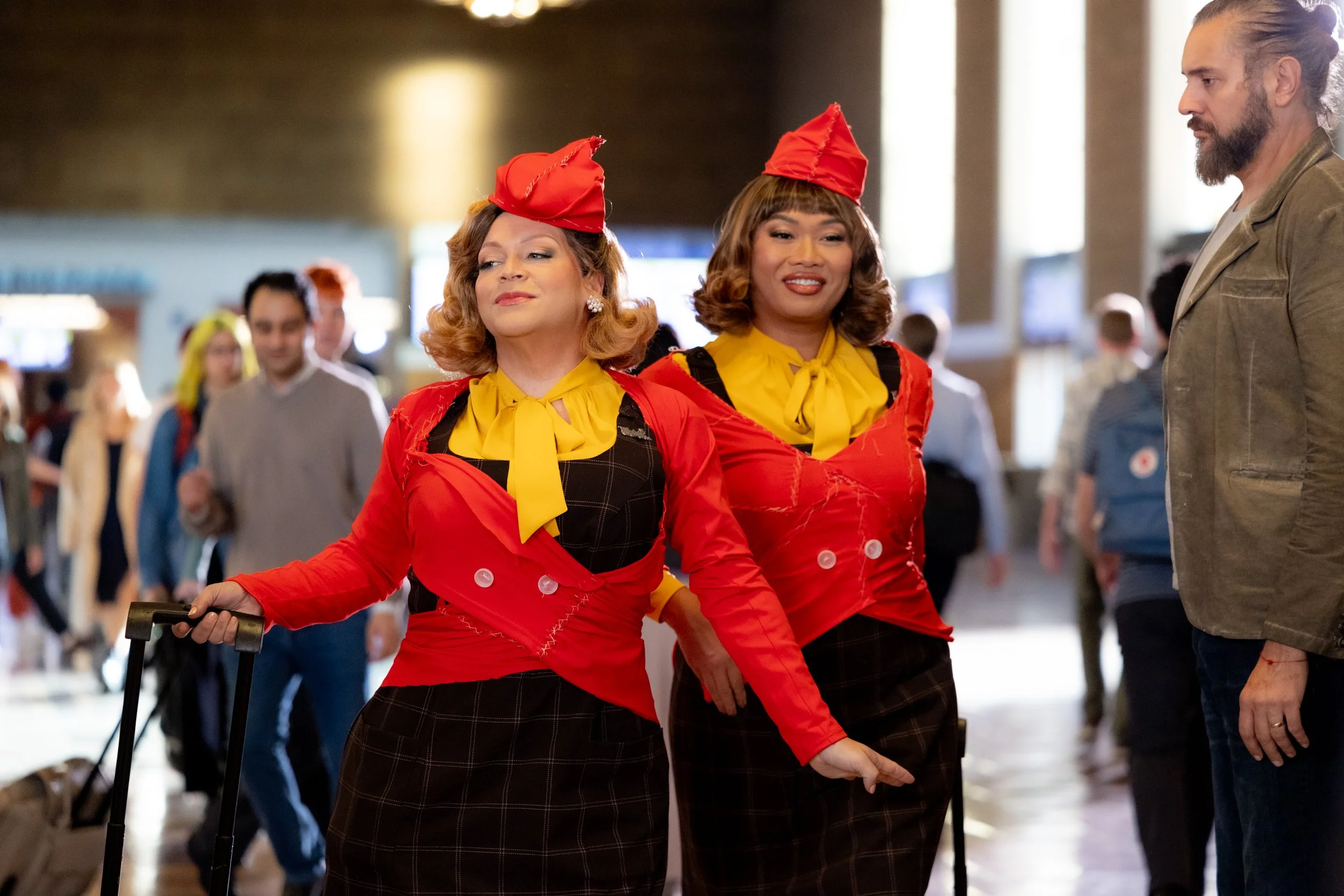
A scene from Stop! That! Train!
And a sampling of the rest of the fest:
Inside Out 2SLGBTQ+ Film Festival (May 22-31), which includes 29 features and 72 short films, kicks off Friday night and runs until the end of the month. For a complete program and ticket information go to the Inside Out website.
The festival opens wit the action comedy, Stop! That! Train!, a sneak preview of a feature which opens theatrically on June 12. Directed by Adam Shankman, the movie stars RuPaul as President Gagwell, Drag Race alumni Ginger Minj and Jujubee as train stewardesses on a runaway high-speed train that threatens to crash into Los Angeles during a storm. The cast includes other Drag Race regulars (Raven-Symone, Brooke Lynn Hytes, Marcia Marcia Marcia) along with Sarah Michelle Gellar, Nicole Ritchie, Joel McHale and Chris Parnell.
And if that isn’t enough RuPaul for you, two documentaries focus on former Drag Race contestants. A Deeper Love: The Story of Miss Peppermint, a documentary about performer/activist Peppermint, while the closing film is Heals, about Pangina Heals, sometimes called the RuPaul of Thailand, the first Asian drag queen to land a Las Vegas residency.
Give Me the Ball!, a documentary which had its premiere at Sundance earlier this year, celebrates the achievements of tennis star Billie Jean King. Reviewing the film from Sundance earlier this year, The Hollywood Reporter’s David Rooney described the film as “a non-fiction feature with the propulsive excitement of a great narrative” which “weaves a wealth of archival material around a captivating present-day sit-down interview with the octogenarian subject, who is candid, funny and unfailingly down to earth.”
Hunky Jesus. The “Hunky Jesus” and “Foxy Mary” competitions are an annual Easter event in San Francisco, overseen by the longstanding LGBTQ+ advocacy group Sisters of Perpetual Indulgence. Screen International called the film a “raucous, joyful documentary” built around the 2023 event, but going deep into the organization back to the late 1970s and its history in AIDs activism and queer rights.
The Brazilian-set Gugu’s World, which a Variety called a “radiant queer coming-of-age charmer” about a pre-teen soccer player, took the jury prize for Generation section at the 2026 Berinale. Another Berlin prize-winner, the Spanish-language romantic drama Iván & Hadoum (“fresh and intriguing” Screen Daily) deals with class differences and social expectations in the relationship between a trans-man migrant worker and a Spanish Moroccan woman co-worker in an industrial greenhouse in southeast Spain.
For those who missed it at as the opening film of last month’s Hot Docs, Inside Out includes the documentary about former Rough Trade singer and songwriter, Antidiva: The Confessions of Carole Pope.