
Original-Cin Chat: Stars of At the Place of Ghosts on Native Visions, History and Horror
Bretten Hannam’s Sk+te'kmujue'katik (At The Place of Ghosts) is a hard-to-pin-down tale of two estranged Mi’kmaq brothers brought back together by a series of supernatural events.
Siblings Mise’l and Antle (Blake Alec Miranda and Forrest Goodluck) shared a childhood trauma, with Mise’l fleeing his memories in the city, and Antle staying at home trying to suppress them.
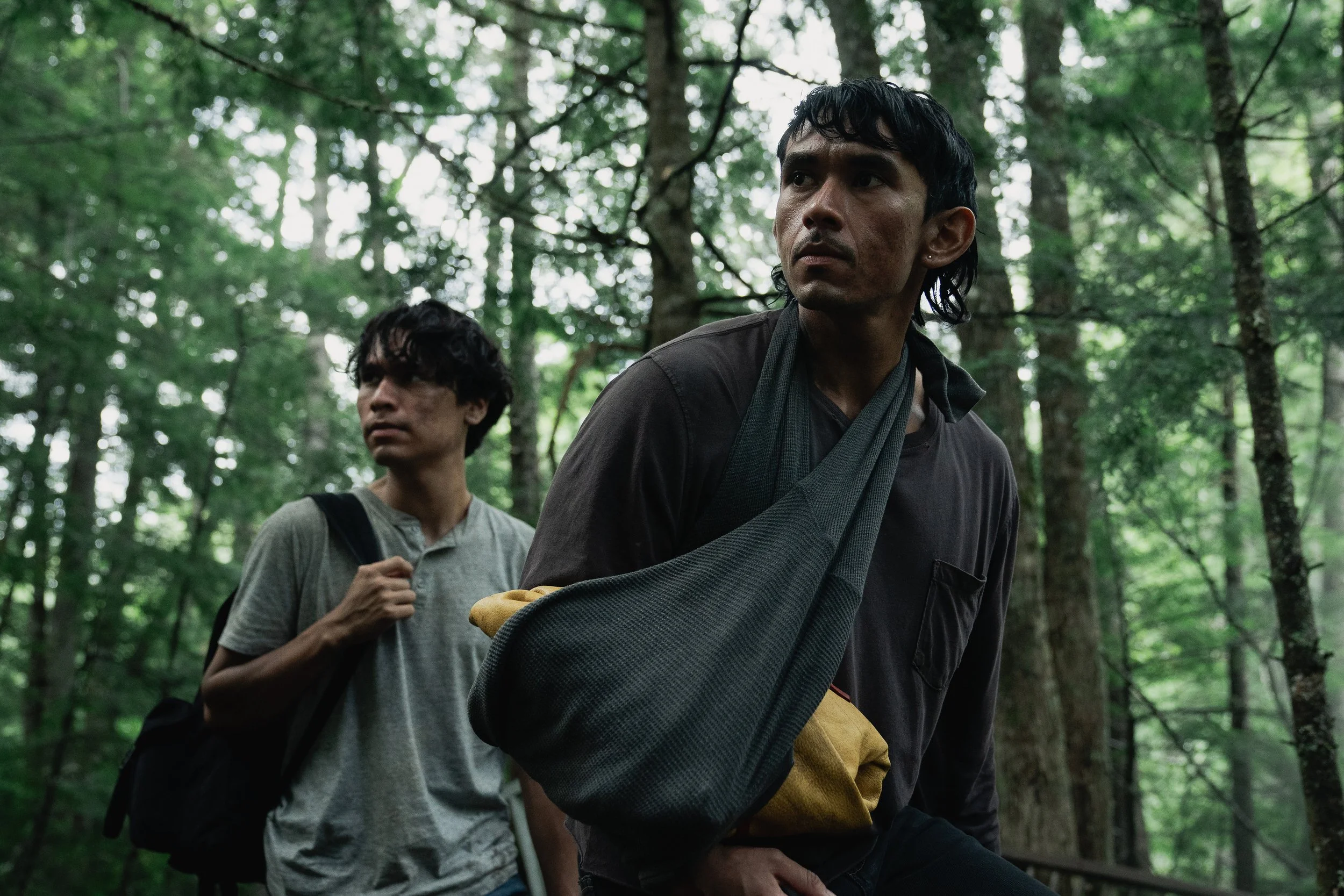
Forrest Goodluck and Blake Alec Miranda take to the trees in At the Place of Ghosts
The movie doesn’t show its cards all at once. All we know going in is that, for better or worse, the answer lies in the woods, at The Place of Ghosts. What follows is a tree-lined trek through various past visions, friendly and threatening, going back hundreds of years to colonial British soldiers, encounters with spirit-driven direwolves, and with childhood versions of themselves.
I spoke with the California-born Miranda and Goodluck (The Revenant, Indian Horse) the day after At the Place of Ghosts premiered at the Toronto International Film Festival. Two-spirited in more ways than one, Miranda is both an actor and a scientist, with a degree in cognitive neuroscience.
I asked him about the notion of there being a spiritual region of the brain, and how that might relate to the hallucinations in At the Place of Ghosts. “Well, the brain is biology, but the mind is something completely crazy and different,” he says.
“I think what this film does is play with psychology in a very interesting way, and it makes a lot out of this mysticism to play with our anxieties. We trust our minds, but you can’t always trust your mind.”
The brothers’ interactive visions cover a broad range of themes, from colonial history to child abuse. So, is it a horror movie?
“I think it’s a vaguely horrifying movie,” Goodluck says with a laugh. “But yeah, it plays with genre.”
“I’m a huge horror movie junkie,” Miranda adds. “I love the traditional conventions of horror films. But one thing that stood out for me about this particular film is that it feels pretty fresh. It doesn’t feel like it deals in traditional conventions.

“I love the way this film portrays Mi’kmaq spirituality in an accurate and truthful way.”
The two American actors are from Indigenous cultures separated from the Mi’kmaq by thousands of miles. Goodluck was exposed to it, however, working with the late director Jeff Barnaby on the Native-themed zombie movie Blood Quantum.
“I got to know a bit of the modern history and the tumultuous relationship they’ve had with your government, and the really intense side of history, how they’ve preserved their culture and their land.
“I think this film is very cool because it took a completely different approach going back so far (in time in the visions), from pre-contact to first contact and then giving us this story of modern Indigeneity versus what it used to be.”
A key plot point in the film is the uncovered memory of a murderously homophobic father (Glen Gould) who’d disowned his son Mise’l for being gay – a decided non-believer in two-spiritedness.
“The way Bretten has explained it to me, and what I’ve seen is that all these colonized people went through boarding school,” Forrest says. “It was a Christian upbringing, forcibly impacting Native people and our relationship with our two-spirit and our queer community.
“And the Mi’kmaq people who supported that community was destroyed. And I think a lot of the characters in the film from Holy Joe (a distant ancestor of the brothers) to this queer woman warrior (who fought the British), they speak to the openness that there was in the community. That was destroyed and turned into a vile thing - which Brennan has experienced.”
Adds Miranda: “It was a very sharp meeting of colonialism and generational trauma. As a queer person, it’s something I myself have experienced and am reconciling with. I think that message is intergenerational. I think it’s a universal sort of thing, people inheriting the scars of their ancestors.”
Acting with an entirely Indigenous cast doesn’t happen often for either. Playing in a film with a mainly white cast is one thing, but I ask whether they’ve encountered non-Indigenous actors playing Indigenous roles.
“That’s a touchy subject, but yeah for sure. Yes, I have,” Goodluck says.
“I think those stories are so well known,” Blake adds.
But these days? Would anyone dare?
“Oh, they dare,” Goodluck says. “But once you have people like in this film, Bretten in the community, the language keepers bringing in John R. Sylliboy (Dalhousie University’s vice-provost of Indigenous Relations) as the language consultant, it’s a different environment.
“I’m interested in seeing Native and Indigenous folks behind the camera, cinematographers and ADs, producers, crew. You can have a bunch of Native actors, which is cool. But like you turn around and it’s sort of homogenous behind the camera.
“There’s so many talented people who need that opportunity as well.”