
Camp: When Girl Power Gets Scary
By Liam Lacey
Rating: A-
It isn’t every day that you learn about a gifted Canadian filmmaker at the vanguard of a new sub-genre.
Avalon Fast, a 26-year-old filmmaker from Vancouver Island, has been making short films since high school. Her first feature, Honeycomb (2022) was a cabin-in-the-woods psychological drama about a kind of all-girl commune which played at Slamdance and other festivals.
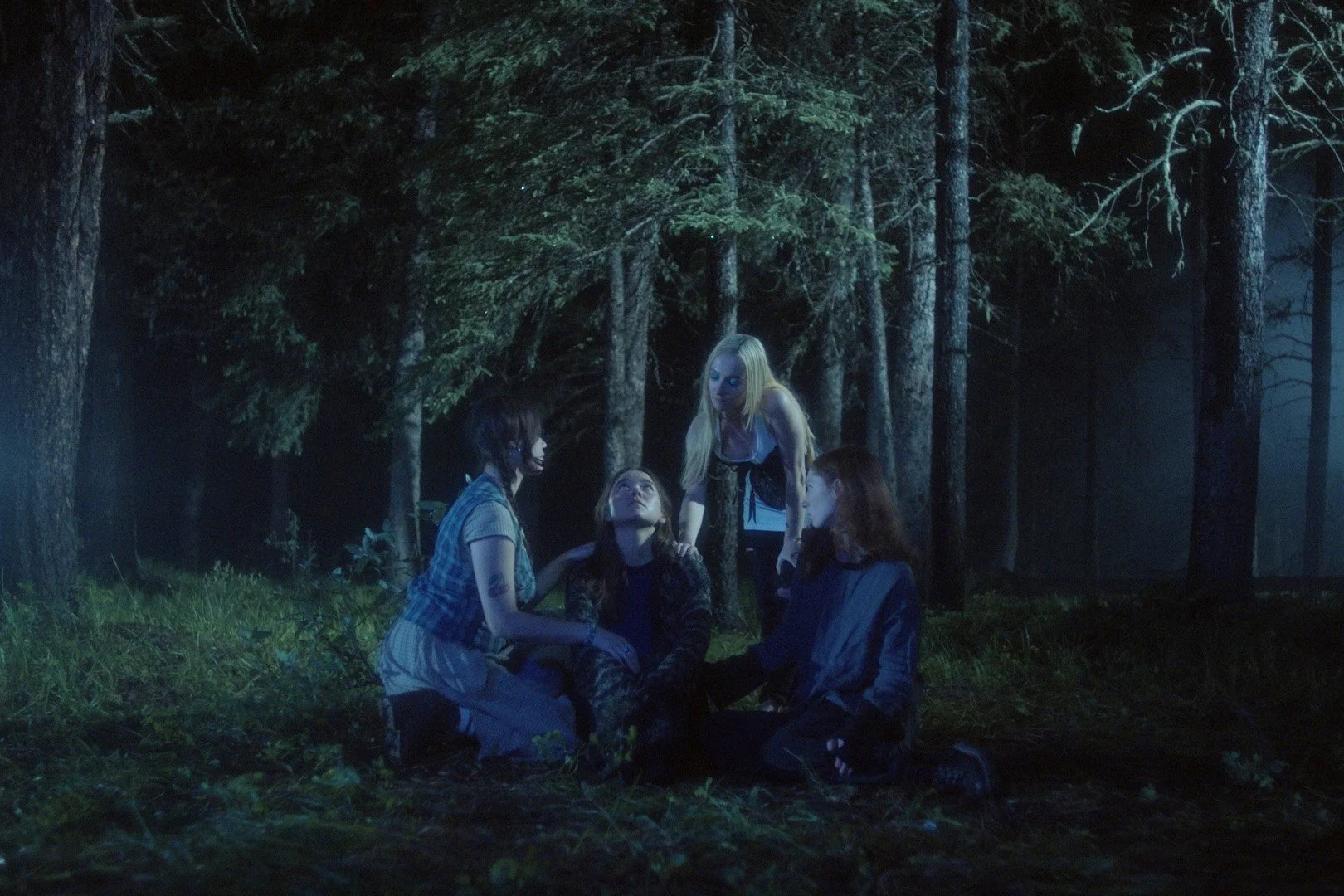
Camp, her sophomore film — which won prizes at the Fantastic Fest and Brooklyn Horror Film Fest last year — follows a different group of girls in the woods.
Fast has adopted the brand “Girl Horror” for her oeuvre, which extends to films she has acted in (Alice Maio Mackay’s The Serpent’s Skin and Louise Weard’s Castration Movie Anthology) and a wave of experimental horror films that explore questions of trauma and transformation. (I recommend Payton McCarty-Simas’ feature in the January issue of Rue Morgue: “Girl Horror! A Vibe a Community and a Revolution”).
So, what kind of film is Camp? The title is not a pun on mocking summer vacation films (But I’m a Cheerleader, Wet Hot America Summer). Still, Fast’s film shuffles many of the genre’s cliches (crushes, bonding, loss of virginity, the misfit kid) and lavishes on the narrative an abundance of style including symbolic images, drug trips, dreams and flashbacks, and a palette of changing textures, coloured lighting on smoke and fog, and bits of animation, both within live action scenes and in a standalone dream sequence.

At the centre of this visually unstable world, there is a semi-naturalistic story about Emily (Zola Grimmer) stoically carrying a mountain of guilt. At a college end-of-year party, during a game of truth or dare, Emily informs the other guests she once accidentally killed a child with her car which puts a pall on the party games. After leaving the party, Emily lets her best friend Charlie snort some of the cocaine she has in her glove compartment. Charlie promptly dies. Now Emily has two deaths for which she is responsible.
The script isn’t interested in the mundane forensic details (autopsy, police investigation?). The next thing we know, Emily’s father (Michael Tan) takes her for a walk in the woods and makes the puzzling recommendation that she should travel to work as a counsellor at a camp for “damaged kids” on the assumption that this will prove therapeutic.
Emily accepts and soon we see her on a spooky train ride journey where other riders stare at her and, somehow, Emily calls her father on a landline from the train to tell him she has discovered, via the internet, that the camp is a “God camp.”
Given the unmistakably David Lynchian vibe of these early scenes, a viewer might suspect that it was actually Emily, not Charlie, who overdosed in the car that night and we are following her dream journey to the other side, a.k.a. “God camp.”
That possibility remains a loose strand in a film that, for all its atmospheric richness, can sometimes feel overstuffed and overextended. Ultimately, Fast is less interested in the supernatural scares than social behaviour.
When Emily reaches the camp, she is greeted by the Christian head counsellor, Dan (Austyn Van de Kamp) who introduces her to his second-in-command, Jo (Sophie Bawks-Smith), a former camper turned counsellor, both of whom radiate warm, naïve sincerity.
In fact, most of the counsellors are former campers, now carrying their childhood traumas into their adult caregiving jobs. The male staff includes Kayne (Henri Gillespi), a guy with a predatory manner who reportedly once threw his girlfriend down the stairs and broke her leg, and the fragile God-fearing JB, (Aidan Laudersmith).
Most important to the story are a group of tightly knit girl counsellors who operate a sort of shadow cabinet under the noses of the naïve Christian camp directors. They include their charismatic leader, Clara (Alice Wordsworth), the highly sexual Nev (Lea Rose Sebastianis), the introspective Hope (Ella Reece) and Emily’s insistently cheery roommate Rosie (Cherry Moore), who welcomes Emily as “another gorgeous weirdo like the rest of us,” who mentions that she had a baby once.
Though we don’t know about their specific traumas, Emily finds herself embraced and absolved in their collective acceptance. Clara declares: “I know what it’s like to be lost with some guilty conscience about some fucked-up shit that shouldn’t have ever happened.”
There’s a paradise lost allegory here. As well as the character of Kayne (Cain?), Emily is assigned to supervise a brooding young adolescent named Eden (Izza Jarvis), who proves resistant to her attempts to form a big sister bond. Implicitly, the girls are rebelling against the guilt of being born female (Eve, apple, sin) that justifies their second-class status.
In the evenings, the girl counsellors get trashed on drugs and chug wine from the bottle and hug and compliment each other until they pass out, facing the kids (“little nightmares”) with bad hangovers. In the attic above the dining hall, the girls play secret sharing games, which escalate into full-fledged cult behaviour with late night forest witchy rituals with candles, black lipstick, waving arms, flowing dresses and sparks flying from their fingers. (I kept thinking of Stevie Nicks, who guest starred as a witch on Ryan Murphy’s American Horror Story series).
Even as Emily goes along with group, she is increasingly aware that the girls have internalized and imitated the cruelty of the system they are rejecting. Camp grows increasingly fantastical and in its final 10 minutes, climaxes in a distorted mirror image of Christian sacrifice in which the potential shock value is tempered by a kitschy prettiness.
Horror tropes aside, Camp feels like a response to something that hangs heavily in the air these days: claims about religiosity and victimhood. Think of U.S. vice president J.D. Vance, a Catholic convert, mentored by tech billionaire Peter Thiel, a perverse disciple of the late French anthropological philosopher René Girard, whose theories of imitation and scapegoating have proved increasingly popular in explaining today’ culture wars.
Why, for example, did Vance lie about Haitian immigrants eating cats and dogs in Springfield, Ohio? Because oppressors need to seize victims’ moral high ground: “If I have to create stories so that the American media actually pays attention to the suffering of the American people, then that's what I'm going to do.”
In the meantime, Fast’s next film, Drinking and Driving — co-directed with Jillian Frank — is currently on the festival circuit. Here’s looking forward to their next transgressions.
Camp. Written and directed by Avalon Fast. Starring Zola Grimmer, Alice Wordsworth, Cherry Moore, Lea Rose Sebastianis, Ella Reece, Austyn Van de Kamp, Sophie Bawks-Smith, Izza Jarvis and Aidan Laudersmith.
Now playing at Cinéma Public, Montréal, Tivoli, Charlottetown, Cinéma Moderne, Montréal, and Cinecenta, Victoria. Opening June 26 at Globe, Calgary and Revue Cinema, Toronto. Opening July 1 at ByTowne, Ottawa and July 2 at Paradise, Toronto. Opening July 9 at Dave Barber Cinematheque, Winnipeg and Fleapit (Carbon Arc), Halifax. Opening July 12 at Metro, Edmonton and July 17 at VIFF, Vancouver.