
Dust Bowls and Jewish Souls: Woody Guthrie Bio is a Toronto Jewish Film Fest Stand-Out
By Liam Lacey
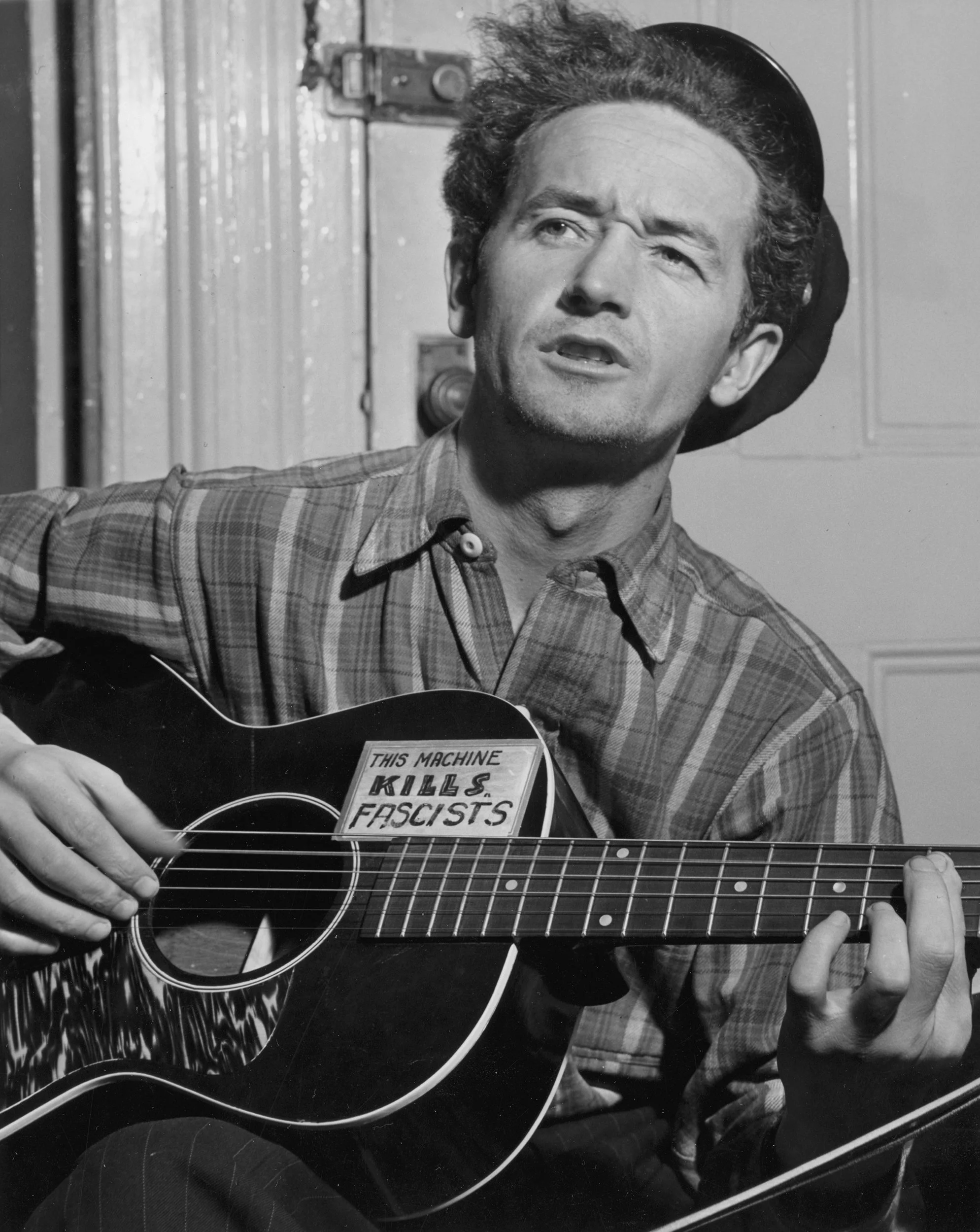
Steve Pressman’s documentary, Dust Bowls and Jewish Souls: Another Side of Woody Guthrie - which has its world premiere opening at the Toronto Jewish Film Festival Thursday - is a reminder that the folk singer, was, like his literary muse, Walt Whitman, a self who contained multitudes.
Those multitudes included dust bowl refugees, immigrant labourers and Jewish artists in New York City.
The spirit of Guthrie (who died in 1967 of Huntington's disease) and his anti-fascist musical crusade is all around us these days. Think of Bruce Springsteen, on the penultimate episode of Stephen Colbert’s Late Night, with his guitar and harmonica, singing The Streets of Minneapolis with its lyric “We’ll take our stand for this land,” echoing Guthrie’s This Land Is Your Land.
Or consider the viral videos of four-time Grammy nominee, Arkansas native, Jesse Welles, using the same guitar, harp and raspy delivery on the sardonic protest songs, Join ICE and Good vs ICE, protesting the goon squads of Immigration and Custom Enforcement. Not to forget Scoot McNairy’s turn as the bed-ridden Guthrie, in the opening scenes of James Mangold’s A Complete Unknown the spirit guide for Bob Dylan’s journey.
A major reason why Guthrie’s legacy flourishes is a constant stream of books, biographies and new recordings based on his lyrics.
For these, credit the archival work of his second wife, Marjorie Mazia (née Greenblatt). Marjorie was a modern dancer with the Martha Graham Company, who Guthrie met in 1942 (when they were both married to other people), and wed in 1945.
According to the major biographies over the past 40 years (by Joe Klein, Ed Cray, Gustavus Stadler) the relationship was volatile and complicated. They had four children together: Cathy died at the age of four in a fire, Arlo became a famous folk singer, Joady lives a private life in San Francisco, and Nora, the youngest, is the current curator of the family history.
For a few years in the 1940s, part of which spent doing service in the Merchant Marine, Guthrie was a doting father who embraced his Jewish family and Coney Beach neighbourhood. Guthrie wrote many lyrics on Jewish themes, including Jewish history, a song about the German war criminal Ilsa Koch, and cheerful children’s Hanukkah songs.

He developed a creative bond with his mother-in-law, Yiddish poet and songwriter, Aliza Greenblatt, the “Bubbie” to his four children. One of the fascinating documents shown in the film is a typed page showing Guthrie’s line-by-line edit of an English translation of one of Aliza’s poems. He also drew illustrations for one of her books. It was also the period when he published his own semi-autobiographical book,Bound for Glory,.
Dust Bowls and Jewish Souls is an anecdote-rich, family-friendly and celebratory film, full of tales of Shabbat dinners and Arlo telling stories of beach walks and Hanukkah Christmas trees. The film’s interview subjects express astonished delight at the connection between Jewish New Yorkers and the Dust Bowl balladeer. (“There’s not Jewish and then there’s really not Jewish,” says Yiddish Book Center founder Aaron Lansky, referring to Guthrie’s small town Oklahoma background).
But there was considerable political common ground between Guthrie and his new found family. In his Guthrie biography, Joe Klein quotes Irwin Silber, the socialist editor of the magazine, Sing Out: "There was the heart of America personified in Woody . And for a New York Left that was primarily Jewish, first or second generation American, and was desperately trying to get Americanized, I think a figure like Woody was of great, great importance."
Not surprisingly, Guthrie had numerous Jewish connections in the music business, including his manager, Harold Leventhal, and Moses (Moe) Asch of Folkways Records, who recorded many of Guthrie’s songs.
And there were his famous Jewish musical acolytes, Robert Zimmerman of Hibbing, Minnesota and Ramblin’ Jack Elliott (a Brooklyn surgeon’s son, born Elliott Charles Adnopoz.) The film does not mention one of his important political mentors, Ed Robbin, a radio host and editor with The People’s World, a Los Angeles communist newspaper.
The film’s weakness as history is in its eagerness to smooth over the rough patches of Guthrie’s family life. Late in the film, Nora recounts her mother saying she and Woody agreed to a divorce so she would not be responsible for his medical bills and that she cared for him for the next 15 years. (Marjorie said the same thing in a 1977 New York Times interview).
But various biographies and memoirs offer a more complicated account of the dissolution of the marriage, beginning with the onset of Guthrie’s disease symptoms, when Marjorie struggled with his irresponsibility, moodiness, drinking and the fear of violence against her and the children and in 1952, ordered him out of the house.
The narrative skips over the events after Guthrie’s 1952 Huntington’s diagnosis, when he went to California at Marjorie’s suggestion, met and married another woman, Anneke van Kirk, had another baby, got another divorce, and spent much of 1954 wandering the country. In 1956, he was picked up by the police on a New Jersey highway and committed to the first of the hospitals where he spent the rest of his life.
Marjorie, who had remarried, came back into his life and took charge of his care. Before her death in 1983, she became an important activist for research into Huntington’s disease, leading to advances which improved detection and treatment (though it is still incurable). The other part of her legacy was sustaining Guthrie’s cultural relevance.
In 1956, the year of his admission to hospital, Marjorie, along with Pete Seeger and Harold Leventhal and others, set up the Guthrie Children’s Trust Fund to protect Guthrie’s royalties and provide for their children education and medical bills.
That organization evolved into the Woody Guthrie Foundation (1972) to oversee his archive. In 2013, became the Woody Guthrie Centre, an archive and public museum based in Tulsa, Oklahoma. The Guthrie Centre also hosts an archive of the late folk singer, Phil Ochs. A nearby museum and archive is dedicated by the Bob Dylan Centre, all of these financed by late George Kaiser, a Tulsa oil billionaire whose parents fled the Nazis.
In the late 1990s, the torch was handed down to Guthrie’s daughter, Nora, who, as president of the Woody Guthrie Foundation, opened his archives up to musicians to create and record music to Guthrie’s lyrics. That includes three albums entitled Mermaid Avenue by Billy Bragg and Wilco, and two albums based on Guthrie’s Jewish-themed lyrics, by The Klezmatics. The latter including Happy Joyous Hanukkah and Wonder Wheel, which won a 2007 Grammy for best world music recording. Some of The Klezmatics songs are included in the film.
As Woody Guthrie’s spirit lives on, so does the legacy of his adversaries. In 2014, one of the film’s interview subjects, the author and musician, Will Kauffman, uncovered the lyrics of one of the hundreds of unpublished songs in the archives, entitled Old Man Trump, condemning the racist rental policies of Guthrie’s landlord, Fred C. Trump, father of you know who. To quote Guthrie’s friend and fellow protest singer, Pete Seeger, “When will they ever learn?”
Dust Bowls and Jewish Souls screens at the Hot Docs Ted Rogers Cinema at 7:30 on Thursday night. The festival closes on June 14 with a film which previously screened at TIFF, You Had to Be There: How the Toronto Godspell Ignited the Comedy Revolution. For a complete schedule of films in theatres around Toronto and online and for ticket information, go to tjff.com.
Other selected highlights from the Toronto Jewish Film Festival (June 4-June 14)
Oxygen (Centrepiece Drama, June 7, 8 pm, Al Green Theatre)
Netalie Braun’s drama about a single mother who goes to desperate measures to get her soldier son away from the front, won the top prize at the Jerusalem Film Festival last year. The film is described as an anti-war film and critique of Israeli’s military ethos and conscription. Haaretz critic Oron Shamir declared it the best Israeli film of 2025. The festival also includes Braun’s recent; documentary, Shooting, on the role of cinema in state violence. (June 7, 4 pm, Carlton Cinema).
Holofiction (Centrepiece Doc, June 11, 5:45 pm, Al Green Theatre).
Shoah director, Claude Lanzmann’s criticism of Steven Spielberg’s 1994 film, Schindler’s List is that it was the “gravest transgression” to create a ictionalized depiction of the Holocaust. Inspired by Lanzmann’s critique, Polish director and media artist Michal Kosakowski assembled a montage film of more than 3,000 images from hundreds of movies and TV series, exploring repeated tropes and scenes, including examples of actors who have played both perpetrators and victims in different films.
The Safe House. (June 5, 1 pm, Cineplex Cinemas Varsity)
The setting is Paris, May ’68, and student protests explode across the city calling for the resignation of President Charles De Gaulle. Meanwhile, a nine-year-old boy is left in his grandparents apartment while his parents join the crowds outside. Swiss filmmaker Lionel Baier, adapting the 2015 novel by Christophe Boltanski, gives a child’s eye view of his intellectual and artistic family including a great-grandmother and uncles (one of whom is based on the artist Christian Boltanski). The film is described as a whimsical comedy and exploration of family history.
The Boys and Other Snapshots of Jew-ish Toronto. (June 6, 6 pm, Al Green Theatre)
This collection of three short student films set in Toronto in the 1970s isset around Bathurst Street, Lawrence and Forest Hill. Two of these are by Alan Zweig (Vinyl, I Curmudgeon), including the improv male bonding film, The Boys (1977), with Ralph Benmergui and Joel Axler; Laurence Plaza (1973) also by Zweig, with Bernie Lightman and Paul Hutter. The third film, Justice (1974) by actor-writer-director, Eric Weinthal, is about a kid who steals gum from a Bathurst and Eglinton convenience store leading the police on a chase through Forest Hill.