
The Odyssey: Nolan Turns Homer's Epic into a Bracing, Powerful Thinking Man's Adventure
By Karen Gordon
Rating: A+
Christopher Nolan has given us movies that are both breathtaking and mind-bending in their scope and action. Think a car chase where the cars go forwards and backwards at breakneck speeds, or cityscapes that fold on top of themselves.
In his more conventional movies he’s looked at war from the heroic (Dunkirk) and from morally disturbing (Oppenheimer).
So, what would attract him to an almost 3,000 year old epic poem, a mythical story set in the ancient world?
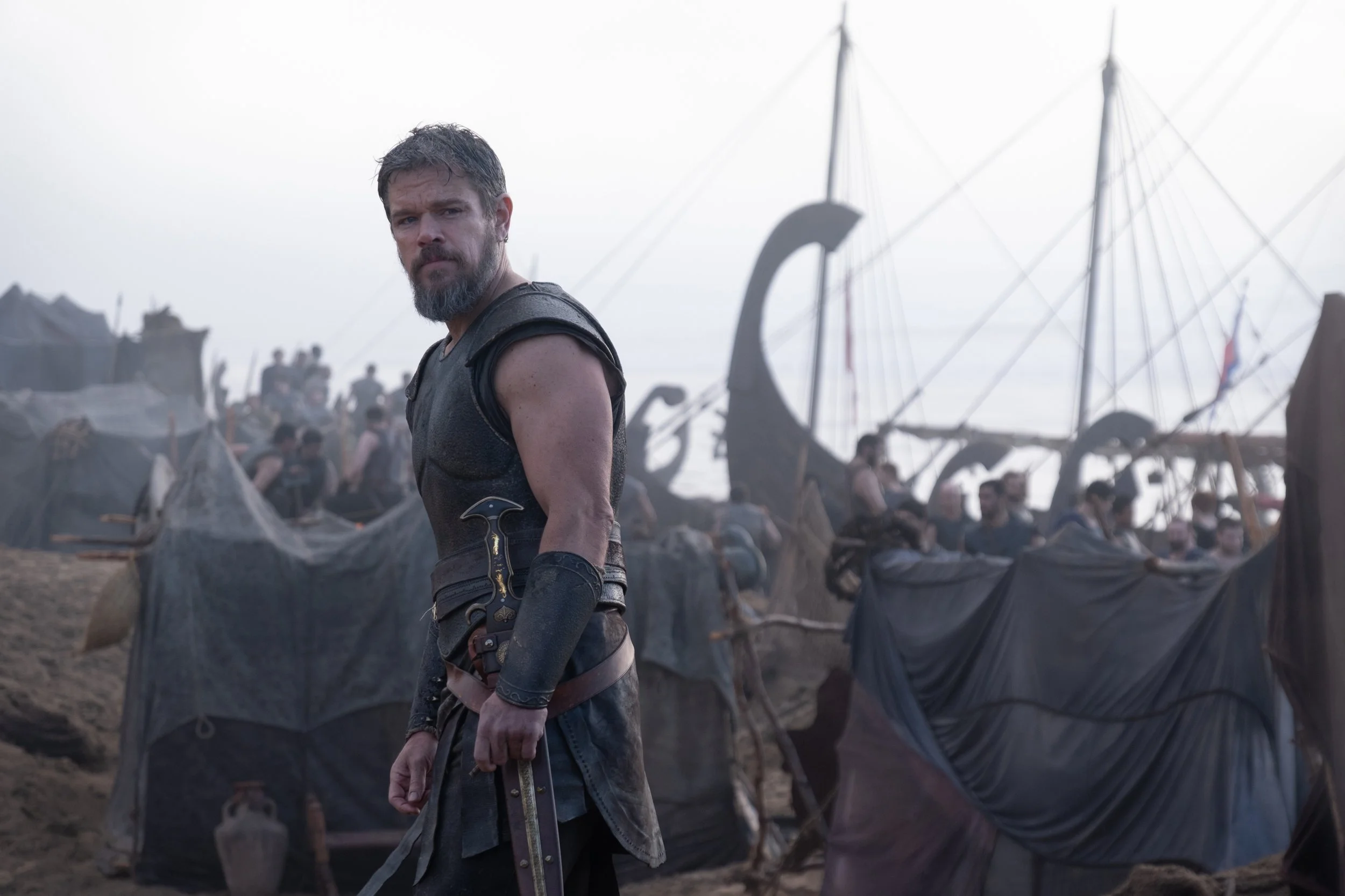
The Odyssey, which he adapted and directed, is as epic and visually spectacular as you would imagine from this master filmmaker.
It’s shot totally in the latest IMAX film technology - making it the first feature entirely shot in that expensive and labour intensive format - with his frequent collaborator, cinematographer Oscar winner Hoyte van Hoytema (Oppenheimer, Dunkirk), and with Oscar winning production designer Ruth De Jong(Oppenheimer, Us).
The result is a film that’s visually stunning and which transports us to the ancient world in a visceral and exciting way.
But Nolan isn’t dipping into one of the Western world’s most enduring myths for its visual potential, or the chance to shoot fabulous battle scenes for their own sake. This isn’t a superhero movie.
Nolan’s The Odyssey, which is filled with gods and monsters, rage and battles, love and persistence, is, at its core, about something much bigger: a plea for peace and humanity, a continuation of the themes he presented in Oppenheimer.
In his adaptation, Nolan has stayed fairly true to the core of Homer’s poem about King Odysseus of Ithaca who, after 20 years away for the battle of Troy, just wants to get back to his home and family.
Odysseus (Matt Damon) set out from Ithaca in service of his King, Agamemnon (Benny Safdie) leaving behind his beloved wife Penelope (Anne Hathaway) and his young son Telemachus, (Tom Holland) to wage war on the heretofore impenetrable city of Troy.
After a decade of waging siege, Odysseus succeeds by sending in a deception, a ‘gift’—the Trojan Horse—that leads to the sacking and brutal destruction of the city.
With that behind them, they head home. But that voyage home ends up being trickier and more fraught than they could ever have imagined. Odysseus and his men must make stops on various islands along the way to rest and get supplies, but luck eludes them.

At each stop they run into into conflicts with monsters (The Cyclops), a witch, Circe (Samantha Morton), a goddess, Calypso (Charlize Theron), storms at sea, and seductresses who sing sailors to their deaths, plus a side trip to Hell for Odysseus. Soldiers die. Odysseus loses his memory for seven years after being fed a delicious plant with druggy properties.
In the meantime, there is a separate storyline going on in Ithaca, where a snake-pit of aggressive suitors have moved into Odysseus’s castle demanding that Penelope admit that her husband is dead and never coming home, and choose a new husband from their ranks.
The suitors, led by the handsome, treacherous Antinous (Robert Pattinson) are basically all cut from the same scheming cloth. Odysseus’s son Telemachus is to inherit the throne. But the suitors all plan to murder him if they are chosen by Penelope. She keeps them at bay with her own trickery as best she can, as they grow impatient, and become more threatening.
For his part, Telemachus grows tired of waiting and, in spite of his mother's warnings, takes to sea to find his father, or anyone who can tell him whether he is alive or dead.
Nolan’s adaptation is relatively faithful to the story. Odysseus is an intelligent man on a quest for knowledge, a battle-forged leader, a loyal servant, heroic in all the ways an ancient world warrior should be.
He’s supported by Athena (Zendaya) who silently appears to him from time to time, perhaps giving him strength. But, as time passes, his crew begins to doubt him. They believe that he has angered the gods, especially Poseidon.
Homer’s The Odyssey ticks a lot of the boxes of the kinds of stories that Nolan is typically drawn to: action films built around men, intelligent, complex and morally flawed, even if they aim to do good things. He also likes to play with time, with sometimes almost incomprehensible results (I’m looking at you Tenet).
The Odyssey, by contrast, is utterly comprehensible and will stand up to multiple viewings. Nolan’s script is beautifully constructed, with flashbacks that build the story.
All of this leads up to a moment in the film where Odysseus in the disguise of a beggar, talks about where he’s been and what he’s seen: the futility of war and killing, horrible things done for no particular reason other than following a command.
There is more to the film than this, and more themes to consider both in the original and in Nolan’s movie. Nor is this the end of Odysseus’s personal journey here. Penelope, Telemachus and the suitors have scores to settle as well.
Driven by powerful performances, particularly from Matt Damon, we see a thinking man in The Odyssey, who is really us, in an adventure bigger than we could imagine. It is both relevant and urgent.
It’s bracing, powerful stuff by a master storyteller.
The Odyssey. Written and directed by Christopher Nolan. Starring Matt Damon, Anne Hathaway, Tom Holland, Robert Pattinson, Hamish Patel, Charlize Theron, Elliot Page, Samantha Morton, and Lupita Nyong’o. In theatres July 17.