
A Sad and Beautiful World: A Rom-Com Struggles to Survive in Lebanon
By Liam Lacey
Rating: B
A Sad and Beautiful World is an original, deliberately artificial mashup of romantic fantasy and social political drama, signified by the contrasting adjectives of the title.
The first feature from documentary filmmaker Cyril Aris, which was Lebanon’s 2025 Academy Award submission, has a straightforward plot. It follows the relationship between two middle-class Beirut natives: the adorably optimistic and romantic orphan restauranteur Nino (Hasan Akil) and cynical, pragmatic business consultant, Yasmina (Mounia Akl).
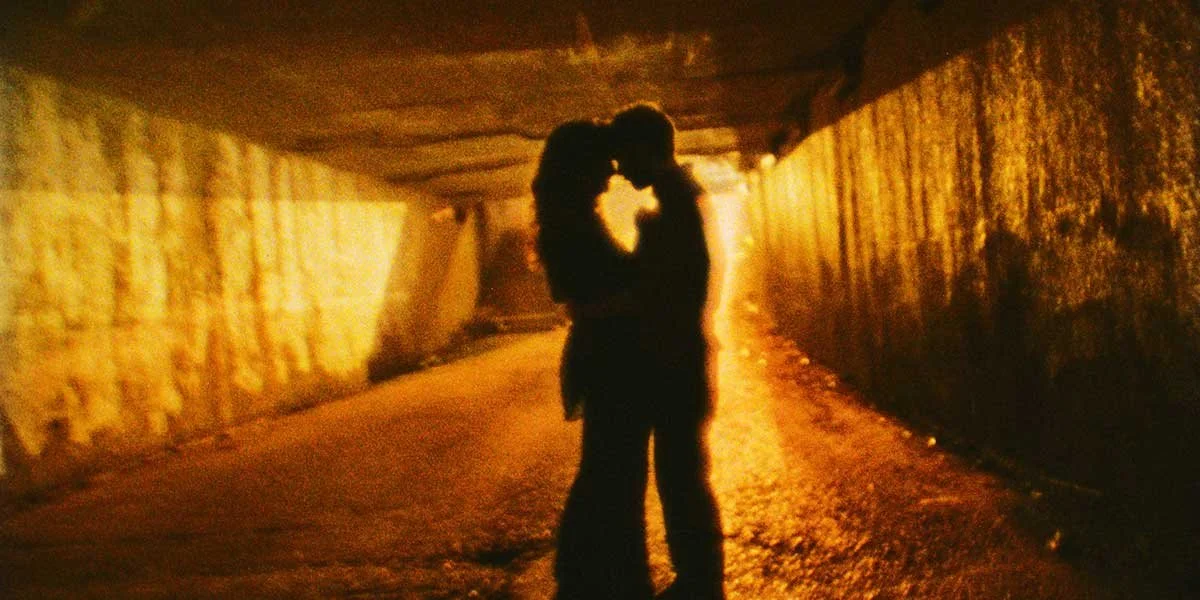
Their relationship takes place over 30 years against the background of Lebanon’s chaotic modern history leading up to the country’s economic collapse in the late 2010s.
The film’s first half follows the conventions of a romantic comedy, albeit one with gunfire and explosions as part of the background noise. Nino, juggling multiple challenges of running his Lebanese Italian restaurant Chez Nino, falls asleep at the wheel and crashes his car into a middle-aged woman’s business office.
Nino tries to make amends by offering the woman (Julia Kassar) and her extended family to dine at his restaurant. While she is awaiting her food, Yasmina sees a picture on the restaurant wall of Nino’s late parents and realizes that their host is her elementary school sweetheart.
Cue the first of several flashbacks of their childhood selves with well-cast Alex Choueiry as the serious young Yasmina and Mohamad Farhat as the irrepressible young Nino, when they were classmates who formed a bond over their different traumas.

Yasmina’s parents were going through an angry divorce, forcing her to choose between them. Nino’s parents were dead, but the boy clung to a story his grandfather told him, that they are still alive living a peaceful island. When he describes it to Yasmina, the island appears as a shimmering image on the screen. For both children, the imaginary island serves as a paradisal refuge.
After their earlier connection is revealed, Nino eagerly pursues a romantic relationship, insisting he has been in love with Yasmina since he was seven. Yasmina’s imperious mother is disdainful of his brash enthusiasm and Yasmina, too — a brooding loner and workaholic — is skeptical.
She comes close to leaving Beirut for a job in Germany but at the last minute, drawn by Nino’s adoration, agrees to stay. Within months, he proposes to her and again, with reservations, she accepts. Later, he persuades her, despite her doubts, to have a child together.
The contrast between the characters is shown by their different workplaces. Nino’s chaotic restaurant is dominated by his tempestuous chef and comic sidekick, Chafic (Tino Karam). In contrast, Yasmina reports to men in suits in high-rise boardrooms, who ignore her worried economic forecasts.
The film’s lively first half is driven by Nino’s cat-and-mouse romantic pursuit, his over-the-top overtures, and her eye-rolling resistance. But the second part is where reality settles into grayer shades and a slower pace, as the actors shift dramatic gears to a more resigned and sombre register and Anthony Sahyoun’s fine electronic score shifts from upbeat to subtly tense.
This a complex transition and it’s not surprising there are snags. The film blurs a specific historic timeline: In a fanciful opening voiceover narration, Nino tells us he was born five minutes after Yasmina, on the same day as a nearby massacre, the end of the Lebanese railway and the day Lebanon launched a rocket into space — events which took place, respectively, in 1980s, the 1990s and the 1960s.
Presumably, the idea is to present a child’s view of history. Everything that happened before his birth is history.
But the approach blurs the political and social context. The final section of the film is one of the few times we can pinpoint the historic moment, specifically Lebanon’s devastating economic meltdown starting in 2019, which continues today.
There are regular power outages. Moving through the city is difficult. Nino and Yasmina can no longer gain access to their bank accounts, and their visions of the future begins to diverge.
Friends who can find jobs are lining up at night in the hopes of securing passports to Dubai, Germany or Saudi Arabia. The film does not settle for a happy ending, though it’s more wistful than tragic.
A Sad and Beautiful World, written between 2019 and 2023, does not bring us up to the present day and the ongoing Israeli invasion in South Lebanon in its ongoing war against the militant group, Hezbollah or the ensuing Lebanese humanitarian crisis.
Throughout this film, the military clashes exist as background noise, an occasional source of angry frustration, but without naming specific aggressors or loyalties, which makes it feel politically toothless. It is as if the characters were victims of a natural disaster, a calamity without culprits, two appealing people stuck in tragic place.
A Sad and Beautiful World. Directed by Cyril Aris. Written by Cyril Aris and Bane Fakih. Starring Mounia Akl, Hasan Akil, Julia Kassar, Camille Salameh, Tino Karam and Nadyn Chalhoub. At Toronto’s TIFF Lightbox July 24 and Montreal’s Cinema du Musée on August 14.