
American Doctor: Treating Broken Bodies in Gaza, Fighting for Hearts and Minds at Home
By Liam Lacey
Rating: A-
Director Poh Si Teng’s American Doctor, which won the Audience Award at this year’s Hot Docs International Film Festival in April, follows three doctors who volunteered to work in Gaza in 2024 and 2025.
They include Dr. Mark Perlmutter, a Jewish orthopedic surgeon from North Carolina, Dr. Thaer Ahmad, a Palestinian American emergency physician from Chicago, and Dr. Feroze Sidhwa, a trauma surgeon from California whose Zoroastrian parents emigrated from Pakistan.
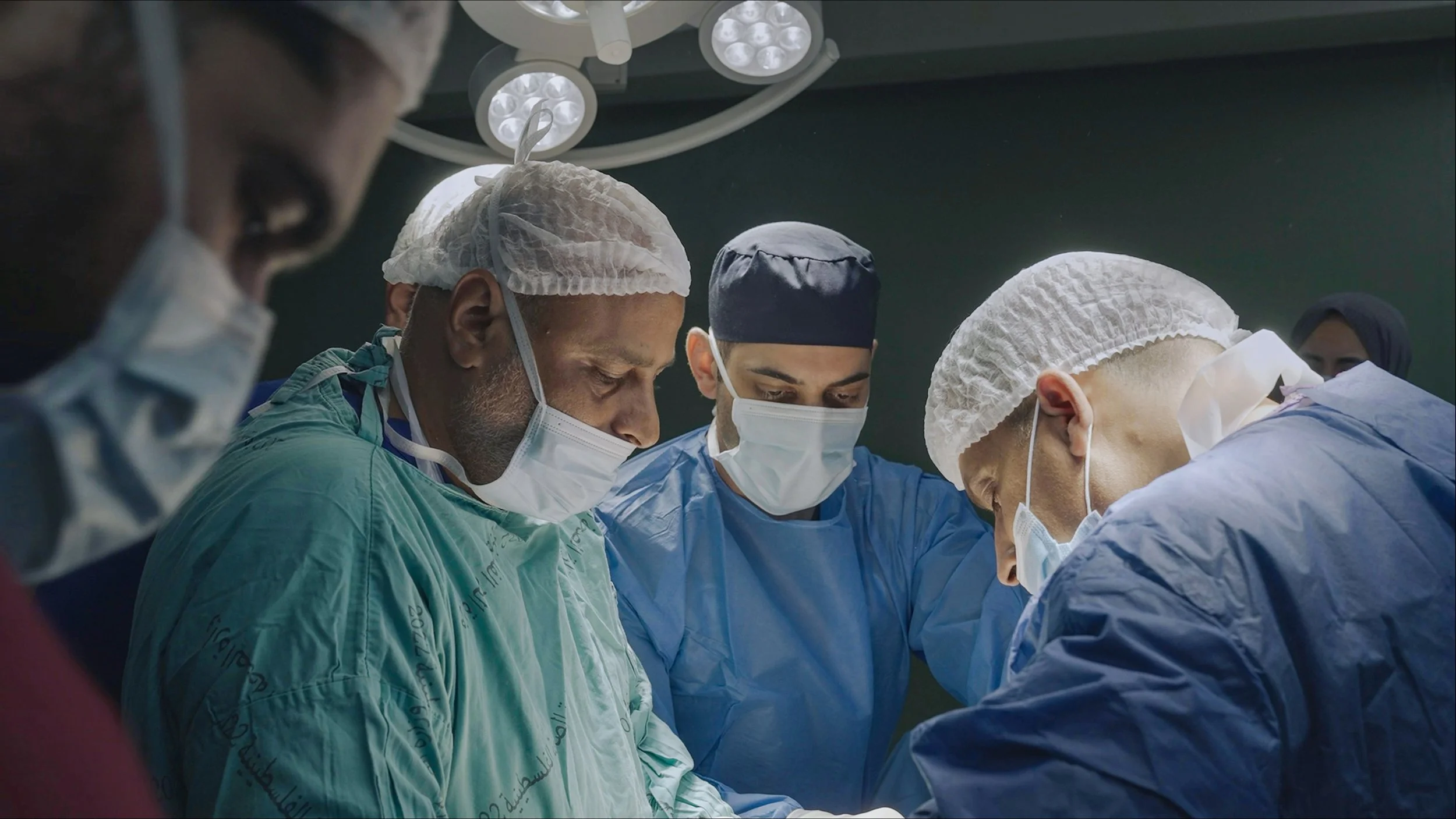
The film captures the doctors working in the chaos of a wartime hospital and follows them home where they attempt to bring the message of what they saw. Israel has banned foreign journalists from entering the Gaza Strip independently since the 2023 Hamas attack, and health workers are an important source of information.
Israel rejects claims by many international organizations — United Nations, Human Rights Watch, Amnesty International, Doctors Without Borders, the World Health Organization, The Committee to Protect Journalists, among them — that its army is committing war crimes, including targeting press, health care workers, and children.
In the film’s opening scene, Dr. Perlmutter is having an argument with the director. He demands that the filmmaker show a photograph of the bodies of young children killed in an Israeli missile strike. The director is reluctant, saying she wants to “preserve their dignity” by blurring the images.
Perlmutter asks who she is trying to protect and insists that softening the brutal reality represents “journalistic malpractice.” His aim is clear: To show the American public what was happening, to push their government from continuing to provide military aid to Israel.
While changing minds and congressional votes is a reasonable goal, for director Teng — a Malaysia-born, New York-based journalist and filmmaker, who resigned from her job at ABC/Disney — the motive was initially a response to her sense of helplessness.

At the Copenhagen International Documentary Festival last March, she told host and TIFF programmer Thom Powers, “A year into the genocide, I didn’t have any more words. I was very angry. And then came despair. I didn’t know what to do with those emotions.”
When she found it difficult to raise enough money for a film about Gaza in the United States, she found further funds from family, friends, and financiers in Malaysia. The three doctors she chose to follow, volunteers through the World Health Organization, had served in crisis zones in Syria, Haiti, and Ukraine as well as Gaza. During 2024, all three wrote editorials based on their frontline experiences, in publications such as the Chicago Sun-Times and Politico.
A landmark New York Times article by Feroze Sidhwa shortly after the anniversary of the Hamas October 7 attacks surveyed 65 Gaza health workers who described widespread malnutrition, children dying of infections that could have been prevented with antibiotics and “multiple cases of preteen children who had been shot in the head or chest in Gaza.”
Images of violence, as Susan Sontag argued in her 2003 book Regarding the Pain of Others, don’t necessarily create understanding and can even desensitize us. (After the intimacy of the hospital scenes, the film’s closing montage of bombs, bodies, and anti-war protest marches felt formulaic and detached).
Watching American Doctor, running a fast-paced 93-minutes, is a vertiginous experience, not only for the images of wounded bodies onscreen, but because of its fractured timeline. The film includes two different visits for the doctors into Gaza.
In the hospital, we see the American doctors interacting with their Palestinian colleagues. An anesthetist describes how his own daughter died while he was unable leave the emergency ward. We see scenes of unconscious toddlers carried on parents’ shoulders or surrounded by a medical team on the operating table. There are drone shots of acres of buildings reduced to grey rubble across Gaza, contrasted with the gleaming towers of Chicago or Washington.
There are two scenes of Israeli missiles crashing into the Nasser Hospital where the doctors worked. Sidha describes how he saved a 15-year-old boy who had survived a bombing, only to see him “incinerated” by a missile strike on the emergency ward.
Although Teng was not on the ground in Gaza, her film crew was also in the danger zone. Most of the footage comes from two Gaza-based cinematographers, Ibrahim Al Otla and Christopher Renteria, who were embedded with the doctors, uploading footage from a balcony at the Nasser Hospital, which was later destroyed by an Israeli missile strike that killed 22 people, including journalists and medical workers.
Back home in the United States, out of their professional contexts, we identify more intimately with the doctors, alone or with their families, haunted by survivors’ guilt and struggling to express that pain. The doctors take their messages to Jewish and Muslim community groups, to off-camera meetings with U.S senators in Washington and skeptical TV journalists.
Dr. Perlmutter, who insists you can love Israel but hate its right-wing government, is the most emotional and combative of the three, who talks about the “disease of genocide” and calls out the media for its omissions. (His doctor father treated Nazi concentration camp survivors after the Second World War).
Dr. Sidwa, more cautious and tactical, wryly warns him that the media does not typically respond well to criticism. Though he mostly maintains a tone of objective professionalism, he doesn’t hide his frustration with distractions (Donald Trump’s claims about Hamas using “condom bombs”) or what he considers specious counterarguments such as Israeli intelligence claims that hospitals are Hamas command posts, and are therefore legitimate targets.
The third doctor, Dr. Ahmad, who volunteered in Gaza in 2024, is denied access to the enclave, clearly because of his Palestinian heritage, though he was born in a Chicago hospital. He spends much of the time stuck in nearby Jordan. Back home, we see him at a Muslim American convention, a local halal café or barbershop, and watch how the Palestinian diasporic community is gripped by news of the ongoing Gaza catastrophe.
“I’m not a spokesperson for anybody. I’m not ‘pro’ anything,” he insists. “I’m a Palestinian who wants to see babies that look like my babies not be killed anymore.”
American Doctor. Directed by Poh Si Teng. With Mark Perlmutter, Feroze Sidhwa and Thaer Ahmad. At Toronto’s TIFF Lightbox starting on August 14 and VIFF Cinema on August 28.