
Late Fame: Willem Dafoe Headlines a Lively Poets’ Society
By Chris Knight
Rating: A
In any work of art that includes a (fictional) great poem there exists a tension. Do you let the audience hear or read the supposedly immortal words? Or do you admit such a thing is undoable, and just let folks use their imagination?
In Jim Jarmusch’s Paterson, the filmmaker employed a real poet, Ron Padgett, to craft the halting, heartfelt lines delivered by Adam Driver. Ian McEwan’s incredible new novel What We Can Know places an intricately constructed epic poem at its centre, but never reveals it.
Late Fame, adapted by Samy Burch (May December) from an 1890s novella by Arthur Schnitzler spends a long time flirting with which way to go. The story concerns Ed Saxberger (Willem Dafoe), a former New York poet who now works in the post office.
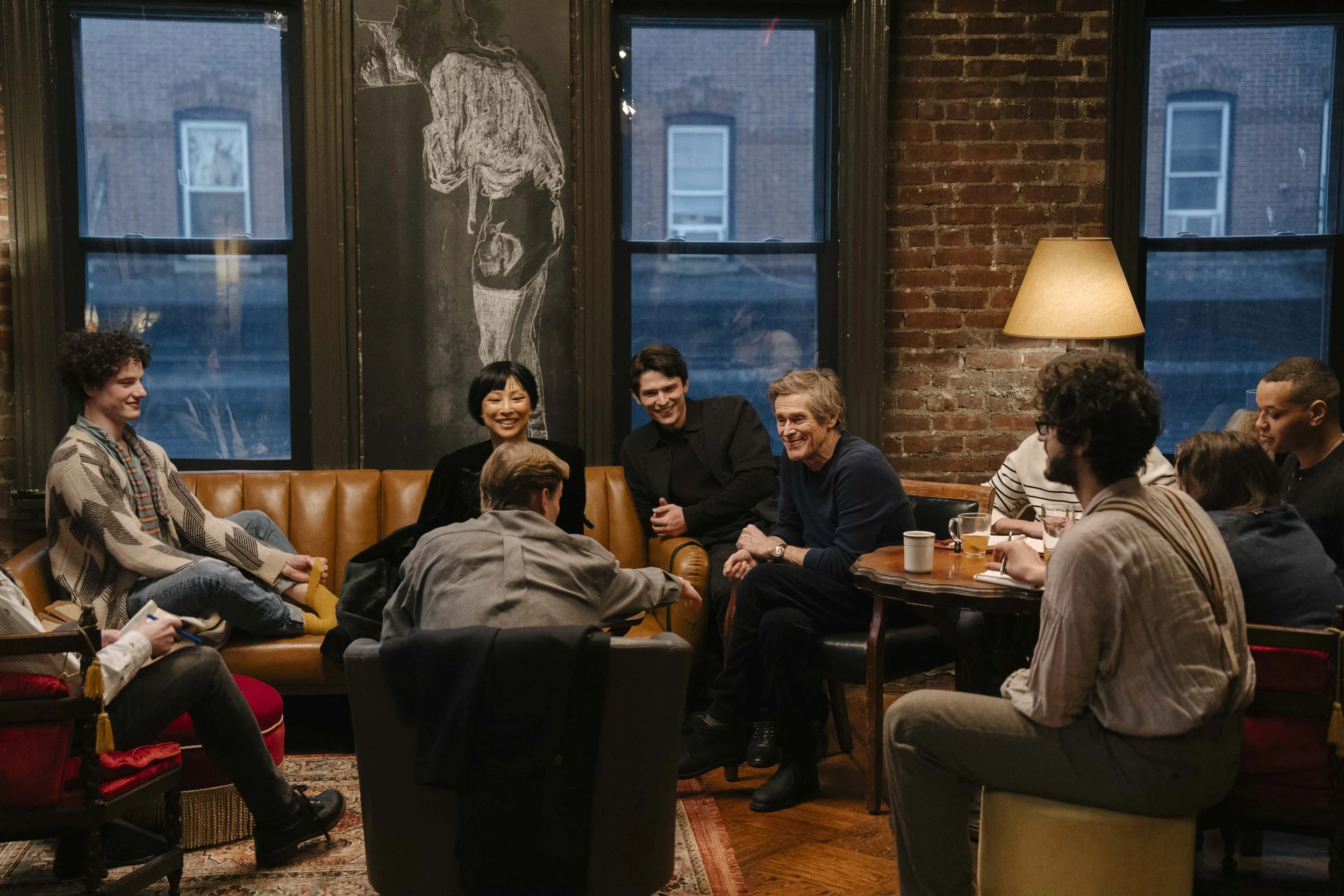
Poet Ed Saxberger (Willem Dafoe) meets his fan club in Late Fame.
He has a simple life and a circle of friends at the local bar, though he doesn’t drink. He also has an ailing brother, the subject of intermittent phone conversations with his sister that it seems he would rather avoid.
One day, Ed is accosted on the street by Meyers (Edmund Donovan), a young man with a penchant for absurd hats and for using words like “penchant.” Ed later refers to him as a “dandy.”
He is exceedingly, almost naively earnest. He tells Ed that he recently picked up an old copy of Way Past Go, a book of poems Ed wrote in 1979. He’s a fan. So is everyone in “The Enthusiasm Society,” a collective of young artists whose self-styled moniker sounds like a Dead Poets’ cross between the League of Extraordinary Gentlemen and Scooby-Doo’s Mystery Gang. Ed says it sounds “Victorian.”
But who wouldn’t be smitten with being christened a rediscovered genius? And so, Ed falls in with this cadre of youthful intellectuals, a group that includes one slightly older member, the mysterious and flirtatious Gloria, played by Greta Lee (Past Lives). The group is similarly revved up by his presence, and is soon planning an evening of performances and readings, including a new work by Ed.

As directed by Kent Jones (2018’s Diane), Late Fame is an appealingly humane movie, kind to its characters’ foibles in a way that a lesser film might play for laughs. There are random, scattershot references to intellectuals needing a ride from parents, and the big night of performances is clearly attended mostly by friends and relations. But we’re never invited to chuckle, except perhaps in knowing sympathy.
The Enthusiasm-ites at one point direct Ed’s attention to a similar group of kids across the floor of their coffee-shop hangout, referring to them dismissively as posers, influencers and addicts. Ed looks shocked. “Heroin?” No, someone correct him: “Phones.”
And yet clever editing reveals that just about everyone has a phone. And a scene of Ed visiting Meyer in his opulent, parent-purchased loft ends, after he leaves, with the young man instructing Alexa to turn down the volume of the classical music she’s playing. And there I was, convinced it was a stereo, perhaps even a Victrola.
Dafoe perfectly embodies the role of the aging poet-turned-clerk, at one point visiting his local bodega to buy a package of cigarettes, “whatever the young people are smoking.” He’s taken aback by the price.
Late Fame is enamoured of its poetic milieu, name-dropping Bukowski and Burroughs while delivering snippets of Ezra Pound and William Carlos Williams.
And Ed’s poetry? I hope it’s not a spoiler to say that we do hear a recitation, the words written by poet Peter Grizzi, who also gets a cameo and a dedication in the film.
I’m glad the movie bent this way; the verse we hear is a glorious work and a capstone for a wondrous tale.
Late Fame. Directed by Kent Jones. Starring Willem Dafoe, Greta Lee, and Edmund Donovan. In theatres August 21.