
The Salt Path: Deeply Flawed Drama Paved with Good Intentions
By Liz Braun
Rating: B
In The Salt Path, a middle-aged couple has a reversal of fortune that turns their lives upside down.
Among other things, Raynor Winn (Gillian Anderson) and her husband Moth Winn (Jason Isaacs) lose their money and their home, then Moth is diagnosed with a neurodegenerative condition that will eventually kill him.
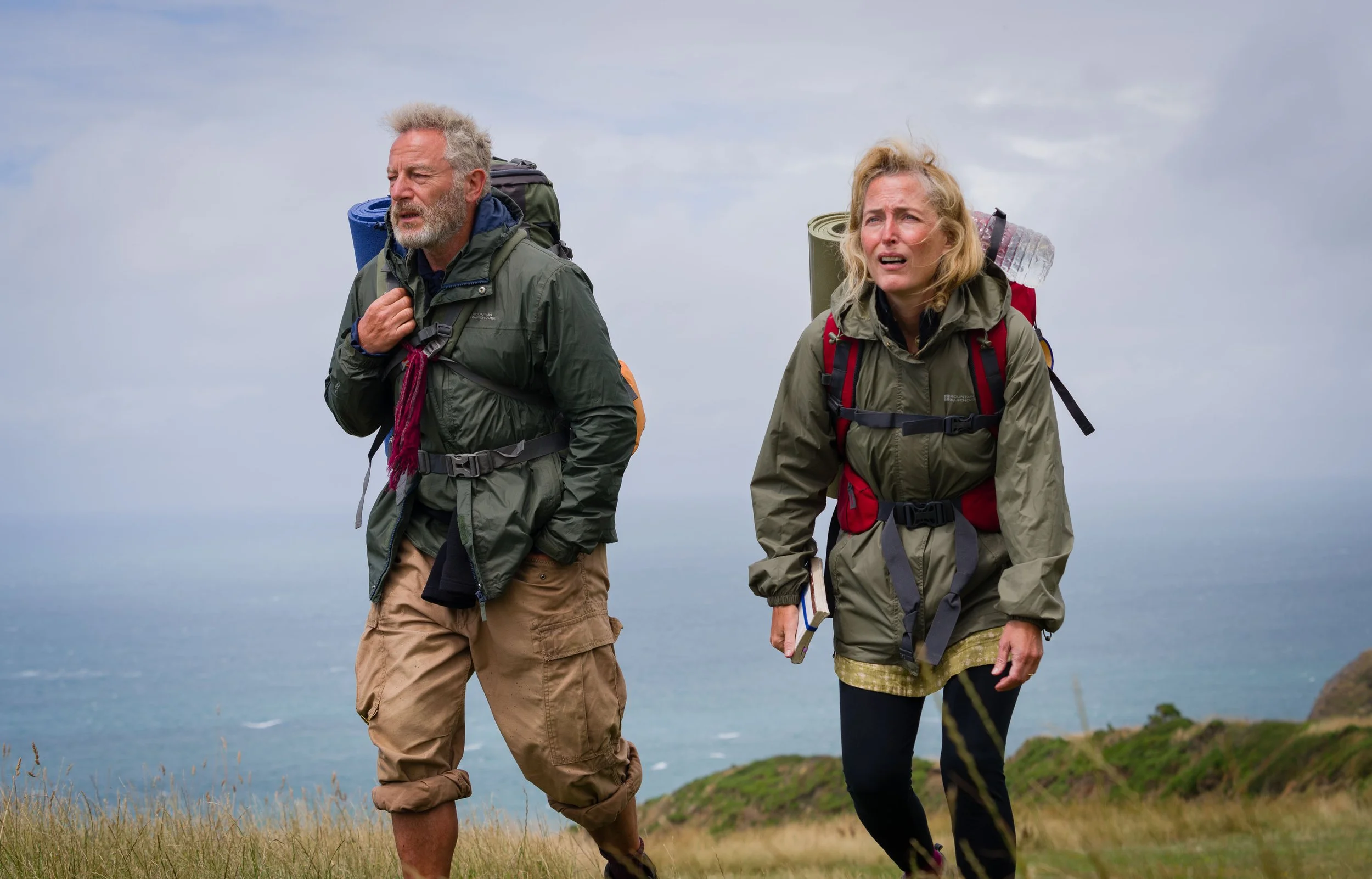
Their response to adversity is to gather up the scraps of their lives and hike a 630-mile trail around England’s southwest coast. It’s a spur-of-the-moment decision: there’s a bailiff banging on the door ready to evict them, and a frightened Raynor’s eye falls upon their copy of 500 Mile Walkies by Mark Wallington. The impulse decision to just start walking away from their troubles paints a portrait of people in shock, reacting to trauma.
So off they go. Raynor and Moth are plucky but penniless. As their walk progresses, fraught with deprivation and frustration though it may be, they slowly begin to commune with nature and recover their equilibrium.
It’s a bit of a redemption story, a tale about love, the reinvention of self, and the indomitable human spirit. Sadly, it doesn’t work.
The storytelling in The Salt Path is dodgy and disjointed, with a confusing first half hour that flashes back and forth in time but never establishes exactly why these people are hiking or why we should root for them.

An hour in, this viewer still didn’t know enough about Mr. and Mrs. Winn to care about their fate, although the pleasure of watching Anderson and Isaacs put in terrific performances is not thereby diminished.
The Salt Path is told in chapters marked out by the miles Moth and Raynor have conquered in their walk from Dorset to Somerset. At the 126-mile point, The Salt Path lost us. Moth Winn has cut his medication and begins to get better — a medical miracle! — and he starts busking (about Beowulf??) in a market town, prompting locals to put money in a hat for him and Raynor. Wut?
Then he and Raynor nearly lose everything in a chaotic skirmish with the ocean.
So, some questions:
a) Is the indomitable human spirit enough to indomitable one’s way out of a terminal illness?
b) Are the Winns actually too stupid to consider the tides when they pitch a tent by the ocean?
By the time an Obviously. Symbolic. Bird. begins to soar overhead on a regular basis, one gives up. The willing suspension of disbelief shouldn't really require a hydraulic lift.
The bestselling memoir by Raynor Winn upon which The Salt Path is based was published in 2018. Various reports since have intimated that elements of the book are not entirely factual, and there was quite a hubbub in the UK last year when an investigative journalist suggested that much of the story was spun from whole cloth.
Interestingly, what’s unlikely in print proves to be just as unlikely on the big screen. The story is uplifting as all get out, mind you.
The Salt Path. Directed by Marianne Elliott. Starring Gillian Anderson and Jason Isaacs. In theatres in Toronto August 28; in Vancouver September 4; and expanding in Canada through September.