
The Samurai and the Prisoner: Solving Mysteries Within Mysteries in a Besieged Japanese Castle
By Liam Lacey
Rating: A
Guess what? There’s another movie about a long-ago military siege, faith, leadership, marriage, and ancient codes of honour in movie theatres this summer. It’s quite different from that movie that is heading toward a billion-dollar box office and has launched a thousand “think” pieces from columnists desperate for a break from Trump commentary. And in this instance, the characters don’t travel anywhere.
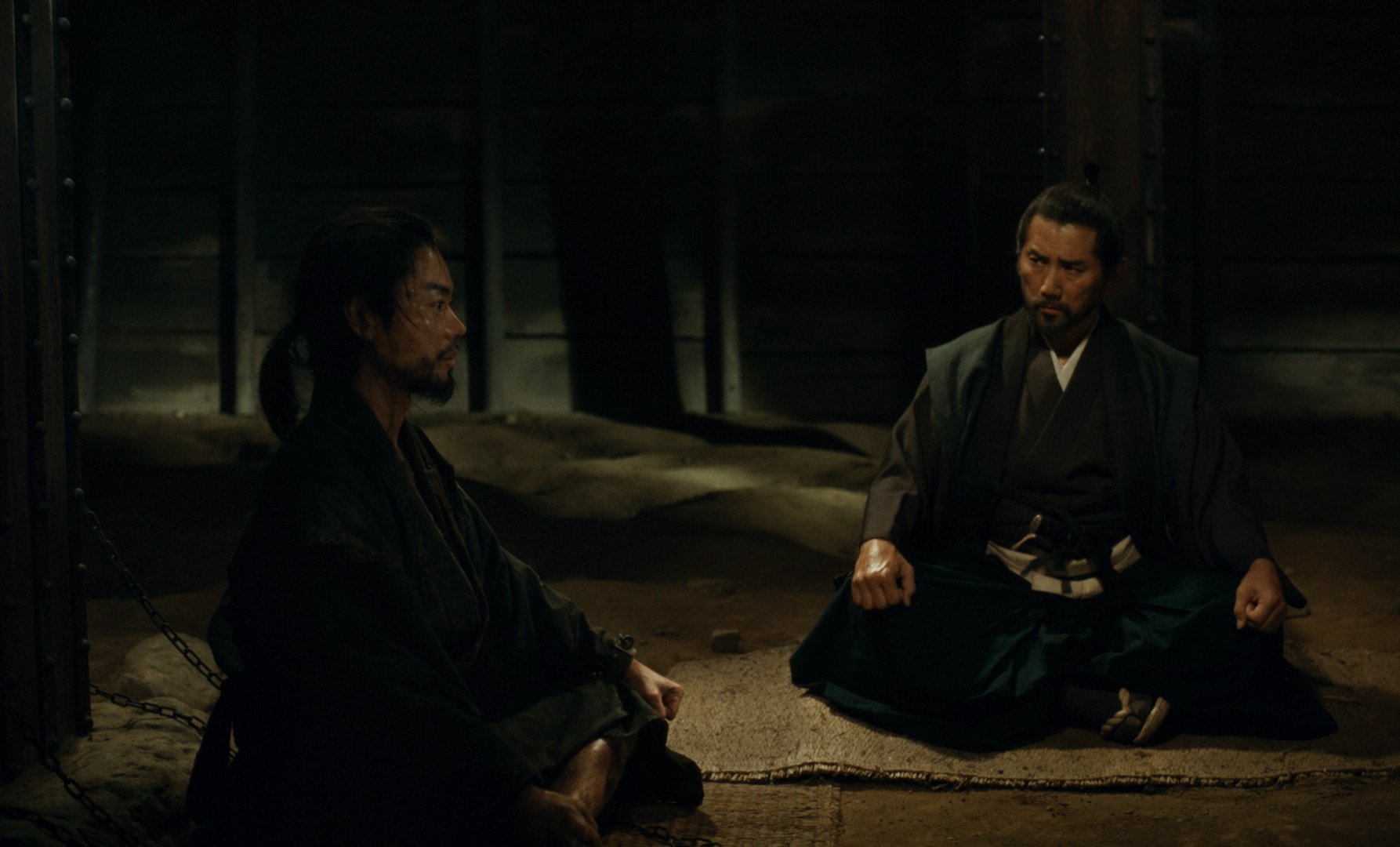
The Samurai and the Prisoner, the latest film by the prolific Japanese director Kiyoshi Kurosawa, is intelligent entertainment, based on a 2021 historical mystery novel by Honobu Yonezawa and, as with Kurosawa’s anxiety-charged previous thrillers (Cure, Pulse, Cloud), follows chain-reaction social disasters.
There’s an echo of that serial approach in the nested puzzles that make up the movie’s plot though the tone here is classically restrained. The setting is a series of minimally furnished rooms, adjoining corridors, and courtyard of the castle, almost resembling a stage set or, perhaps, a game board, illuminated by shafts of overhead light and the intensity of the performances.
The year is 1578, known as the period of the “warring states” dominated by the campaigns by feudal warlord Nobunaga Oda. Though known historically as the great unifier of Japan, Oda is also infamous for his brutal suppression of enemies.

In this film, Oda is mostly an off-screen presence whose troops surround the Arioka Castle near present-day Osaka. Inside the castle walls, the warlord Murashige Araki or Lord Murashige (Masahiro Motoki) has taken siege while hoping to summon alliances to defy his former commander’s ruthless cruelty. His atrocities included the mass slaughter of Buddhist monks and rebellious peasants at Nagashima, religious zealots whose motto was “Advance to Paradise, Retreat to Hell.”
The story pivots on one curious historical detail: During the early part of the year-long siege, an envoy of Oda’s — the military strategist Kanbei Kuroda — came to the castle urging Murashige to surrender. Instead, Murashige imprisoned him. The rest of the story is invention.
In the film, Kanbei (Masaki Suda) insists he should either be set free or killed, according to the samurai code. But Lord Murashige breaks with the violent tradition, both out of disgust with violence and, strategically, because he wants Oda to believe that Kanbei has switched sides.
Soon, Lord Murashige finds a need to use the prisoner’s analytical skills to solve a series of crimes that take place within the castle, exchanging small freedoms for Kanbei’s insights. What follows is chain of four separate who-done-its, with each crime taking place in a different season of the year over the length of the siege.
The first death, in winter, is of an eight-year-old boy whose father surrendered to Oda. Custom demands the boy, as a son of a traitor, must be killed but Lord Murashige refuses. The boy is murdered anyway, apparently by an arrow shot through a narrow slit between doors — but no arrow can be found. Murashige’s wife Chiyoho (Yuriko Yoshitaka) was particularly close to the boy.
In spring, in a skirmish outside the castle walls, an enemy general gets decapitated and rival clans, one Christian and one Buddhist and both under Murashiga’s command, claim credit for the trophy. It is considered a bad omen when the head appears to be switched for one with a grotesque grimace.
In summer, a priest and a skilled swordsman are killed by unknown assassins, and a prized tea kettle, which Murashige intended to give to an ally, goes missing. The next autumn a warrior standing on the castle wall is killed by lightening on a clear day. With each case, Lord Murashige descends to the dungeon to consult with Kanbei who, without direct access to the physical evidence, deduces a solution, and provides a gnomic clue.
The spectre of divine retribution hangs over the residents of the castle, though both Murashige and his prisoner are, in some sense, men of the enlightened future, relying on the intellect, not religious superstition, and a common desire to break the chains of escalating violence. “Not a single man, besides myself can understand you,” says Kanbei, which is both a boast and acknowledgement of respect.
The final chapters in Murashige Araki and Kanbei Kuroda’s lives are well known to fans of samurai lore (there are 50 episodes of the 2014 TV series Strategist Kanbei available on Netflix), so it’s no spoiler to report that, his post-military life, Lord Murashige became known as a famous “teaist,” or master of tea ceremonies, thus proving there are second chapters in the warrior’s life and provides us with a useful motto: Make tea, not war.
The Samurai and the Prisoner. Written and directed by Kiyoshi Kurosawa, based on the novel by Honobu Yonezawa. Starring Masahiro Motoki, Masaki Suda and Yuriko Yoshitaka. At Toronto’s TIFF Lightbox August 7, followed on August 14, by Cinema de Musee, Montreal, Globe Cinema, Calgary and The Roxy Theatre, Victoria.