
The Uprising: Stealing from a Rich History and Giving It to a Poor-Man's Robin Hood Story
By Karen Gordon
Rating: C
The Peasants Revolt – a.k.a. Wat Tyler’s Rebellion - is a significant event in British history. As the name implies, it was a rebellion of the besieged peasant class that led to violence and ultimately (spoiler alert) betrayal by the King.
By way of inspiration, Paul Greengrass, writer/director of The Uprising, says he saw parallels between the revolt, with its protests against the elite and powerful who were crushing the peasant class, and the unrest in today’s world.
Further to that, he’s folded his interpretation of the rebellion into an origin story about Robin Hood.
It’s an interesting idea - even though the eras don’t line up - and could have worked. It's certainly a philosophical match, since Robin Hood legendarily did his thing to support the oppressed and the poor.
But good intentions don't always work. And in this case, the premise feels tacked on in a film that goes in too many directions, and ends up feeling thematically messy and unfocused.
The Uprising is set in 1381. Thirty-ish years earlier, the Black Plague had wiped out a third to a half of the population of England. Many of the peasant class, the farmers, fishermen, craftspeople, etc., struggled to feed themselves.
That includes the main character, Ploughman, played by Andrew Garfield.
There are historical characters in the film, but Greengrass has created Ploughman as a kind of everyman. Ploughman is, a taciturn and humble peasant farmer who is struggling to work his land, and grieves for his late wife and children.
During this era, England was draining its coffers warring with France. King Richard ll (in a formidable performance by Woody Norman) is just 14 years old. As the film begins, he is clearly terrified and overwhelmed by the weight of the Crown. He hides in his room, praying, crying refusing to come out, and so the country is run for him by a group of wealthy elites and his late father’s cabinet. Their agenda: a little for the country, a little for their own pockets.

So, send in the tax collectors! Collect by force if necessary!
On the day that the tax collectors are in his area, Ploughman shows up as commanded with almost nothing. When an out-of-pocket woman is about to be assaulted, he attacks them to protect her. His action inspires others to join in and force the tax collectors out.
This brings him to the attention of the Priest John Ball (Jamie Bell), and then to Wat Tyler (Cosmo Jarvis) who plan to march to London to plead their case to the King. They see Ploughman’s quiet strength and moral nature and feel he is an asset for them.
In a crowd of peasants who are quick to anger, he seems like a natural leader and a voice of rational, moral calm.
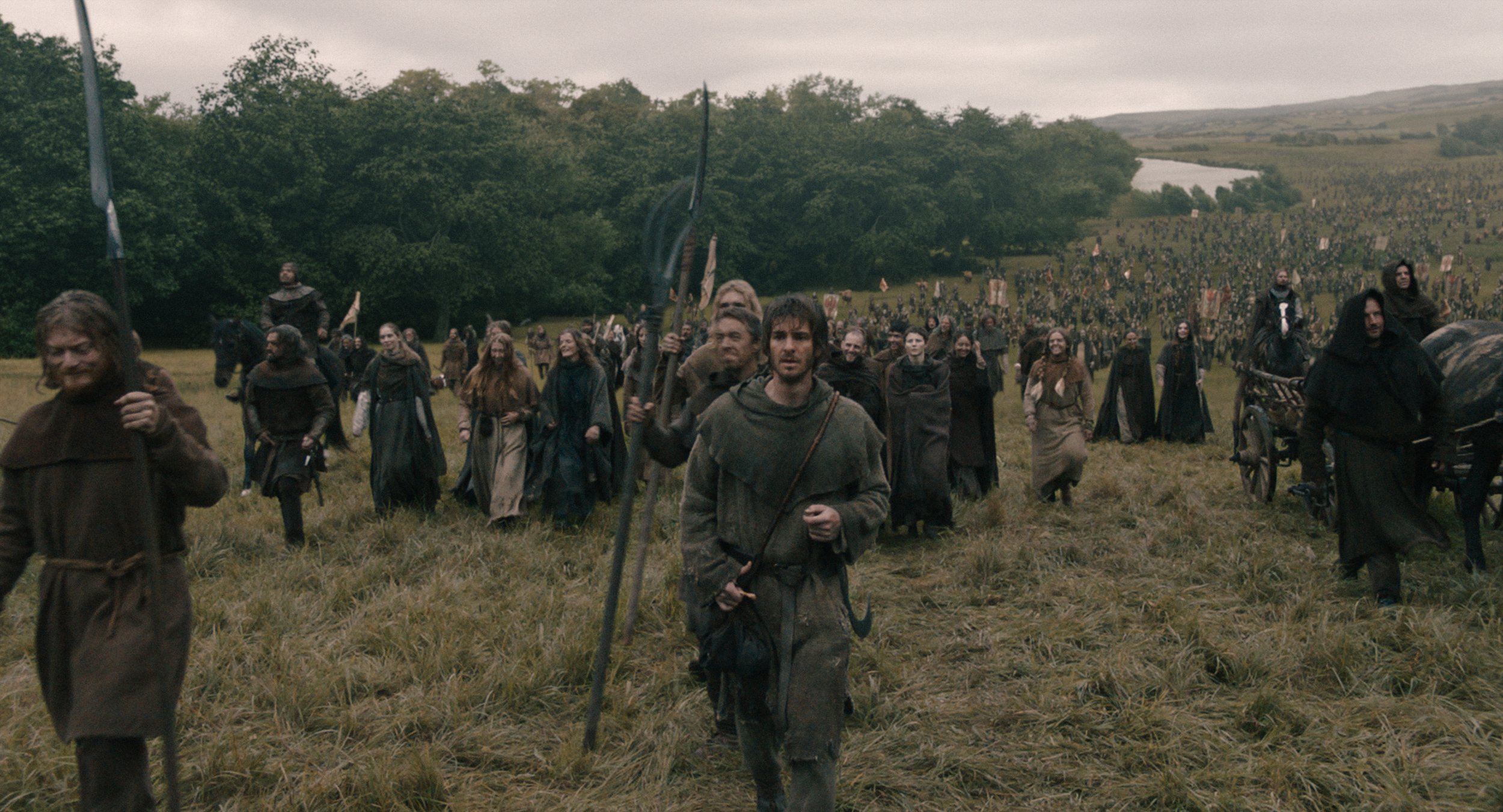
And so, they march. The peasant army grows. There is deep anger powered by group-think.
When the peasants get to London, Ploughman is indeed a leader, brought to the attention of the young King Richard, who has suddenly found his mettle. The King sees the numbers who have gathered, and insists he wants to talk directly to his subjects.
Deals are made, as the King appears to be sympathetic to the peasants and their demands. The King betrays the location of his elite group of advisors in hiding, as an apparent sign of his support of the crowd. He announces that there will be a deal signed in the morning. Ploughman is asked to come with him to help craft the language.
But instead of the news calming people down, the opposite happens. The peasants find the elites. Mob rule once again takes over. The leaders lose control of the people and watch horrors committed on innocent people in London. Betrayals are everywhere.
Historically we know the Peasants Revolt didn’t yield the reforms the King promised. That would come decades later, but the movie doesn’t go into that.
Instead we get a coda of sorts. Rather than return to his farm, we see Ploughman and some of the peasants who marched with him are now in the forest. Ploughman, as severe and taciturn as ever, stops a carriage carrying the King and his mother. This is meant to suggest that this he has now become the mythical Robin Hood of Sherwood Forest. And it’s the most humourless version of such ever seen on screen.
So, what’s it all about? Greengrass is giving us a bit of history and aiming to use the setting to make a point, but it’s hard to tell what that is. Is it a surprise that the elites of the era were so self-serving?
It’s hard to know how he wants us to see the peasants. There are many scenes of them as an uneducated, angry, unprincipled mob running amok. it’s hard to know whether he wants us to sympathize with them, or if the film wants us to see the uneducated mob violence as a cautionary tale.
I kept waiting for Ploughman, Ball and Tyler to walk away.
I wouldn’t have blamed them.
The Uprising. Directed by Paul Greengrass. Starring Andrew Garfield, Jamie Bell, and Cosmo Jarvis. In theatres September 11