
Sound of Falling: Giving Voice to the Ghosts of Young Womanhood
By Liam Lacey
Rating: A
German director Mascha Schilinski’s sophomore feature Sound of Falling — which won the Jury Prize at Cannes last year, is shortlisted for a Best International Oscar, and is on numerous best-of 2025 lists — is a bravura example of an endangered species: the unapologetically enigmatic, visionary European art film.
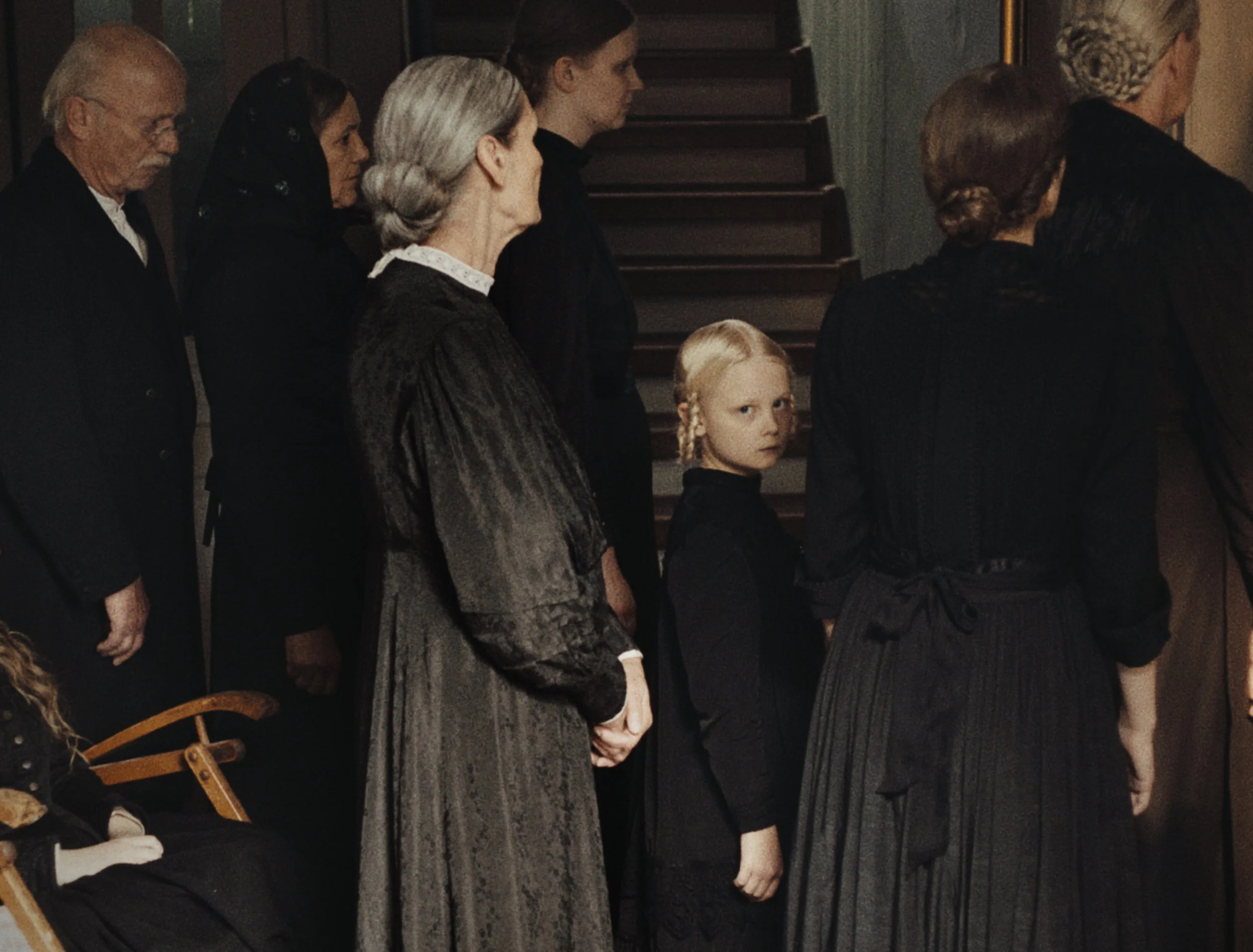
Schilinski’s script, cowritten with Louise Peter, weaves together the lives of four girls from different eras of the last century living in the same remote farmhouse in the Altmark region of northeast Germany. There’s Alma, a child in the early 1900s; Erika, a teenager in the Second World War; Angelika, another teen in the 1980s East Germany; and Lenka, a girl from Berlin in her parents’ summer home.
Their interrelated tales of isolation, erotic awakening, and male violence form a gothic collage of young women’s repressed experiences against the distant background of Germany’s brutal 20th-century history.
While the film is unmistakably the work of a Schilinski’s singular perspective, it is also a showcase for the contributions of cinematographer Fabian Gamper, editor Evelyn Rack, and sound designer-editor Billie Mind.
In particular, Gamper’s ever-mobile camera, shooting in the boxy Academy ratio, assumes the role of the farm’s resident spirit, a time-traveling voyeur that watches the lives of girls and women in both public and secret moments, in recurrent scenes of celebration and grief, mischief and cruelty, fear and sensual experience.

The film’s setting occasionally drifts as far as the nearby Elba River, the dividing line between East and West Germany, a current that links time periods teeming with blatantly phallic eels. Mostly though, Sound of Falling is about a rambling house and its secrets. Different characters, all but one of them women, serve as intermittent narrators across the various eras.
Chronology shifts without warning from one period to the next, compelling the viewer to keep updating mentally. The historically earliest section focuses on a farming family in the lead-up to the First World War that was already steeped in childhood mortality.
Alma (Hanna Heckt), the blonde child who is the main character of the earliest section, is haunted by the death of a lookalike relative and the post-mortem photograph on the mantle, in which a child’s corpse was posed as if still alive before her internment.
Her older sisters play a prank on the maid, nailing her shoes to the floor and are chased about the house for their misbehaviour. It’s all in giddy fun, though later we learn that the maids are routinely sent away to a doctor in town to be sterilized, in order to “protect the men.” One of them tends Alma’s older brother Fritz (Filip Schnack) who has a missing leg due to what is called a “work accident,” and which allows him to avoid military duty.
In a morning in the aftermath of the Second World War, teenaged Erika (Lea Drinda), who turns out to be Alma’s niece, limps down the hallway of her home on a crutch. But the crutch, we learn, actually belongs to the now-older Uncle Fritz (Martin Rother).
Erika steals into his room and stares at his bare sweating torso, then reaches out to touch his navel while he pretends to sleep. When she heads outside into the barnyard, her father slaps her across the face for failing to attend to the pigs on time.
Jump forward to the 1980s, in the Soviet-controlled German Democratic Republic (a.k.a. East Germany). Erika’s niece Angelika (Lena Urzendowsky), a rebellious teen who yearns for the freedoms of the West, finds herself under the sexually predatory gaze of her uncle, and his jealous and socially awkward son.
In the current century, Lenka (Laeni Geiseler) — daughter of a middle-class Berlin family who use the farm as the summer getaway — becomes friends with a girl (Zöe Baier) who is mourning her mother’s recent death.
Engrossing, if not easy to follow, Sound of Falling is a film that invites repeated viewings. Connections between the individual vignettes are only gradually, if ever, revealed. The viewer becomes aware of repeated words (“warm”) and camera angles, the prevalence of water imagery, the recurrent whooshes of noise and then sudden silence on the soundtrack, the grim themes of suicide, sexual coercion, and mutilation, but also family pranks and strands of dark humour.
One way of understanding Sound of Falling is to see it as a response to the German genre known as the heimatfilm or “homeland film,” a type of sentimental historical rural drama that was popular in the decade-and-a-half following the Second World War.
The genre’s most famous descendant is the American musical The Sound of Music, a remake of a 1956 German “heimatfilm” called Die Trapp Familie though, apart from the similar sounding titles, there’s no direct link between Sound of Falling and the Julie Andrews-starring singalong drama. (Sound of Falling’s original German title, In die Sonne schauen translates as “Looking into the sun.”)
Another film that undercuts the kitsch tradition of the heimatfilm was Michael Haneke’s 2009 drama The White Ribbon, a sort-of illustrated argument that the seeds of Nazism growing from the embedded authoritarian, patriarchal, and repressive family structure of pre-WWI Germany.
While Schilinski’s drama explores a similar background, Sound of Falling is far less schematic, more open to mixing dark and light, exploring the twin pulls of fear and longing, the mysteries of the body, and the undefined places where memory and dreams are entangled.
Sound of Falling. Directed by Mascha Schilinski. Written by Mascha Schilinski and Louise Peter. Starring Hanna Heckt, Filip Schnak, Lea Drinda, Martin Rother, Lena Urzendowsky, Laeni Geisseler and Zöe Baer. In select theatres January 16.