
Yunan: A Tempest and Hanna Schygulla Give a Sad Man Reasons to Live
By Liam Lacey
Rating: B+
Yunan, an existential drama from writer-director Ameer Fakher Eldin, asks that taboo question that can so easily embed itself into the mind during these dark midwinter days: Why live?
The film’s stocky, sad-eyed protagonist, Munir (portrayed by soulful Lebanese actor, Georges Khabbaz), is a middle-aged novelist of Middle Eastern background. When we first meet up in close-up, he’s strapped into a breathing device in a German doctor’s office.
Munir, who suffers from panic attacks, is being tested for his lung function. The medic tells him his physical health is normal and recommends and tells him he should “take a few days off. Go for a walk.”
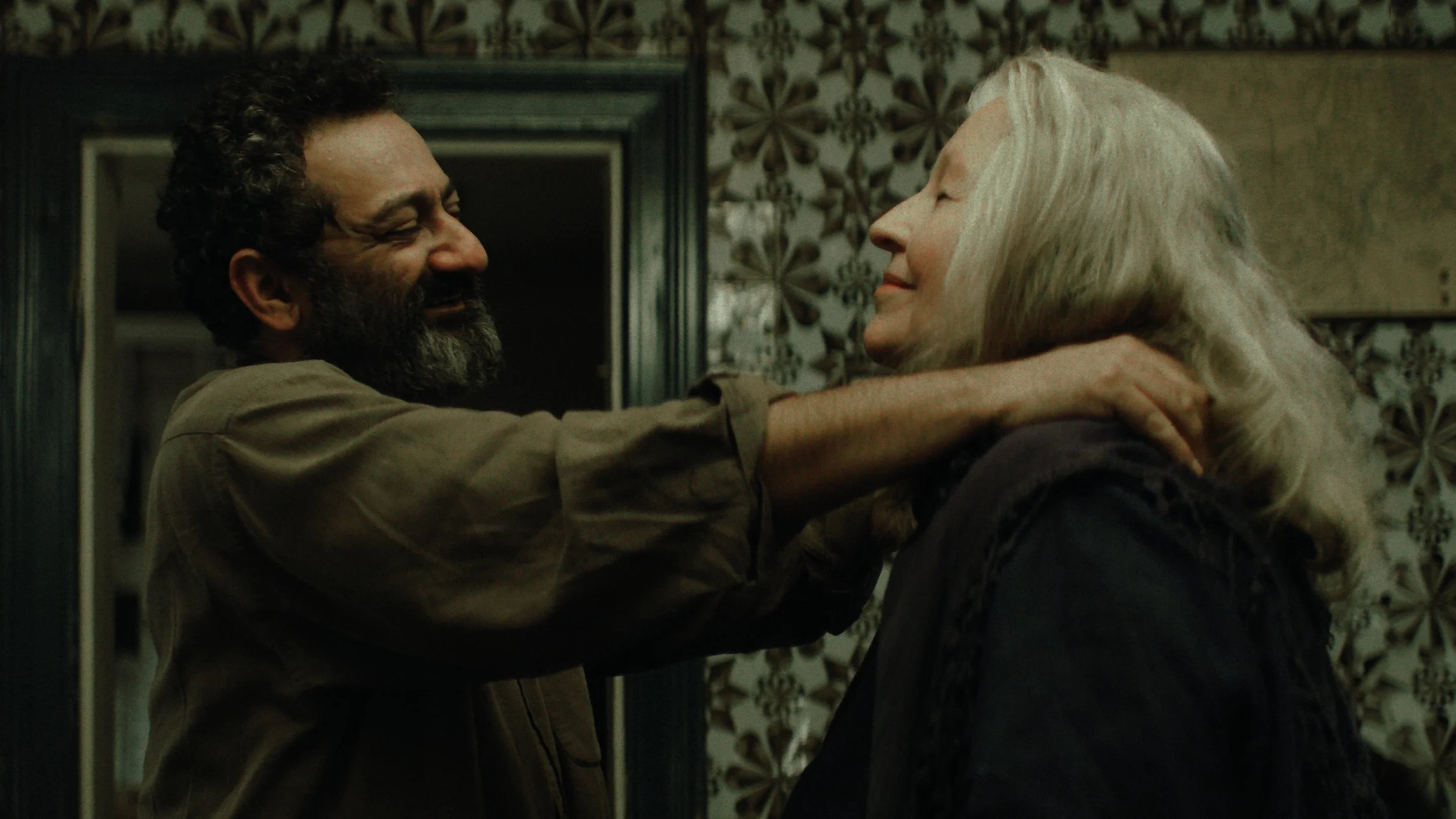
Georges Khabbaz and Hanna Schygulla in a life-affirming moment in Yunan
Yunan the second feature of a proposed “Homeland” trilogy by the 33-year-old, Berlin-based director (he shot 2021’s well-received The Stranger), who was born in Kyiv, Ukraine, to Syrian parents from the Golan Heights. His theme is plight of exile, a plight illustrated early on in the film by Munir’s phone call back home, when Munir’s sister reveals both that Munir’s mother’s dementia is worse.
When he gets his mother on the phone, Muniz, seeking help for his writers’ block, urges her to tell him what she can recall of a childhood story about a shepherd who has no eyes, ears, nose or mouth, who has nothing but a flock of sheep and a wife “as beautiful as the moon.” (A series of scenes, depicting that enigmatic fable, shot in the browns and greys of the Jordan desert, appears intermittently, and to not much purpose, throughout the film.)

The phone call does nothing to cheer Munir up. After a brief visit with his girlfriend, where Muniz attempts but fails to make love, he asks her to take care of his dog while he goes on a trip. After slipping a pistol in his packed clothes, we understand the trip will be one-way.
He takes a ferry from Hamburg to one of the flood-prone islands off Germany’s North Sea coast. When the island’s only hotel is full, the elderly widowed proprietor, Valeska (Hanna Schygulla), checks him into a nearby cottage near a barn.
A stickler for protocol but good-humoured and generous, Valeska’s hospitality contrasts with the behaviour of her drunken, son, Karl (Tom Wlaschiha). She even offers Munir medical advice for his panic attacks: Breathe less! (Though the nice white old lady bonding with the lonely foreigner is a terribly creaky trope, I completely buy that a hug from the now 82-year-old Hanna Schygulla, the charismatic icon of the German New Wave, would ameliorate whatever spiritual trouble you have.)
Along with Schygulla’s warm performance, Yunan is elevated by the choices of Canadian director of photography, Ronald Plante, who captures the melancholic beauty of the island with its slate and blue skies, black sea and white-capped waves, and pale green fields. There’s a beautifully choreographed scene that sees Munir wandering aimlessly through a field of Herford cattle. They at first graze quietly, then startle and turn to stare at the interloper blundering among through the herd.
Yunan’s visual climax is the rendering of a once-in-a-generation flood that engulfs the island, turning hilltop barns and houses, raised on protective mounds, into mini-islands. The external threat to the community postpones Munir’s personal plans for self-destruction, and helps him re-think his place in the universe.
The imagery, more than the human interactions, persuades us that Munir undergoes a transformation, not by elevating his self-esteem, but by making himself less important, a process that the philosopher-novelist Iris Murdoch called “unselfing”, when we experience in communion with nature or art, “to clear our minds of selfish care.”
Munir comes to find paradoxical comfort in the ego-liberating internal recognition that: “You will be gone, forgotten. As if your existence was nothing but an illusion.”
A note about the title: There’s no person or place called Yunan in the film, or direct reference to the title. However, at one point, wandering about the island after the devastation of the storm, Muniz encounters the carcass of a beached whale. Yunan is the Arabic name for Jonah, the prophet of the Old Testament and the Quran, who was swallowed by a large fish or whale, and, after three days of prayer, spit out.
A kid-friendly story (it is repeated in Carlo Collodi’s fairy tale, Pinnochio), Jonah has been interpreted in many ways, but most pertinent is that of the Canadian literary critic, Northrop Frye, who said the story of Jonah is a metaphor of humanity caught in space and time, “the world that we are all living in and want to be delivered from.”
Yunan. Directed and written by Ameer Fakher Eldin. Starring: Georges Khabbaz, Hanna Schygulla and Tom Wlaschiha. In select theatres January 16.