
Dead Man’s Wire: Gus Van Sant Serves Up a Taut Slice of '70s Drama
By Chris Knight
Rating: A-
The ’70s are a rich vein for stories. The time period is modern enough to feel familiar and not “period,” but as the final decade that was fully in the analogue age it carries a whiff of societal simplicity — though it didn’t feel that way to the people living through it.
And while it was recorded and broadcast, chronicled and examined, those records today are not at our fingertips. Unless you happen to remember the details of a given event, it can still surprise. Think of Argo (2012), Munich (2005), American Hustle (2013), Woman of the Hour (2023) or The Post (2017), all set in the Me Decade.
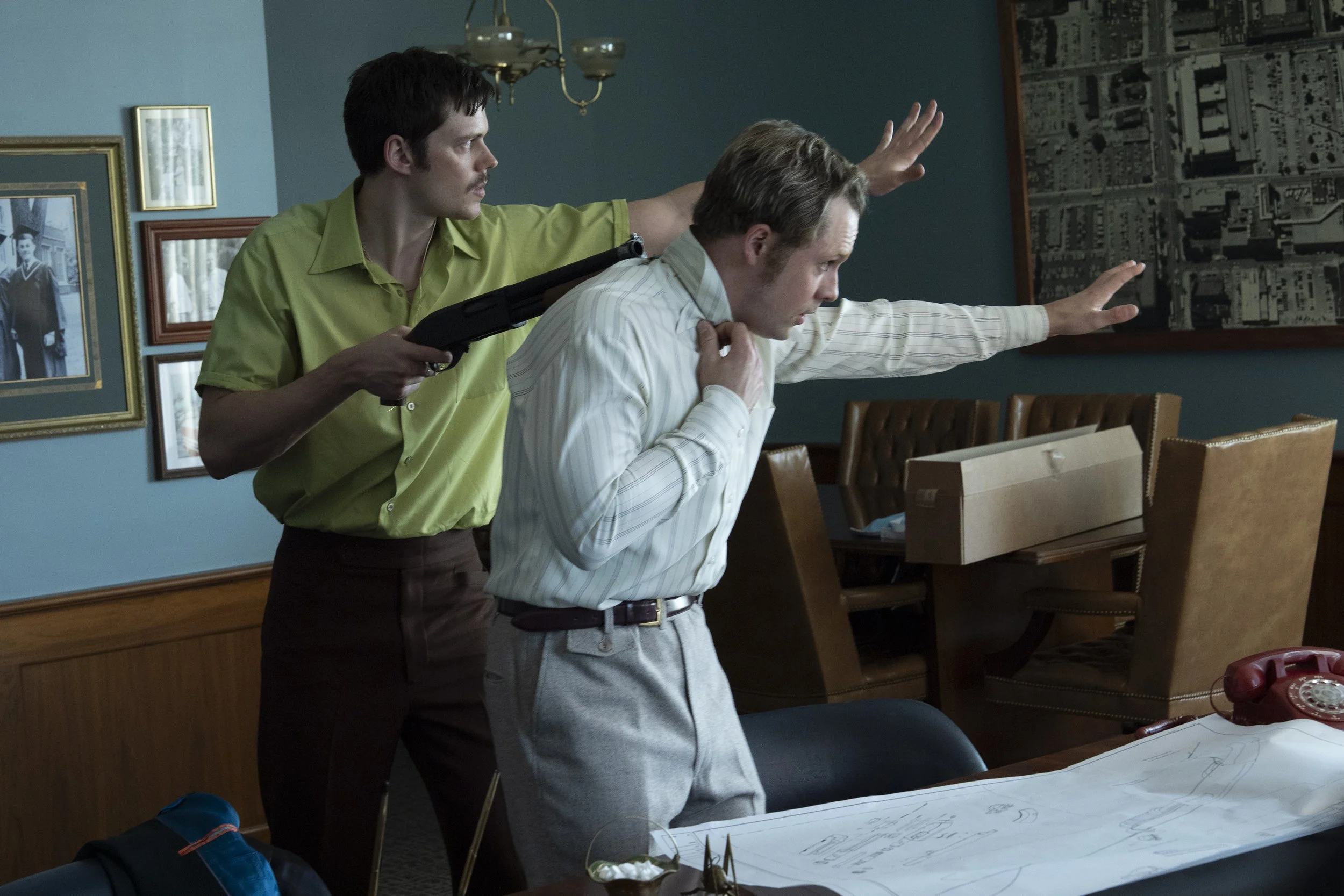
Bill Skarsgård holds Dacre Montgomery hostage in Dead Man’s Wire.
Dead Man’s Wire, Gus Van Sant’s latest feature (and his first since 2018’s messy biopic Don’t Worry, He Won’t Get Far on Foot) is another such tale. Bill Skarsgård plays Tony Kiritsis, a smalltime Indianapolis businessman who, on a cold February morning in 1977, marched into the offices of Meridian Mortgage with a loaded shotgun and a grudge.
Read our interview with Gus Van Sant
He was convinced (and may have been right) that the company had swindled him out of a fortune. Alas, the boss (Al Pacino) is on vacation in Florida, so Tony kidnaps his son, Richard Hall (Dacre Montgomery).
The shotgun is attached to a (movie title goes here), meaning that if Tony gets killed by a sniper, his hostage will die too. His demands are simple: restitution ($5 million), a wholesome apology (very important, this one) and immunity from the very crime he is committing. He’s got it all figured out.

What followed was a tense and intermittently darkly funny three-day standoff. Tony’s key broke in his car’s ignition, so he decides to take Richard’s car, calling “shotgun.” When that proves too far away he commandeers a police car to head to his apartment, which is wired with explosives, just in case.
The leads are fantastic — Tony swings between belligerent and conciliatory — but Van Sant stacks his deck with a fantastic supporting cast that includes Colman Domingo as a local radio DJ, Myha’la as a TV news reporter looking for her big break, Cary Elwes as a grizzled cop, and Pacino as the vacationing M.L. Hall, who resolutely refuses (in a Foghorn Leghorn accent no less) to apologize.
The film features fantastic period-specific music, including Roberta Flack’s “Compared to What,” the Yes hit “I’ve Seen All Good People,” Labri Siffre’s “Cannock Chase,” Jim Pepper’s “Witchiti-to,” and (of course) Gil Scott-Heron’s “The Revolution Will Not Be Televised.” I was disappointed not to hear Tony use Peter Finch’s “mad as hell” line from Network. That movie was probably still in theatres when this story took place!
The outcome is of course a matter of historical record, and the events and their aftermath resonated through journalism ethics courses and jurisprudence to this very day.
But if you’re unfamiliar with the details, far be it for me to spoil them.
Just strap in and let Skarsgard’s chain-smoking, proudly sober, pushed-too-far little guy take you on a helluva ride.
Dead Man’s Wire. Directed by Gus Van Sant. Starring Bill Skarsgard, Dacre Montgomery, and Colman Domingo. In theatres January 16.