
All That’s Left of You: A Palestinian Epic on The Roots of Rage and Obligation of Compassion
By Liam Lacey
Rating: B +
With All That’s Left of You, Palestinian American director Cherien Dabis is determined to put the Palestinian history of the last 75 years on the cinematic record.
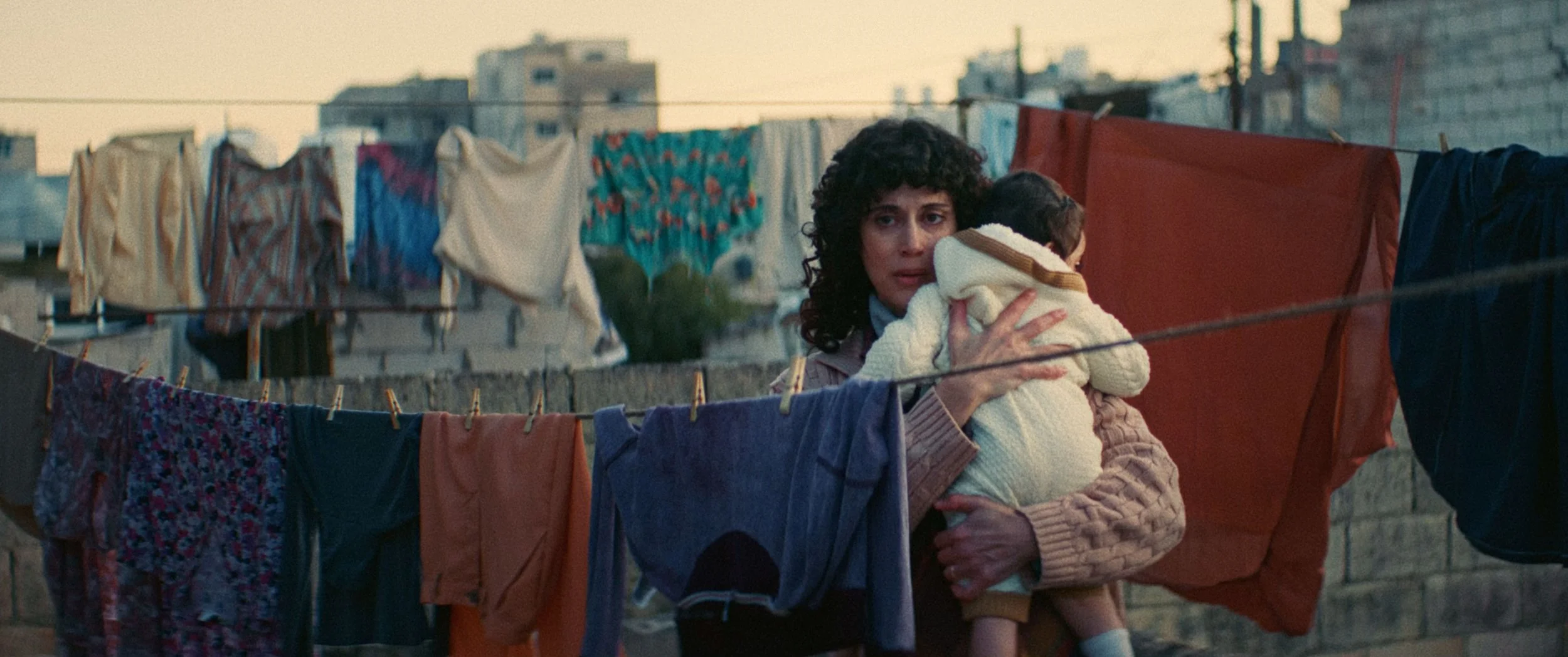
This is a challenge made more so by the circumstances of its production, shot in Cyprus and Jordan, after the start October 2023 war forced production to move from the West Bank. Not only does Dabis write and direct, but stars in a pivotal role, as a mother who ages over 30 years during the course of the story.
Though sometimes over-explanatory, the film gains in complexity as it progresses, raising thorny questions about the duty of victims to maintain their humanity.
The film, which was Jordan’s submission to Best International Picture for the 98th Academy Awards, begins with a couple of teenaged boys, Malek (Rida Suleiman) and Noor (Muhammad Abed Elrahman), on an off-school day, clowning around on the streets of the West Bank town of Nablus in 1988.
When they get swept up in a swarm of men heading to a political protest, the nervous Malek suggests they should return home.
“Why? Are you scared?” Noor mocks him.

Noor joins the jostling crowd of protestors, waving their fists and chanting: “Intifada!” the Arab word for “uprising.” The noise of the crowd rise in intensity and then shouts of panic as shots ring out. A car window breaks in a star-shaped pattern.
The film cuts to a solemn, grey-haired woman, Hanan (played by Dabis), the mother of the boy, Noor. She seems to be speaking directly to the camera or, as we later learn, an unseen listener.
An American-born Palestinian American, raised in the United States, Dabis as directing episodes of such TV series as The L Word, Ozark and Only Murders in the Building, she has made two previous features about the Middle East, including her lovely debut, Amreeka (2009).
It follows a mother and son moving from the West Bank to Chicago (the partly Canadian-produced film was largely shot in Winnipeg) and the 2013 Jordan-set wedding dramedy, May in the Summer.
“You don’t know very much about us,” says Hanan. “It’s OK. I’m not here to blame you, I’m here to tell you who is my son. But for you to understand, I must tell you what happened to his grandfather.”
So the film begins again with the story of Noor’s poetry-loving middle-class grandfather Sharif (Adam Bakri) in the city of Jaffa in 1948, with his wife (Maria Zreik) and children on the eve the first Arab-Israeli war.
As Israeli paramilitaries move closer, the town’s people predict that the armies of nearby Arab countries will protect them. The Israeli expansion progresses and soon sneering gun-wielding Israeli soldiers appear into Sharif’s orange grove, declaring that his gracious home no longer belongs to him.
The family is transferred to a refugee camp and separated. The film’s first act is an exercise in blunt messaging, a simple portrait of multi-generational trauma that has been largely left out of cinematic narratives.

We telescope into a smaller world in 1978, in a crowded village under Israeli occupation. Sharif (now played by the late veteran Palestinian actor Mohammad Bakri) is a grandfather, suffering from memory problems which is doctor says might be a gift from God.
He is living with his adult son, a teacher Salim (Saleh Bakri) who is married to Hanan (Dabis), parents of the boy, Noor. One evening, when making a run to the pharmacy for his dad, Saleh and the child are stopped by a group of young Israeli soldiers looking to cause trouble.
The soldiers accuse Saleh of breaking curfew and amuse themselves by humiliating and threatening the father in front of his young son. Afterward the boy, who is close to his grandfather, is furious with his father’s submission, an episode that marks his life, and, eventually, leads him to the fateful protest years later.
(It’s relevant that, when Dabis was eight — about the same age as the young Noor — she visited Palestine for the first time. Her family was held at the Israeli border for 12 hours, and she and her sisters were strip-searched.)
The father’s humiliation and the son’s outrage sets the ground for the film’s most morally weighty last act, exploring the obligation of victims to model compassion. We return to the opening demonstration of the first Intifada, where we learn that the bullet that broke the car windshield also entered Noor’s head, leaving the boy on life support in an Israeli hospital.
A social worker for the hospital asks the boy’s parents permission to donate the boy’s organs. Saleh is outraged that his son’s death might be used to allow Israelis, even soldiers, to go on living. His wife Hanan is open to the idea that Noor’s death should not be remembered simply as an act of hate, but the result in some good.
The parents condition? They want to meet the people who have received their son’s gift of life.
All That’s Left of You. Written and directed by Cherien Dabis. Starring Saleh Bakri, Cherien Dabis, Adam Bakri, Maria Zreik, Mohammad Bakri, Muhammad Abed Elrahman. In theatres January 30 including Toronto’s TIFF Lightbox; Vancouver’s VIFF Centre, Montreal’s Cinema du Musee and Edmonton’s Garnea Theatre.