
Primate: Evolution Takes a Step Back. Violence Leaps Ahead
By Thom Ernst
Rating: B-
Full disclosure: I have never owned a pet chimpanzee. In fact, the degrees of separation between me and anyone who has owned a chimpanzee are vast enough to qualify as a nature preserve. So, it’s entirely possible I’m missing some crucial social etiquette here.
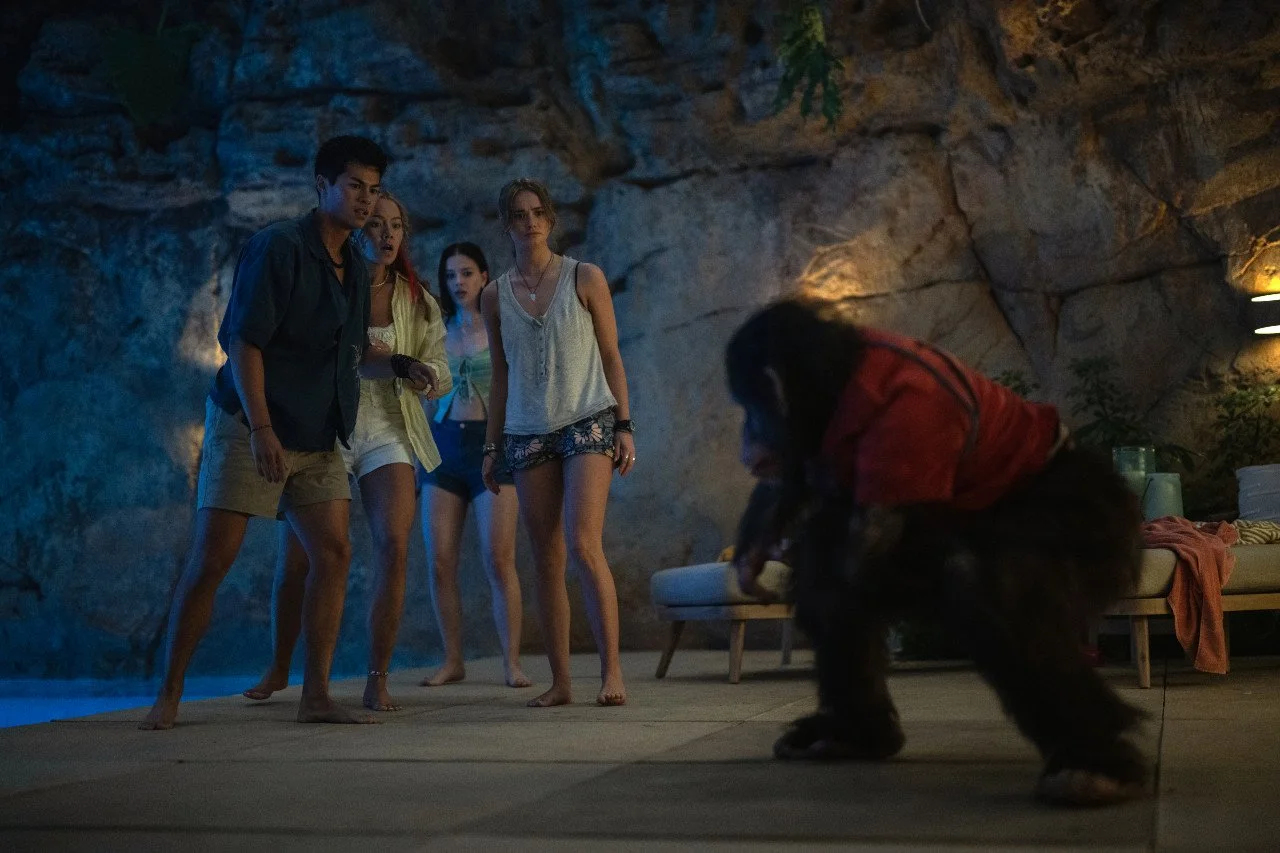
Still, I find it odd when a visiting houseguest in Primate reacts with genuine shock upon discovering that the family they’re visiting owns a chimpanzee. Not mild surprise. Not a raised eyebrow. Shock. As if this were a secret that simply never came up in conversation,
You’d think owning a chimpanzee would be the kind of information that circulates freely among friends, friends of friends, neighbours, delivery drivers and garbage collectors. This is not your garden-variety household pet. This thing wears clothes. On purpose.
This only deepens my confusion when the same character shouts, “Did it come in from outside?” as though the real mystery isn’t what the creature is, but where it entered from. Never mind that the animal she can’t identify is wearing a T-shirt. Apparently, indoor primates are unsettling; wild primates with a passion for retail are perfectly acceptable.
Both are, ultimately, trivial annoyances. After all, Primate quickly introduces extenuating circumstances so outsized they render the ethics of owning a pet chimpanzee a conversational footnote at best. Once things go sideways — and they do so with admirable efficiency — the question isn’t should this family own a chimp, but who’s still alive and what will be left of them? (Animal activists sympathizing with the chimpanzee might think otherwise.)

Director Johannes Roberts appears increasingly comfortable in the natural-horror subgenre, that reliable cinematic playground where nature, having finally had enough, runs amok. There are familiar beats here, echoing the sharks-gone-wild mechanics of 40 Meters Down and 40 Meters Down: Uncaged, not least the strategic marooning of characters in water.
In Primate, that environment happens to be the family swimming pool, where Lucy (Johnny Sequoyah) and company discover some small and temporary protection from an enraged chimpanzee.
Lucy has been absent from home for years. Grieving the loss of her mother — a linguistics professor — she left behind her father (Oscar-winner Troy Kotsur), a bestselling author; her younger sister Erin (Gia Hunter); and Ben, their cute pet primate.
After a few obligatory rounds of Why did you leave us? efficiently dispensed with, the family reunites, joined by Nick (Benjamin Cheng), Lucy’s boy-band-pretty stepbrother, and friends Kate (Victoria Wyant) and Hannah (Jessica Alexander).
And then there’s Ben. Not just a pet, but family: squatter, hairier, and locked in a cage at night, but still family. At least until he goes full Cujo on his siblings and their friends.
It’s impossible not to note the real-world shadow looming over the film: the horrific attack on Charla Nash, who suffered devastating injuries after being mauled by a friend’s pet chimpanzee. Given that context—and an early scene that seems to nod in that direction — Primate risks feeling like a cheap or insensitive riff on genuine trauma.
But lingering too long on that moral hand-wringing would be to indict the horror genre wholesale, which has always thrived on pushing the unthinkable into even less comfortable territory.
And when Primate commits to that push, it can be startlingly effective. There’s a mid-film set piece, weighted with dread and prolonged anticipation, that jolts the film into another gear, reminding us that Roberts knows exactly how to weaponize audience expectation. It’s the moment where laughter curdles into shock, and the film earns its stripes.
What Primate ultimately becomes is a delivery system for some genuinely jaw-dropping bursts of violence seen in mainstream horror. When Ben the chimp is front and centre, the film crackles with danger. When he isn’t, it stalls in familiar teen-drama territory, weighed down by romantic frictions and the sort of friends whose primary function is to be loudly expendable. Kotsur’s role, meanwhile, seems largely confined to intermittent adult supervision and calmly dispensing exposition.
My real issue, though, is Ben himself — or rather, the film’s relationship with him. We’re never given enough time with Ben as Ben, the lovable quasi-human family pet, for his transformation into a murderous force to register emotionally.
What should be Lucy’s central conflict — the wrenching divide between the chimp she loves and the chimp tearing apart her friends — arrives in flashes. They’re fleeting and rarely allowed to land. The tragedy is implied, not felt.
Compounding that problem is Ben’s appearance. There’s something slightly off about him. Not quite AI-weird, not quite guy-in-a-suit weird but manipulated-in-post weird. It’s not amateurish, just distracting. Whatever authenticity the film hopes to build through its natural-horror premise is occasionally undercut by a visual distortion that pulls us out when it should be dragging us further in.
And yet, despite my quibbles, annoyances, and perhaps unreasonable expectations of chimp-centric emotional realism, Primate does deliver where it counts. When it commits to chaos, it does so with ferocity, confidence, and the occasional gasp-inducing surprise. I just wish the film had trusted its most compelling monster long enough to make his rampage hurt as much as it shocks.
Primate. Directed by Johannes Roberts. Starring Johnny Sequoyah, Troy Kotsur, Gia Hunter, Benjamin Cheng, Victoria Wyant, and Jessica Alexander. Now playing in select theatres.