
Original-Cin Chat: Cancer-Clear Dolph Lundgren on Life, and Being a Good Father When His Was Not
By John Kirk
Like an iceberg, there’s a lot of Dolph Lundgren we don’t see at first glance.
Spurred on after beating kidney cancer, and coming close to losing that life, his biopic, Dolph: Unbreakable looks to reveal more of this hidden nature. It also explains why he shared intimate details of his life with the world.
We asked him what we hoped to achieve with this film.
“I hope to inspire people. To make them feel something. Not just for me but for themselves.in general. We’re all on this perilous journey together and it’s not easy.”
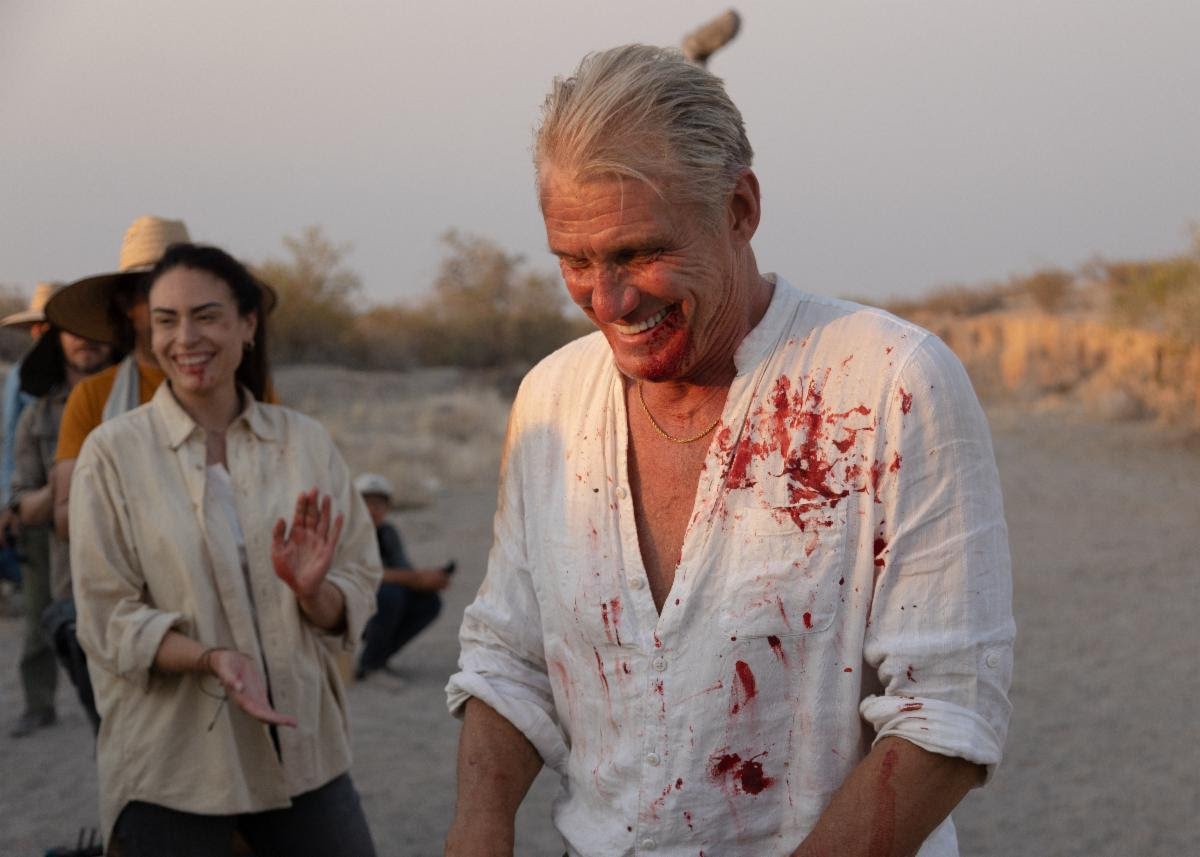
Still bloody working: Lundgren in Mexico with co-star Christina Villa on the set of 2024’s Wanted Man.
It’s a simple aim. He’s right, of course. We are all in this together and the more opportunities we can take to make life a bit easier on ourselves and those around us, the better it can be.
But can we take this ambition seriously from someone with all the accomplishments and accolades he has achieved?
“I knew when I was a young kid, that life is short. I wanted to squeeze the most out of it. I didn’t care what I had to do. You can call that over-achieving, but I really see it as having a passion for life.”
Dolph’s drive is clear. What also stands out in this film is his accomplishments. A Fulbright Scholar, a Master’s Degree in Chemical Engineering, 80 films, a 4thDegree Black Belt in Karate, all peppered by appearances from his colleagues and peers who attest to his ability, his joie de vivre and his work ethic. To call Lundgren an overachiever is an understatement.

He shares that the reason for this drive is the adversity he faced at a young age.
Lundgren is a survivor of family abuse. He suffered violence at the hands of his father, exacerbated by a lack of intervention from his mother. When his father had enough of him, he was uprooted from his friends and home, and exiled to live with his grandparents in rural Sweden.
There was also gratitude in that drive.
“I was grateful for my mother. She was loving and kind. She tried to keep the family together. My father was a classic guy form the ‘50s and ‘60s. Hardworking, he expected his dinner on the table when he came home from work. He’d beat up the wife and kids a bit, mostly me. My grandmothers took care of me too.”
Adversity can breed direction. Dolph mused that perhaps there was a constructive effect that came out of his family life.
“In a strange way, you know a lot of men who end up with a love of ambition and drive have a tough relationship with their fathers. So did I. Maybe it was meant to be? We can’t pick our parents.”
In the film, Lundgren admits to overcompensating as a parent, as a way of distancing himself from the parent role model he had in growing up. But in our conversation, he affirmed that the greatest joy he has today are his children.
“My happiest moment is when I am with my daughters. They are pure love. For me, the happiest moment is a meeting of the souls. They are my heart.”
In the film, working on film projects in other countries away from his family would create an impulsive desire to lavish them with expensive gifts and vacations. In turn, that would force him to take more jobs to make more money and create a vicious circle. He now says all that was really needed was to be a parent more present in their lives.
We asked Dolph if he ever reconciled with his father.
“I did, myself, internally. When I was about 20 years old. I realized that he was a sad old man. His life kind of ran away from him and he got fired from his job and retired early. I felt sorry for him. I couldn’t speak to him about what had happened because he refused to address the issues. It was like it never happened.
“It was like he was schizophrenic about it. He could never say ‘I love you,’ because he was never loved himself, as a kid. Different generations. But I have forgiven him many times.”
All of this reflection is a direct result of his close call with death. Self reflection is not an easy task to undertake, whatever the reason. But to unload traumatic memories and root causes for what direct the course of his life, placed within the framework of receiving a prognosis of three or four months to live is not only sobering but forced him to ask: have I lived a good life?
In short, the purpose of this film is to connect with people and share what propelled him through his life.
Despite this adversity, life didn’t break him and maybe this film will help others not to be broken.
Dolph: Unbreakable streams on Super Channel October 16th.