
Klara and the Sun: Taika Waititi's Whimsical Robot Movie Loses the Plot
By Karen Gordon
Rating: C
I don't think there’s another filmmaker who is as radiantly in love with the pureness and sense of wonder of childhood than New Zealand writer/director Taika Waititi.
His work, largely comedic, is often focused around children, like Jojo Rabbit (for which he won the Oscar for Best Adapted Screenplay), Boy and Hunt For the Wilderpeople. The children aren't living fairy tale lives, but the films are shot through with what seems like a belief that inside of all of us there remains a child of pure love, believing that the best is possible, even if the world is showing something much darker.
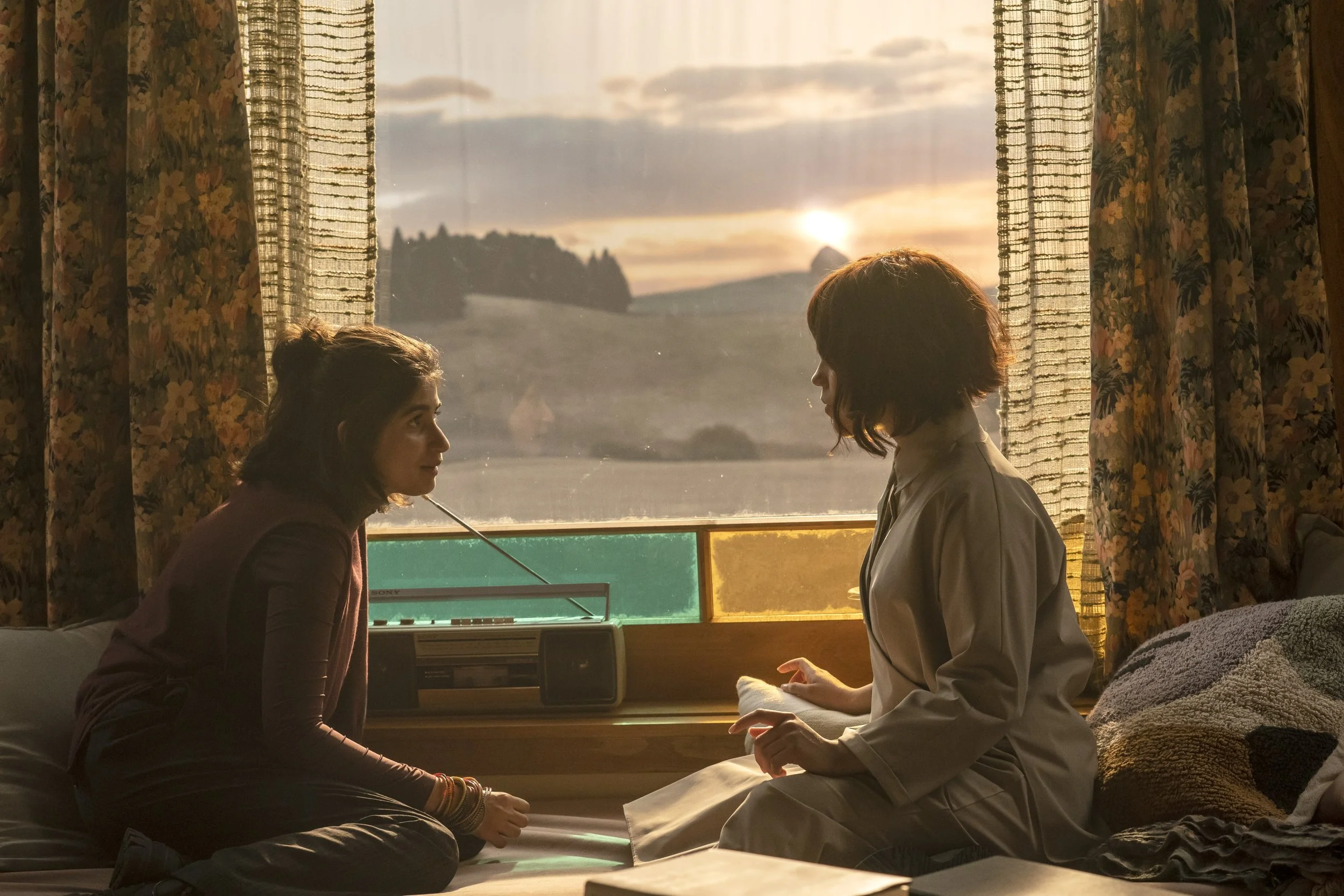
Josie (Mia Tharia) and her automaton friend Klara (Jenna Ortega)
And so perhaps it’s no surprise that he’d be drawn to the novel Klara and the Sun by Nobel prize winning author Kazuo Ishiguro (The Remains of the Day), a story built around a character programmed to radiate happiness and be a true friend.
Alas, in spite of a wonderful cast, Klara and the Sun doesn't quite seem to know which story it wants to tell and feels more like a well-meaning misfire.
Set in a future world, where the Internet no longer exists, Jenna Ortega plays Klara, a robot designed to be an Artificial Friend (AFs), an older model still in the store, hoping to be bought before long or be returned to the factory and melted down.
The AFs all have slightly different personalities. Klara is walking sunshine. She comes across as pure happiness. Of course, it’s programmed happiness, but still Klara, more than the other AFs seems to radiate positivity and whimsy.
And even among her fellow AFs, all for sale and hoping to be bought ASAP, she’s a bit of an oddball. She has a tendency to stand on one leg. She routinely sneaks away to a little alcove, where she can look out and see the sun, a celestrial body she talks to as if it was a person or a deity.
This is perhaps not surprising because her batteries are charged by the sun, but she is the only AF who talks to the sun.
Then, wonderfully for her, she catches the eye of a teenaged girl named Josie (Mia Tharia) who is out shopping for an AF with her mother Chrissy (Amy Adams).
Josie sees Klara in the store window and decides she wants her instead of the newer models, which annoys her mom. But mom and Chrissy come to an agreement and Klara is delivered to the family’s home.

Chrissy and Josie live slightly out of town, on a farm that grows acres and acres of wheat. Perhaps that distance from town, with no Internet to connect her to the larger world, are reasons that Josie needs an AF. She’s lonely, and it seems that her only friend is Rick (Aran Murphy), a boy about her age who lives close by and on whom she has a bit of a crush.
But, as Klara learns, there are more dramatic reasons for Josie to need someone to stay close and watch over her. Chrissy had Josie undergo a series of procedures called Lifting that have augmented her IQ and artistic talents.
But something went wrong leaving her with a life threatening illness that land her in bed. We're not really told what the illness is, but the prognosis is not good. Josie tells Klara that she has a very slim chance of surviving.
Klara, is of course, programmed for optimism, and loyalty. She’s now devoted to Josie, of course. And so she does what she knows how to do: she talks to the sun - we might call it praying - and asks it to heal Josie. If Josie is better the next day, Klara believes that the sun has answered her request.
There are more complicated things that have shaped the characters, that are unspoken, but that affect the way the characters interact as Klara enters the picture. For a long time, Chrissy remains hostile towards Klara. There is unresolved grief in the family. And there are a few more elements, a surprise turn or two that should add emotional complexity to the characters and how they move forward.
But, although there are some interesting moments, things in the film don't ever seem to add up to anything that we can get a grip on. We see a bit more as it progresses. We learn about the things that Chrissy and Josie are carrying, and of course we get a steady dose of Klara’s unshakeable optimism and loyalty. The tone ranges from whimsical to comedic to dramatic and back around again.
The actors do a good job of holding ground on their characters. Ortega channels this gorgeous sunniness and, in one of the best choices in the film, doesn't grow deeper emotions. She’s true to her programming.
Ideally, the story should bring us to a deeper and more emotional sense of how these characters affect each other: how the choices made bring out some kind of catharsis, since that’s what the film seems to be setting us up for.
But we don't really get this payoff. We don't really see an emotional cause and effect that would make sense of the overall story, even just for the human characters. That tone bounces around too much in this film, which makes it hard to know where Waititi wants us to look, or wants us to feel. In the end, the film doesn't really gel.
Klara and the Sun. Directed by Taika Waititi. Stars Jenna Ortega, Amy Adams, Mia Tharia, Aran Murphy, Steve Buscemi.
In theatres, October 23.